
What this line covers
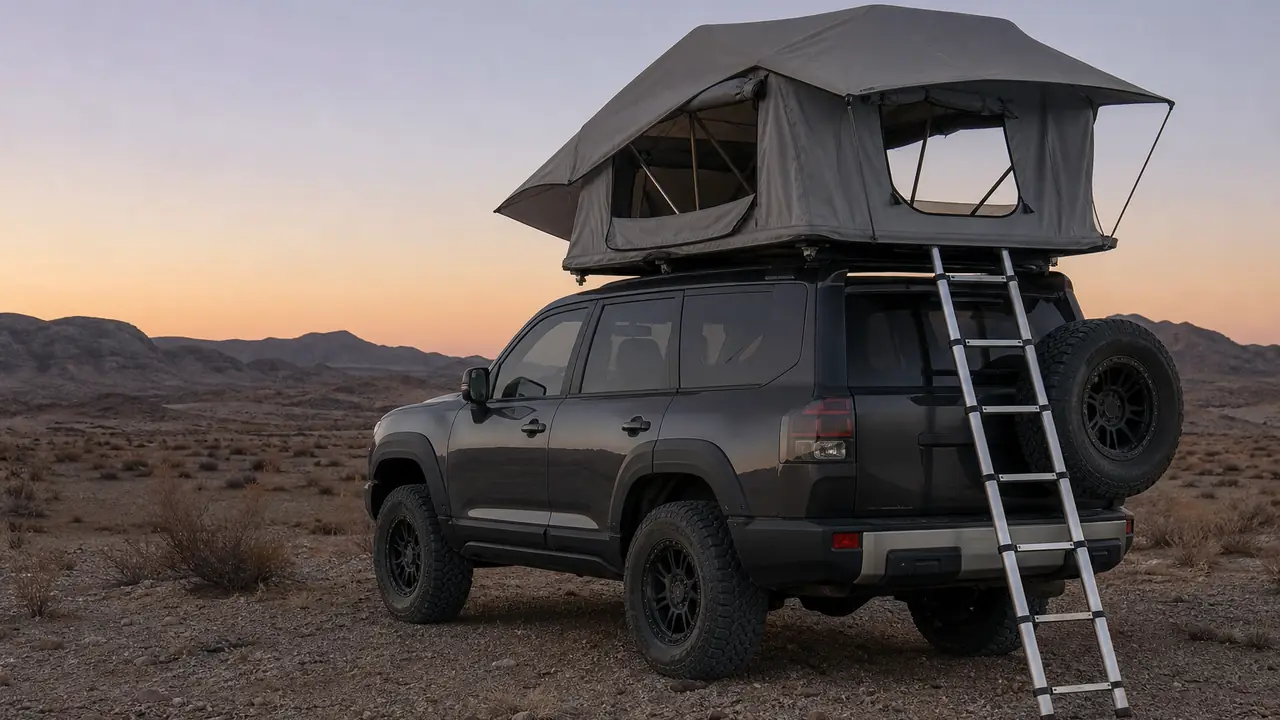
A rooftop tent mounts on the roof bars of a car, SUV or pickup. Folded, it travels as a flat box under a PVC cover; at camp the owner unzips the cover, unfolds the hinged base and the tent stands on poles above the vehicle, reached by a ladder that also props the overhanging half of the base. The appeal is a flat sleeping platform off the ground with the mattress already inside. Buyers are DTC brands and overlanding specialists, and the line pairs naturally with the overlanding and winter use setting.
The reference model on the pitch plate is a three-person soft-shell rooftop tent from public listings: 241x140 cm open with a 130 cm peak, folding to about 140x124x30 cm. The body is 280G polycotton or 600D oxford under a 420D polyester fly, with aluminium poles, a hinged base, an aluminium ladder and a 1000D PVC travel cover. It weighs about 48 kg depending on the listing; that figure, measured on your sample, decides what roof bars and vehicles the tent suits.
Load: what can and cannot be stated
The single most important figure for a rooftop tent is load, and it is the easiest to state wrongly. A supplier gives a static load rating for the tent and base, meaning the weight it carries when parked and open. That figure is always limited by the vehicle's roof bars and roof: the bars have their own rated load, and the vehicle maker sets a roof load limit. Listings should say static load rating per supplier spec, limited by the roof bars' rated load, and tell customers to check their vehicle and bars before fitting. The weight of the tent itself counts against the dynamic limit when driving. The desk does not convert a supplier figure into a claim about any specific vehicle.
Soft shell options compared
| Part | Common options | Trade-off |
|---|---|---|
| Body fabric | 280G polycotton or 600D oxford | Polycotton breathes better; oxford is lighter to handle and dries faster |
| Fly | 420D polyester, PU coating | Thicker fly adds weight, resists abrasion |
| Travel cover | 1000D PVC | Zip and seam quality decide road life |
| Base | Hinged panel | Stiffness against weight; the panel design is rarely changed by brands |
| Accessories | Annex room, awning, shoe bags | Add value, add carton size |
Hard-shell and truck bed or rear tents are separate options that the desk scopes per project. The note on bases and ladders and the rooftop versus ground tents comparison go further.
Where rooftop tents are made
Unlike camping tents, rooftop tents have no single cluster in China. Partner factories are spread across Shandong, Zhejiang and Guangdong, and their base designs, fabrics and finishing differ more from one factory to the next than they do for camping tents. The desk therefore shortlists by base design, fabric, inspection record and volume rather than by region, and approves a sample from each shortlisted factory before bulk is placed. See the cluster map.
Inspection, weather and shipping
Inspection covers the full open and close sequence on sampled units, hinge and ladder function, zip function on the travel cover, mattress size and cover, fabric weight, and a water spray check on seams. Hydrostatic head is a fabric test under ISO 811, not a promise about the finished tent, and condensation inside a polycotton or oxford body depends on ventilation. The desk does not publish wind speed ratings; the manual should tell owners to close the tent in strong wind. Rooftop tents ship as single heavy cartons, usually palletised, so packaging and drop tests to ISTA 1A matter more here than for light tents. Freight is charged by volume and weight, and the carton size from the approved sample is used to calculate each shipment rather than a fixed container count.
Private label and ordering
Common customisations are fabric colour, logo on the cover and fly, mattress thickness, ladder length and accessory packs. Existing styles with your branding typically start at 300-500 units per style, with samples in 7-15 days and bulk in 30-45 days, or 45-60 days custom, confirmed in writing for each order; new bases are assessed per project. Send your vehicle targets, fabric preference and market through the quote form.