
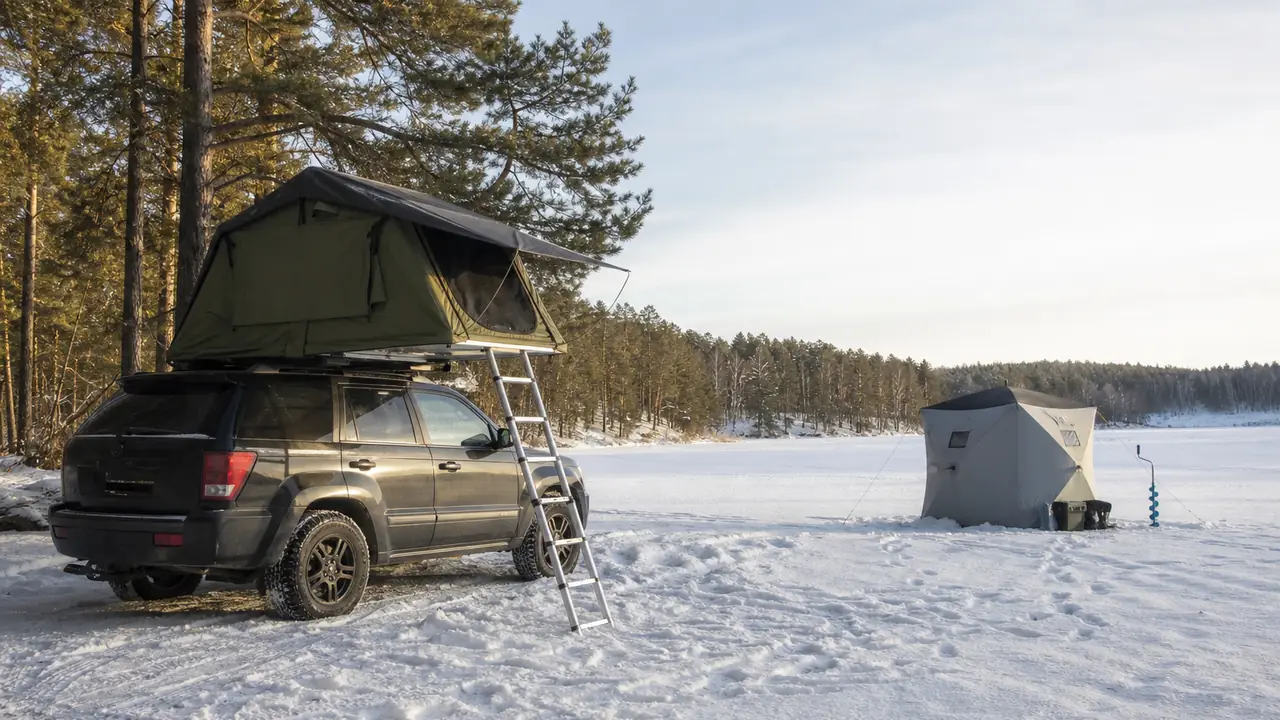
What a cold-weather or overland tent has to survive
An overland tent rides on a vehicle for thousands of kilometres of washboard road and dust, then opens in the dark at a camp that may be windy, wet or freezing. Winter adds snow load on the roof, frozen ground that rejects ordinary stakes, condensation that turns to frost inside the walls, and fabrics and zips that stiffen in the cold. Ice fishing shelters sit on open ice for a full day, exposed to wind with nothing to break it. Each of these tents is packed and unpacked many times in a season, often with cold hands.
Failures in this setting are costly: a rooftop tent mounted beyond the roof bars' capacity, a cover that lets in road dust and water, hinges and ladders that loosen, fiberglass poles that split in the cold, and condensation dripping onto sleeping bags.
Recommended lines and reference specs
| Line | Reference model | Fabric and frame | Weight and anchoring |
|---|---|---|---|
| Soft-shell rooftop tent | 3-person, open 241x140x130 cm, closed about 140x124x30 cm | 280G polycotton or 600D oxford body, 420D fly, 1000D PVC travel cover, aluminium poles, hinged base, aluminium ladder | About 48 kg; mounts on rated roof bars |
| Hub ice fishing tent | 3-person, 178x178x203 cm, about 3.2 m2 fishable area | 300D fabric, insulated versions with a cotton layer, metal hubs and fiberglass poles | About 10-12 kg; 6 ice anchors |
| Canvas bell tent | 5 m diameter, 300 cm centre pole | 285-360 gsm cotton or polycotton canvas, optional stove jack | About 35 kg (5 m reference); 12 guy lines, about 24 stakes |
Rooftop tents come from factories spread across Shandong, Zhejiang and Guangdong rather than one cluster; rear and truck-bed tents are listed as options. Ice fishing tents run from one to eight persons, insulated or not. Bell tents run from 3 to 7 m.
Load and mounting for rooftop tents
A rooftop tent's load capacity is stated as the static load rating per supplier spec, and it is always limited by the vehicle roof bars' rated load, which the buyer must check for each vehicle. The listing should make that clear and avoid any blanket capacity claim. The spec sheet records base material, hinge type, mounting brackets, ladder length and locking, and the travel cover's zip and weather flap, because road dust and rain get in where the cover meets the base. The manual covers torque checks on brackets after the first drive.
Cold, condensation and canvas
Breathing and cooking inside a closed tent produce moisture that freezes on cold walls. Vents high and low, mesh that can be closed, and breathable canvas or polycotton reduce it; insulated ice shelters add a cotton layer. Canvas bell tents are popular for winter camps because the fabric breathes and can take a stove jack, but any stove use needs a flame-resistant fabric tested per report, a heat-resistant jack and clear instructions from your brand; confirm requirements with your test lab. Fiberglass poles grow brittle in deep cold, so the spec notes the pole grade, and zips are sized up for gloved hands. Fabric claims stay at waterproof-rated fabric with hydrostatic head per ISO 811 report.
Anchoring on snow, ice and frozen ground
Ordinary stakes do not hold in snow or frozen soil. Ice tents ship with ice anchors driven by a drill or driver; snow camps use wide snow stakes or buried deadman anchors; rooftop tents anchor through the vehicle but still guy out the fly. The kit list fixes anchor type and count. The desk does not publish wind or snow load ratings; the listing describes the anchoring and advises users to clear snow from the roof and leave exposed sites in severe weather. See the weather and wind guide.
How to brief an overland or winter program
Send the lines, sizes and vehicle types you target, fabric and insulation choices, frame and pole grades, anchor kits, cover and carton requirements, and markets. Existing styles with your logo and colours typically start at 300-500 per style; new bases or structures are assessed per order. Samples take 7-15 days, bulk 30-45 days or 45-60 days custom, confirmed in writing for each order. Rooftop tents ship by volume and weight, so carton or pallet size goes into the freight plan; see logistics and use the quote form.