
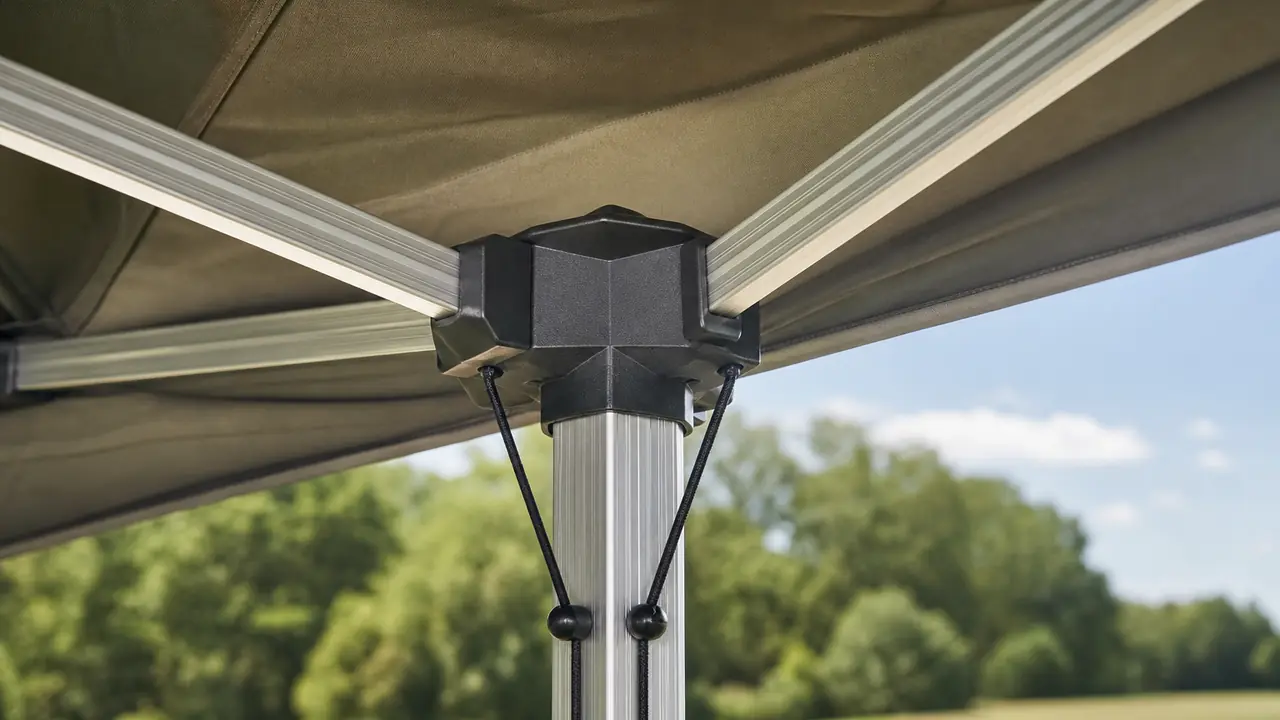
The hardware under the canvas
A soft-shell rooftop tent is a folding base with a tent attached. Closed, the base halves sit one on top of the other under a travel cover, mounted on the vehicle's roof bars. Open, one half stays on the roof and the other swings out on hinges, supported by the ladder, and the tent body unfolds over both halves on its poles. The base is the floor the user sleeps on, the structure the tent hangs from and the part that carries the load into the roof bars.
The three-person soft-shell reference model on the rooftop car tents page opens to 241x140 cm with a 130 cm peak and folds to about 140x124x30 cm. It combines a 280G polycotton or 600D oxford body, a 420D fly and a 1000D PVC travel cover with aluminium poles, a hinged base and an aluminium ladder, and weighs about 48 kg. Factories for this line are spread across Shandong, Zhejiang and Guangdong rather than concentrated in one cluster, and the desk shortlists by the hardware they can build.
Base panels
The base has to be stiff enough to sleep on across the span between roof bars, light enough not to eat into the vehicle's roof load, and resistant to water, because condensation and rain collect on it. Bases are typically built from aluminium frames with panels, or from composite or honeycomb boards in an aluminium edge. The questions for the supplier are the panel material and thickness, the frame profile, how the panel is sealed against moisture and how the mounting channels are built into it. A base that absorbs water swells and grows mould under the mattress; one that flexes too much makes the tent feel unstable to users.
The mattress sits on the base and is part of the product. Its foam, cover and an anti-condensation layer underneath are worth stating, because a damp mattress is one of the most common complaints in rooftop tent reviews.
Hinges
The hinges join the two base halves and take the load of the open half and anyone sitting on it, together with the ladder. They are opened and closed every time the tent is used, often with grit and road spray in them. Specify the hinge material, the number of hinges, how they are fixed to the base frame and whether the fasteners are stainless. Stiff or misaligned hinges make the tent hard to close, and users then force it, which bends frames. On the sample, the desk opens and closes the base repeatedly and checks that the halves align and the travel cover closes cleanly.
Ladders
The ladder does two jobs: access, and support for the fold-out half of the base. Most soft-shell tents use a telescopic aluminium ladder that clips or bolts to the base edge. The ladder's length range has to suit the vehicles the brand targets; a ladder too short for a tall vehicle cannot support the base at the right angle. Ask for the extended length range, the locking mechanism between sections, the foot design and the attachment to the base. Telescopic ladder locks can trap fingers, so the manual should show how to collapse them safely.
The ladder also stands on whatever ground the vehicle is parked on: gravel, sand, a slope. Wide feet with a non-slip pad help, and the manual should tell users to check the ladder angle and footing before climbing, and to level the vehicle where possible. During inspection, the desk extends each sampled ladder through its full range, checks every lock engages and confirms the attachment hardware is in the box.
Mounting hardware and load
The tent is fixed to the roof bars with brackets or plates and bolts that run in channels under the base. This hardware has to fit the range of bar profiles the brand's customers use, and it has to be stainless or well coated, because it lives in road spray. Load is where honesty matters most. The supplier gives a static load rating for the tent itself, the weight it can hold when parked and pitched. The vehicle's roof bars and roof have their own rated loads, usually lower when driving, and they set the real limit. Listings should state the static load rating per supplier spec, the tent weight, and a clear instruction that the vehicle's and roof bars' rated loads are limiting; confirm details with the vehicle manufacturer's documentation.
The hardware part by part
| Part | Reference or typical option | What to specify | Common issue |
|---|---|---|---|
| Base | Hinged base, aluminium frame with panels | Panel material, thickness, sealing, channels | Moisture, flex, mould under mattress |
| Hinges | Metal hinges between base halves | Material, count, fasteners | Stiffness, misalignment, corrosion |
| Ladder | Telescopic aluminium ladder | Length range, locks, feet, attachment | Too short for tall vehicles, finger traps |
| Mounting kit | Brackets or plates and bolts | Bar profiles covered, finish | Wrong fit, rust in road spray |
| Travel cover | 1000D PVC on the reference model | Zip, seams, closure | Zip failure, water ingress |
| Load | Static load rating per supplier spec | Rating, tent weight, roof bar note | Overstated or unqualified claims |
Weight and shipping
At about 48 kg, the reference model is heavy, and that weight counts against the vehicle's roof load. It also ships as a bulky, heavy carton that needs good protection at the corners, since the base edges and hinges are easy to damage in transit. Carton design and drop testing to ISTA 1A belong in the order; see tent packaging and cartons. Truck bed and rear tents are listed as options on the line page and have their own hardware questions.
Ordering
Write the base, hinge, ladder, mounting kit, travel cover and load wording into the spec sheet, and approve a sample after repeated open and close cycles. Existing styles with your logo or colours typically start at 300-500 tents per style, with custom work in 45-60 days, confirmed in writing per order. See rooftop vs ground tents, overlanding and winter use and MOQ and lead time, or send the brief through the quote form.