
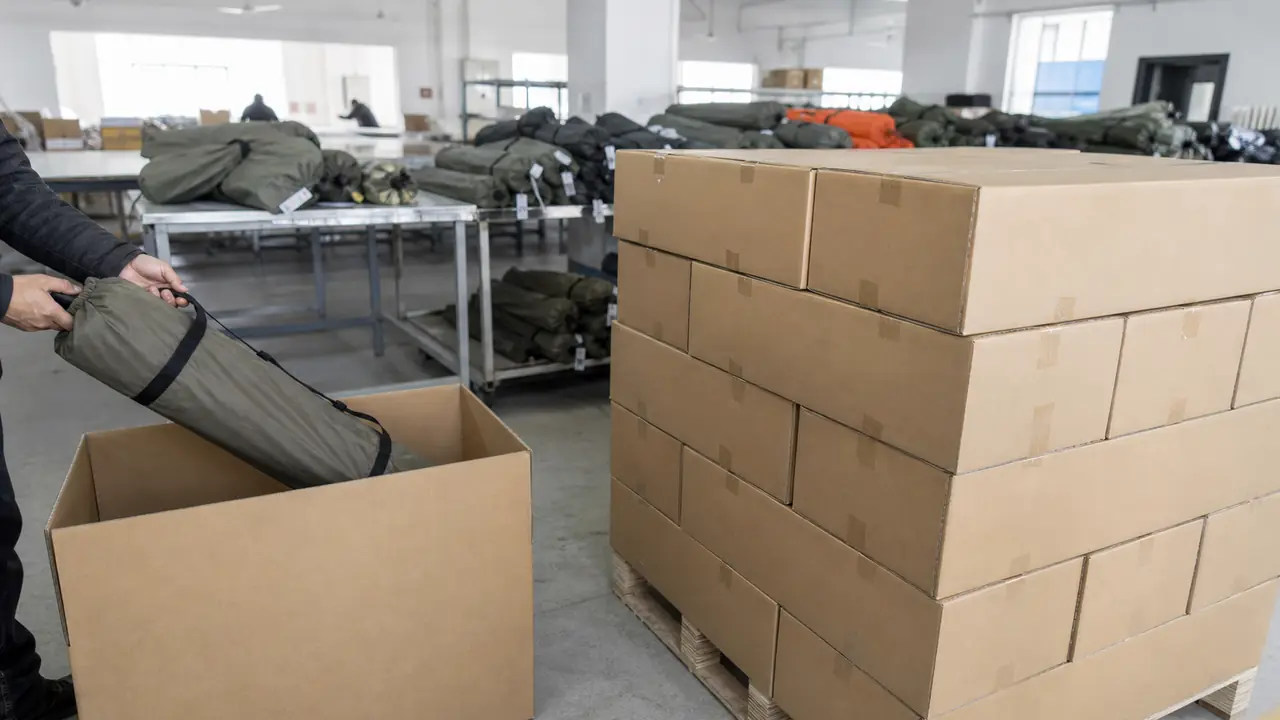
Why packaging is part of the product
A tent is light for its volume. Poles, fabric and stakes pack into a bag that is mostly air and shape, so packaging drives three costs at once: freight, warehouse space and damage. A bag that is a few centimetres too long can push a carton over a pallet edge or into a higher parcel band. A carton without an insert lets steel stakes chafe through the fly on the way across the ocean. The desk therefore treats packing as a line in the spec sheet, approved on the sample, and checked again at inspection.
The packing levels
| Level | What it does | Options to specify |
|---|---|---|
| Carry bag | Holds the tent for the end user; the first thing a customer touches | Bag fabric and denier, print, handles, compression straps, separate pole and stake bags |
| Canopy roller bag | Carries a folded canopy frame with top | Wheels, handle, zip length, bag print, wall pocket |
| Retail or inner carton | Protects one unit and carries the retail face | Printed or plain, barcode, product photo or line drawing, insert |
| Master carton | Groups units for freight and warehousing | Units per carton, board grade, carton marks, gross weight label |
| Pallet | Groups cartons for handling where the receiving warehouse requires it | Pallet type, load height, stretch wrap, corner boards |
Not every order needs every level. Marketplace sellers often ship one tent per carton straight into fulfilment, while retailers want a printed retail carton inside a master carton, and many FCL loads go floor-loaded without pallets to use the container volume.
Canopy cartons and long pieces
A 10x10 ft commercial pop-up canopy folds into a long bundle. On the reference model from public listings the carton is about 158x27x27 cm for one set, with the frame alone around 16 kg and the full set about 20-24 kg. Printed sets with back walls, half walls and flags add a second carton or a larger one, depending on the configuration. Long, heavy cartons need a board grade and taping that survive corner drops, and they decide how the load is planned. Bell tent bags, at about 96x33x33 cm for the 5 m reference model, are bulky in a different way: short but dense.
Drop tests and inspection checks
For parcel and mixed-handling routes the desk asks partner factories to test the packed carton to ISTA 1A, the basic transit test with drops and vibration. It is a test of the packed product in its carton, not of the tent, and results come in a report issued per order. At pre-shipment inspection the inspector also checks:
- carton dimensions and gross weight against the packing list;
- carton marks, barcodes and labels against your artwork;
- accessory counts per bag: stakes, guy lines, poles, repair kit, manual;
- bag print, zips and stitching, and whether the tent fits the bag without forcing;
- moisture: tents should be dry when packed, since damp fabric in a sealed carton invites mildew on a long voyage.
The full checklist is on quality control.
Volume freight and load planning
Sea freight for tents is almost always charged by volume rather than weight, so the carton dimensions on the sample decide the freight cost per unit. The desk does not quote a fixed container count for any line. The number of cartons that fit is calculated per order from the confirmed carton size, the mix of styles and whether the load is palletised. Small changes help: a shorter pole section, a tighter fold or a bag sized to the packed tent rather than the reverse. The blog post on tent packaging and cartons walks through the trade-offs.
Retail faces, labels and documents
Retail cartons carry more than a logo. Buyers usually specify the barcode format and position, the size and capacity statement, the reference to the hydrostatic head per ISO 811 test report rather than a waterproof promise, and any warning text the market requires. Kids play tents add tracking labels for the US and permanent warning labels for Canada; EU sales add GPSR information with an EU responsible person. The desk collects these as a label list in the spec sheet so the printer, the sewing line and the inspector all work from the same page. See compliance and certifications for the documents behind the labels.
Next step
Share your channel (marketplace, retail, wholesale or rental), any warehouse requirements and your packaging artwork status through the quote form. The desk adds packing to the spec sheet and confirms carton sizes on the sample before bulk.