
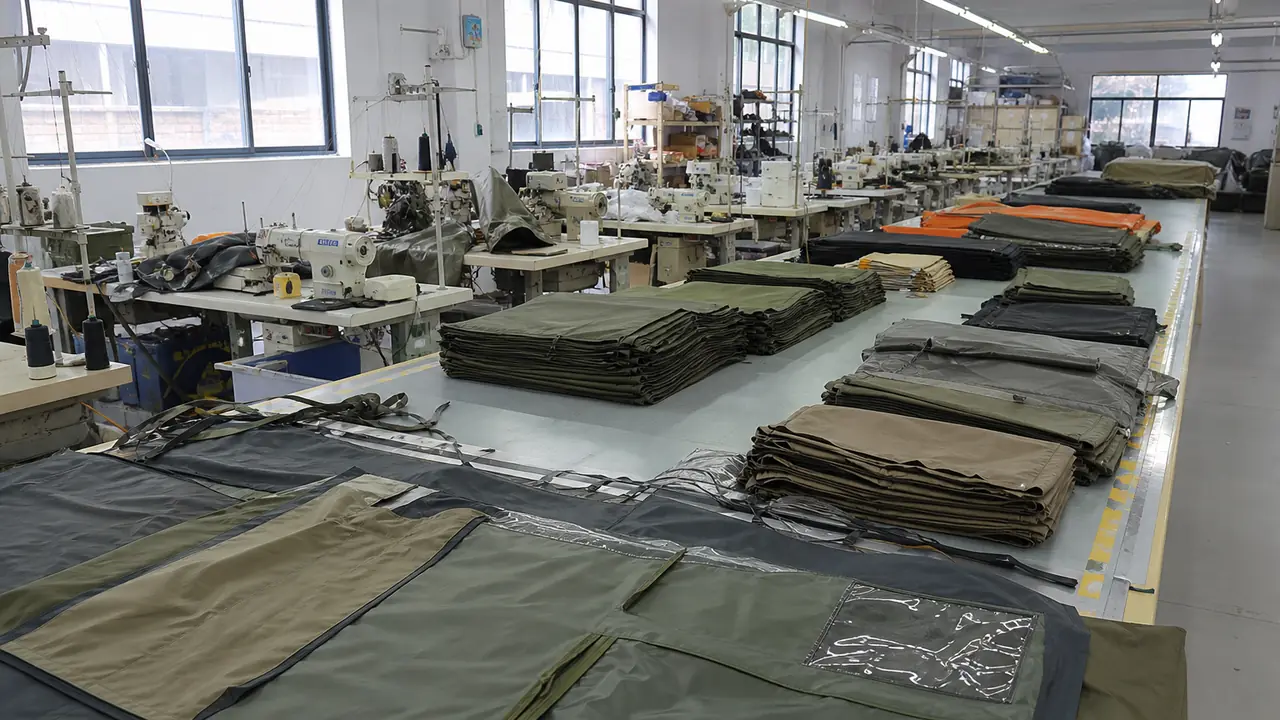
One chain, many tent types
A backpacking tent, a 10x10 ft canopy and a 5 m bell tent look like very different products, but their production follows the same order: fabric is received and checked, panels are cut, sewn and sealed, poles or frames are cut and assembled, the finished tent is pitched, and everything is packed with its documents. What changes is the material, the machinery and the checks that matter most. A canopy order puts weight on frame extrusion and top fit; a camping tent order puts weight on seams and taping.
Pitchmere coordinates production at vetted partner factories; it does not run a production line itself. The desk agrees the checkpoints with the partner factory before cutting starts and records what was found at each one in the order file.
The seven steps
| Step | What happens | What the desk checks |
|---|---|---|
| 1 Fabric inspection | Fly, inner, floor and canopy fabric rolls are received and inspected | Denier, thread count, coating, colour against the approved swatch, lot labels matching the test report |
| 2 Cutting | Panels are cut by template, knife or laser | Panel dimensions against the pattern, grain direction, print alignment on printed canopies |
| 3 Sewing | Panels, mesh, zips, webbing and guy-out points are sewn | Stitch density, seam allowance, reinforcement at stress points, zip type and size |
| 4 Seam taping | Seams on the fly and floor are heat-sealed with tape | Tape width, continuous coverage, peel and water spray checks on sampled panels |
| 5 Pole cutting and assembly | Poles or frame tubes are cut, fitted with ferrules, shock cord and tips, or riveted into canopy trusses | Alloy and diameter per spec, length tolerance, wall thickness on canopy legs, joint and rivet quality |
| 6 Pitch test | Finished tents or canopies are pitched from production | Fit of fly and inner, tension, zips, frame operation, accessory count |
| 7 Packing | Tent, poles, stakes and manual are bagged and cartoned | Packing list, labels, carton marks, carton size and weight against the packing spec |
Fabric inspection and cutting
Most later problems start with the fabric. A fly cut from a different coating lot than the one tested can show a different hydrostatic head, and a colour shift between rolls shows up as two-tone panels on a pitched tent. The desk asks the partner factory to keep lot labels on each roll and checks them against the ISO 811 test report on file. Cutting is checked against the pattern on the first bundle of each panel type; on printed canopies the print position on the valance and walls is checked before the whole run is cut.
Sewing and seam taping
Sewing decides strength at the points that take load: pole sleeves, clips, guy-out points, door corners and canopy top corners. The spec sheet fixes stitch density and reinforcement at each point. Seam taping then seals the needle holes. Waterproof-rated fabric still lets water through seams that are untaped, taped too narrow or sealed at the wrong temperature, so the desk checks the taping machine settings and runs water spray checks on sampled panels. The seams and waterproofing page explains the method.
Poles, frames and assembly
Camping tent poles are cut from fiberglass or aluminium tube, fitted with ferrules and shock cord, and bundled by length. Canopy frames are assembled from hex aluminium or steel legs and trusses, riveted at each joint. The desk checks alloy and diameter against the spec, length tolerance on a sample of poles, and on canopies the leg wall thickness and the movement of the truss when opened and closed. See poles and frames.
Pitch test and packing
The pitch test is where the parts become a product. Tents are pitched from production, not from the sample room, to check that the fly fits the inner, the poles match the sleeves, the zips run under tension and every stake, guy line and bag is present. Canopies are opened, the top fitted and the legs locked at each height. Packing then follows the agreed packing spec: carry bag, pole and stake bags, manual and labels, carton and shipping marks. Carton size matters because tents ship by volume; see packaging and palletizing.
Timing
Samples typically take 7-15 days, bulk production 30-45 days and custom builds 45-60 days, confirmed in writing for each order. Production follow-up feeds directly into the quality control plan. To book a production slot, send your spec sheet through the quote form.