
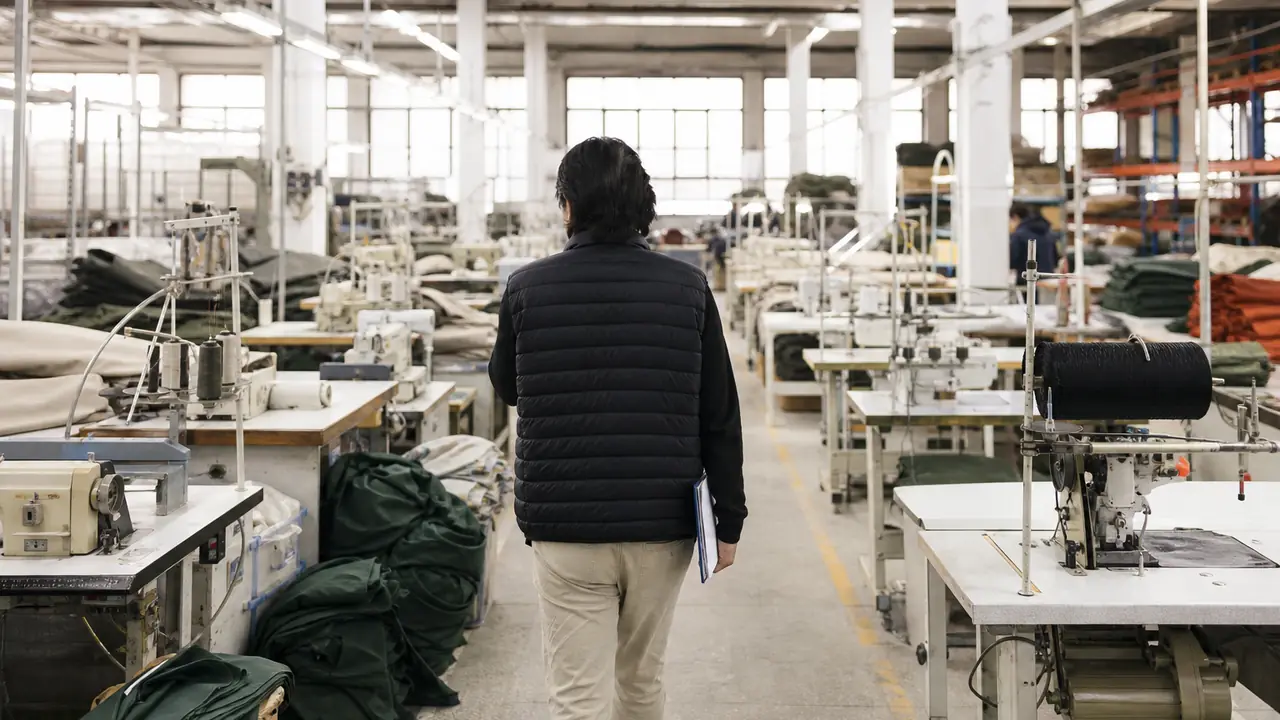
Why audit against the order, not in general
A factory that sews excellent dome tents may have no heat-sealing machine for taped seams, no space to pitch a 20x40 ft party tent and no experience with dye-sublimation printing. A general factory profile says little about whether it can deliver your order. The desk therefore audits each partner factory against a specific line, construction and quantity, and repeats the parts of the audit that matter whenever the product or the volume changes.
Pitchmere is a sourcing desk and does not own a factory. The audit is how the desk earns the right to put a partner factory in front of you, and the findings stay in your order file, so a repeat order starts from known facts rather than a new sales pitch.
What the audit covers
| Area | What the desk checks | Why it matters |
|---|---|---|
| Legal and export | Business licence, export records, who issues the invoice | Confirms you are dealing with the producing factory or a declared partner |
| Fabric intake | Incoming fabric inspection, denier and coating records, lot labels | Hydrostatic head and fabric weight depend on the lot actually used |
| Cutting and sewing | Number of sewing lines, operator experience with the tent type, stitch density control | Seam quality decides leaks and tear-outs |
| Seam taping | Heat-sealing machines, tape width and temperature records, peel checks | Waterproof-rated fabric still leaks through untaped or poorly taped seams |
| Poles and frames | In-house or sourced poles, alloy and wall thickness records, cutting tolerance | Broken poles and bent canopy legs drive returns |
| Pitch test area | Space and routine to pitch finished tents or canopies before packing | Missing parts and pitch faults are found before shipment |
| QC records | Inline and final inspection sheets, defect logs, corrective actions | Shows whether quality is managed or only claimed |
| Test report history | Recent reports for CPAI-84, NFPA 701, EN ISO 5912 or kids product testing | Indicates familiarity with your market's requirements |
Capacity and the season
Tent factories load heavily in the first half of the year to ship for spring and summer shelves in Europe and North America. The audit records the number of lines that can be committed to your order, the factory's existing bookings for the window you need and whether any step, typically seam taping, printing or pole supply, is subcontracted. A factory that looks large can still be the wrong choice if your order lands in its busiest month. The lead times note explains how the season affects booking.
Line-specific checks
- Camping tents: tub floor construction, pole sleeve and clip sewing, seam taping on fly and floor, guy-out point reinforcement.
- Canopies: hex leg extrusion source, wall thickness records, truss and joint riveting, top fit on the frame.
- Printed canopies: dye-sublimation or screen printing capacity, colour proof routine, first-piece approval.
- Party and event tents: PVC welding equipment, frame galvanising, report history for NFPA 701 or EN 13782.
- Kids play tents: experience with CPSIA documentation, tracking labels and Canadian warning labels.
Social and environmental audits
Many brands and retailers require a social compliance audit under their own scheme. The desk arranges these with the buyer's chosen audit body and keeps the report with the order file. The desk does not issue social certificates and does not describe a factory as compliant beyond what the audit report states.
Signals that end an audit early
Some findings remove a factory from the shortlist regardless of price: an invoice issued by a trading name that cannot be linked to the producing factory, test reports that do not match the fabric or model being quoted, refusal to let the desk see the sewing or taping floor, or a sample room that is clearly separate from the production lines. Each of these is recorded in the order file with the reason, so the same factory is not reconsidered without new evidence.
From audit to shortlist
- The desk matches your line to a cluster and lists candidate partner factories.
- Each candidate is audited against the order, with notes and photos.
- Two or three partner factories are shortlisted with the reasons recorded.
- Samples are made by the shortlisted factories and compared on your spec sheet.
- The chosen partner factory, the golden sample and the inspection plan are confirmed in writing.
The audit feeds directly into production follow-up and the quality control plan. To start, send your line, quantity and market through the quote form.