
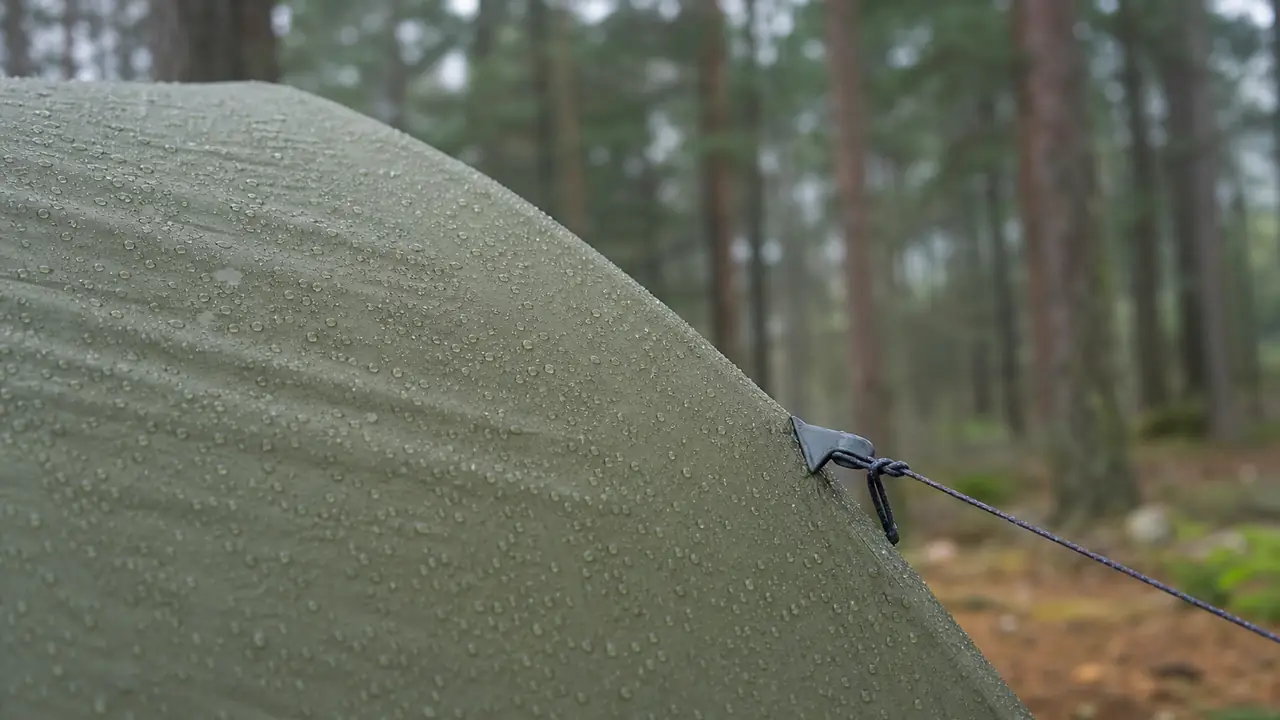
Why seams leak
A tent fly is cut from coated fabric and sewn together. Each needle penetration breaks the coating, and the thread itself can wick water through the seam by capillary action. Under rain and pole tension the seam opens slightly and the holes stretch. Without treatment, even a fabric with a strong ISO 811 result will drip along its seam lines. That is why a hydrostatic head figure says little about a finished tent; see hydrostatic head explained.
Two treatments close the holes. On PU-coated polyester, the usual method is heat-applied seam tape. On silicone-coated nylon, which ordinary tape will not bond to, factories brush on a liquid seam sealant. Some lightweight fabrics have a silicone outer face and a PU inner face so that tape can be used from the inside.
How heat-sealed seam tape is applied
Seam tape is a narrow strip, usually a polyurethane film with a hot-melt adhesive layer, sometimes with a fabric backing. A hot air seam sealing machine blows heated air onto the adhesive as the tape and the seam pass between two pressure rollers. The adhesive melts into the fabric coating and over the stitching, then cools and sets. The operator guides the seam by hand, keeping the tape centred over the stitch line at a steady speed.
Three settings decide the result: air temperature, roller pressure and feed speed. They must match the coating, the fabric weight and the tape. Too cold or too fast and the tape sits on the surface without bonding; too hot and the coating blisters or the tape edges curl. Good partner factories record the settings for each fabric and tape combination at the sample stage and repeat them in bulk.
Which seams need tape
Not every seam needs the same treatment, and a spec sheet should say which ones are covered:
- Fly seams: all seams exposed to rain, including the ridge, panel joins and the seams around windows and vents.
- Floor seams: corner seams on a bathtub floor, where the floor turns up into the walls. Welded PE floors have no stitched floor seams.
- Attachment points: pole sleeve ends, webbing loops, guy-out points and pole clip tabs where stitching passes through the fly.
- Inner tent: usually breathable and not taped, except at the bathtub floor.
- Canopy tops: on 600D polyester canopy tops, seams along the valance and roof panels may be taped or welded, depending on the model.
How seam tape fails
| Defect | What it looks like | Typical cause |
|---|---|---|
| Lifting edges | Tape edges peel away from the fabric | Low temperature, low pressure or contaminated coating |
| Off-centre tape | Stitch holes visible beside the tape | Operator drift, tape too narrow for the seam allowance |
| Gaps at junctions | Untaped spots where seams cross | Tape not overlapped at corners and T-joins |
| Wrinkles and bubbles | Creased tape with air pockets | Uneven feed, curved seams taped too fast |
| Blistered coating | Shiny or bubbled fabric around the tape | Air temperature too high for the coating |
| Delamination over time | Tape releases after storage or use | Weak bond, heat in storage, ageing coating |
Delamination is the one that hurts after sale, because it appears months later. The defence is a correct bond at the factory and care instructions that keep tents out of hot storage.
What to write on the spec sheet
- List the seams to be taped or sealed, by drawing or by panel name.
- State the tape type and width, and that junctions overlap.
- Name the sealing method for silicone fabrics, if used.
- Require a pitch test and water spray check on the sample before approval.
- Carry the same checks into pre-shipment inspection.
Writing the seams down matters because two tents with identical fabric can behave differently in rain depending on how much of the seam work was done. It also stops quiet changes in bulk, such as taping only the fly ridge to save time.
Curved seams deserve a separate note. Domes with arched door panels and cabin tents with rounded window frames have seams that bend as they are taped, and the tape tends to wrinkle on the inside of the curve. Partner factories handle this by slowing the feed, using narrower tape on tight curves or splitting the curve into short overlapping runs. Asking how curved seams are handled at the sample stage tells you a lot about the taping line, and it is a fair question for any supplier before the order is placed.
Checking seams in sampling and inspection
A seam check has two parts. The visual check runs along every taped seam on the inside of the fly: tape centred, edges flat, junctions overlapped, no blistering. The water check pitches the tent and sprays water at the seams, zips and corners for a set time, then looks for drips and damp patches inside. It is not a laboratory test, but it catches the faults that drive returns.
At pre-shipment inspection, both checks are done on tents drawn under the agreed sampling plan, usually ISO 2859-1 or ANSI/ASQ Z1.4 general inspection level II, with major defects at AQL 2.5 and minor at 4.0 as a stated working default, confirmed per order. A missing tape section or a lifting edge on a fly seam is normally classed as a major defect. See tent quality inspection checklist and testing and inspection.
Seam work in listings and after-sales
Listings can name taped seams as a feature, but only where they are actually taped, and only for the seams that are. Copy such as taped fly seams and bathtub floor is accurate; implying the whole tent is sealed is not. After sale, a small tube of seam sealant and a care card that explains drying and storage help customers fix minor seepage themselves instead of returning the tent. Spare parts and repair kits are covered in tent repair kits and spares.
Bringing it into an order
Seam scope is one of the few waterproofing items that changes labour time, so it should be fixed before the quote rather than after. Sampling typically takes 7-15 days and bulk 30-45 days, confirmed in writing for each order; see MOQ and lead time. Send the seam list with the rest of the brief through the quote form.