
What the frame has to do
A tent pole bends under tension to give the tent its shape and has to recover after every pitch, cold night and gust. A canopy frame works differently: it is a folding truss of legs and scissor bars that has to hold a rigid shape, carry a top and walls, and survive repeated set-up by people in a hurry. Both are specified by material, diameter or profile, wall thickness and the fittings that join the sections. Broken poles and bent canopy frames are among the most common causes of returns, so the frame line on the spec sheet deserves as much detail as the fabric.
Tent pole materials compared
| Material | Where it is used | Strengths | Trade-offs |
|---|---|---|---|
| Fiberglass | Entry dome tents, instant tents, ice tent spokes | Low cost, flexible | Heavier, can split when over-bent or cold |
| 7001-T6 aluminium | Backpacking and mid to premium dome tents | Light, strong, recovers well | Higher cost, moves the tent up a price tier |
| 6061 aluminium | General poles, rooftop tent poles, frame parts | Widely available, easy to work | Lower strength than 7001 at the same size |
| Steel | Cabin tents, consumer canopies, bell tent centre poles, party frames | Stiff, low material cost | Heavy, needs coating against rust |
The dome reference model uses 8.5 mm fiberglass poles; the backpacking reference uses 7001 aluminium; the cabin reference uses steel. Instant tents combine steel and fiberglass in pre-attached frames, and hub-style ice tents use a metal hub with fiberglass spokes.
Aluminium alloys: 7001-T6 and 6061
7001 is a high-strength aluminium alloy; the T6 temper is the heat treatment that gives it its working strength. It is the common choice for lighter tents because a thinner tube carries the same load. 6061 is a general-purpose alloy, easier to extrude and cheaper, used for heavier poles and frame parts. Alloy grade should be named on the spec sheet and evidenced by the supplier's material spec; a pole described only as aluminium can be either. Pole diameter, the number of sections and the type of ferrule or joint also change weight and pack length.
Canopy frame grades
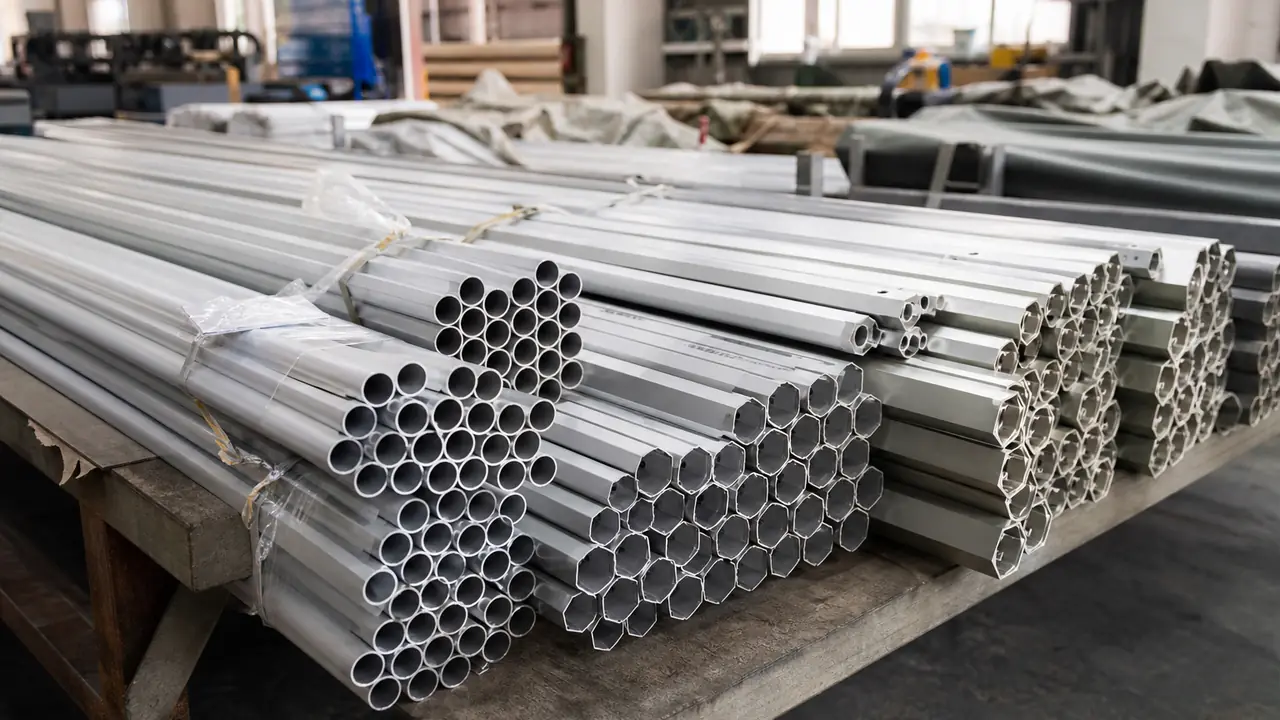
Pop-up canopies come in three common frame grades. Consumer canopies use steel square tube. Commercial canopies use 40 mm hexagonal aluminium legs; the 10x10 ft reference model specifies a leg wall thickness of 1.1-1.2 mm and a frame of about 16 kg within a set of about 20-24 kg. Heavy-duty frames use 50 mm hexagonal aluminium legs for rental and frequent use. Wall thickness matters as much as profile: a 40 mm leg with a thin wall can bend where a thicker one holds, so the desk records wall thickness on the spec sheet and measures it at inspection.
Larger frames and special structures
Party and event frame tents in the common European class use 50 mm galvanised steel tube; pole tents rely on centre and side poles with steel stakes. Bell tents use a steel centre pole (31 mm on the five-metre reference model) and an A-frame door pole. Shower tents use a spring steel wire frame that pops open. Rooftop tents use aluminium support poles on a hinged base with an aluminium ladder. Kids teepees in the reference model use ten pine poles with five connectors. Inflatable air tents replace poles with TPU bladders in fabric sleeves; see inflatable air tents.
Rust, coating and joints
Steel frames need a protective coating such as powder coat or galvanising, and the coating is only as good as the cut ends and drilled holes. Aluminium does not rust in the same way but can corrode at contact points with steel fasteners. Plastic or metal joints, sliders and push buttons on canopy frames take the most wear. Inspection checks finish, joint fit, smooth folding and the frame dimensions against the sample; see quality control.
Specifying the frame
Write the material and alloy, diameter or profile, wall thickness, section count, joint type, coating and spare parts into the order. Typical starting quantities are 300-500 tents per style or 20-50 canopy sets per style, confirmed in writing; see MOQ and lead time, and send your frame requirements through the quote form.