
What this line covers
A custom printed canopy turns a standard 10x10 ft frame into a brand space. It is bought by consumer brands for sampling tours, by promotional product distributors for their clients, by sports clubs, dealers and franchise networks, and by exhibitors who need the same booth at a dozen outdoor shows a year. The frame is the same commercial frame as on the pop-up canopy line; the value is in the print, the fit of the walls and the consistency of colour across repeat orders.
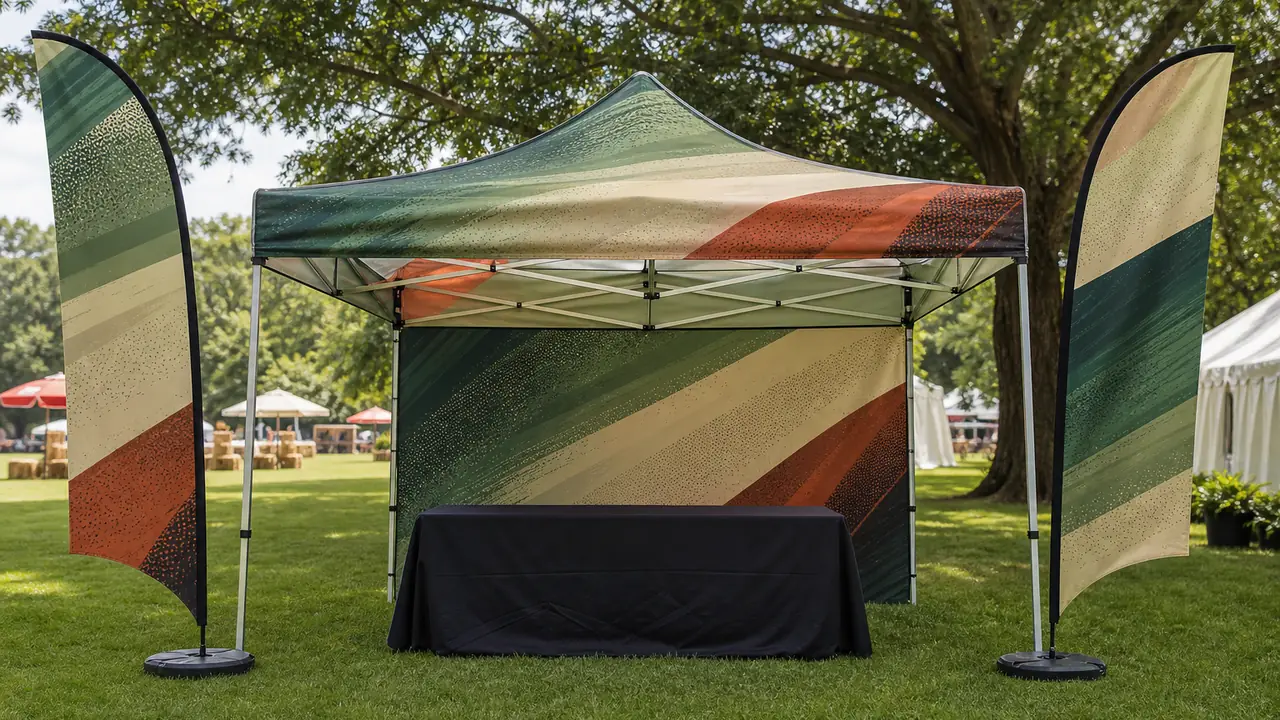
The reference kit on the pitch plate comes from public listings: a 10x10 ft printed top on a 40 mm hex aluminium frame, a back wall of 301x217 cm, two half walls of 301x91 cm and two 11 ft feather flags, all in 600D oxford polyester with dye-sublimation print. The kit weight depends on the walls, flags, bags and frame grade, so it is given as an estimated range of about 23-31 kg and recorded on your sample.
Dye-sublimation or screen print
Most printed canopies use one of two processes. The right one depends on the artwork, the quantity and how many parts carry print.
| Process | Artwork | Best for | Points to fix |
|---|---|---|---|
| Dye-sublimation | Full colour, photos, gradients, edge-to-edge | Fully branded kits, walls and flags | Colour proof, ink penetration, colourfastness and UV fading per report |
| Screen print | One to a few spot colours, solid logos | Logo on valance or top of a coloured canopy | Pantone match, ink adhesion, alignment on each panel |
Dye-sublimation transfers dye into the polyester fibre, so the print does not crack or peel, but light colours can look softer than on screen and the reverse side shows a lighter image. Screen print sits on the surface and gives strong solid colours for simple logos, with one screen per colour. The canopy printing page compares them in detail.
Artwork files and colour proof
Print problems almost always start with artwork. The partner factory supplies a template for each part, top panels, valance, back wall, half walls and flags, with bleed and safe zones marked. Artwork should come as vector files with fonts outlined, and photos at full size in high resolution. Colours are specified as Pantone references, because screen colours do not translate to fabric. Before bulk, the desk asks for a digital layout check and a printed colour proof on the actual fabric, then a first finished piece is checked against the approved proof. See canopy artwork files.
Walls, flags and accessories
A full kit usually adds a back wall, two half walls and one or two feather flags with ground spikes or cross bases for hard floors. Walls attach by hook and loop or zips; half walls often carry the most visible print because they sit at eye level. Printed weight bags complete the look and keep the anchoring visible. Each leg still needs about 40 lb (18 kg) of weight as an industry convention, or stakes and guy lines on grass, and the canopy should come down when wind picks up. The sidewalls and accessories note lists the options.
Repeat orders and range planning
Printed canopy programs rarely stop at one order. A brand that runs a summer sampling tour orders again the next spring, a distributor reorders the same kit for a new client with only the logo changed, and a franchise network adds kits as new locations open. Three habits keep repeats consistent. First, keep one frame model and grade across the program so walls and tops stay interchangeable. Second, keep the approved proof, the artwork files and the Pantone list in the order file under one design reference. Third, order a few spare tops and walls with the first batch, because a torn wall is cheaper to replace than a whole kit and print lots differ over time.
Fire reports, inspection and ordering
Printed parts used at US events are often asked to meet NFPA 701 or California CSFM, and printing can change how a fabric performs, so the report should cover the printed fabric, issued to the partner factory or your brand per order. Inspection checks colour against the proof, print alignment across panels, wall dimensions and stitching. Printed kits typically start at 20-50 sets per design, with 45-60 days for custom work, confirmed in writing for each order. Send your artwork and kit list through the quote form.