
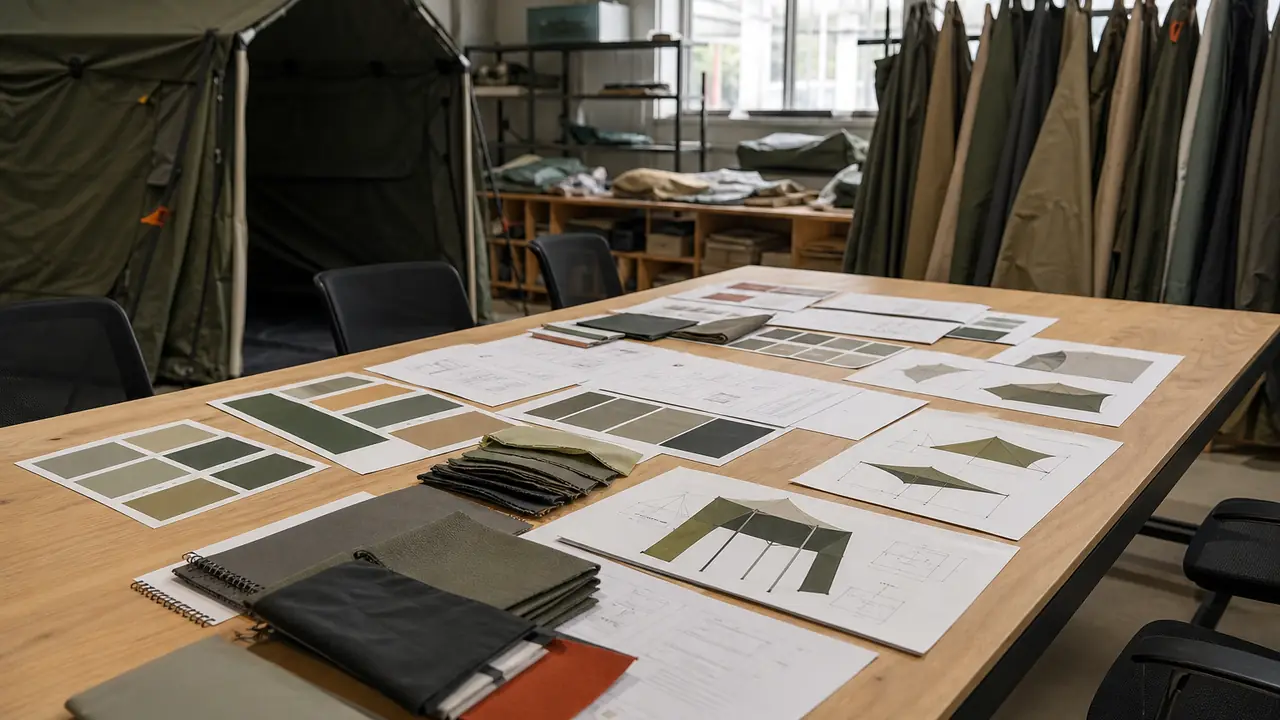
Three models, often mixed up
In the tent trade three working models sit under the same loose labels. It helps to name them by what the buyer brings and what the partner factory brings.
- Private label on an existing style. The factory already makes the tent. The buyer chooses colours, adds a logo, labels, bag and packaging. The design, patterns and tooling stay with the factory.
- ODM (original design manufacturing). The factory designs or adapts a tent to the buyer's brief: a new size, a modified pole layout, extra vestibule, a different floor. The factory does most of the engineering, and ownership of the result has to be agreed.
- OEM (original equipment manufacturing) to the buyer's design. The buyer brings a full design: drawings, pattern files, a bill of materials and a spec sheet. The factory makes it as specified. The buyer normally owns the design and pays for its tooling.
Many suppliers call all three OEM. What matters is not the label but the ownership and the obligations written into the order.
Who owns what
| Item | Private label | ODM | OEM to your design |
|---|---|---|---|
| Structure and design | Factory | Agreed per contract, often factory | Buyer |
| Pattern files and cutting dies | Factory | Agreed per contract | Buyer, held at factory |
| Moulds, hubs, special fittings | Factory | Agreed per contract | Buyer if paid by buyer |
| Exclusivity | Usually none on the structure | Possible, must be written | Buyer's design by default |
| Typical starting quantity | 300-500 tents per style | Assessed per project | Assessed per project |
| Development time | Shortest | Medium, several sample rounds | Depends on how complete the design is |
| Ease of moving factory | Low: the style belongs to the factory | Depends on the contract | High if files and tooling are released |
All quantities above are typical ranges, confirmed in writing for each order. The point of the table is the last row: the more the buyer owns, the easier it is to dual-source or move a style later.
Tooling in tents is smaller than you might think, but it matters
Tent tooling is lighter than in moulded products. The main items are pattern files and cutting dies or templates for each panel, moulded hubs and connectors on instant and hub tents, valve and bladder tooling on air tents, extrusion profiles and joints on canopy frames, and the hinged base and ladder fittings on rooftop tents. Printing adds screens or sublimation files. Each item has a cost, and whoever pays for it should be stated clearly, together with what happens to it if the relationship ends.
For a dome tent built on a familiar geometry, the new tooling may be no more than revised patterns. For a new hub system or a new canopy joint, moulds are involved and the amount of development work rises. The poles and frames page explains which frame parts are standard and which are tooled.
Choosing the right model
Private label suits a first season
A brand testing the market, a marketplace seller or a retailer filling a seasonal range will usually do best on existing styles. Lead times are shorter, samples are quick, typically 7-15 days, and the factory has already solved the pitch, the seams and the packing. The trade-off is that a competitor can buy a very similar tent from the same partner factory.
ODM suits a differentiated range without an in-house designer
ODM fits brands that know what they want, such as a taller vestibule, a darker inner or a different door layout, but do not have pattern makers. Agree before sampling who owns the final design, whether the factory may sell it to others and for how long.
OEM suits established brands
Brands with designers and a spec sheet culture can own the full design and run it at more than one partner factory. Bulk lead times for custom work are typically 45-60 days, confirmed in writing per order, and the sample rounds take longer because the factory is learning a new structure.
Clauses to put in writing
- Who owns the design, the pattern files and each piece of tooling, and who paid for it.
- Whether the partner factory may sell the same or a substantially similar style to others, in which markets and for how long.
- Where tooling and files are held, and how they are released if production moves.
- Who holds the test reports: reports are issued to the partner factory or to your brand per order, and a report issued to the factory may not transfer.
- Which golden sample is the reference for bulk, and how changes are approved.
The desk does not give legal opinions on design rights; confirm ownership and exclusivity clauses with your own legal adviser. What the desk does is make sure the order file records the agreed position before money moves.
How test reports follow the model
On private label styles the partner factory often already holds reports on its fabric, for example a hydrostatic head report to ISO 811 or a flame resistance report to CPAI-84. Those reports describe the factory's fabric and style. If your order changes the fabric, colour or coating, the report may no longer apply. On OEM projects, the reports are usually commissioned for your design and issued to your brand. Either way the desk verifies each report against the fabric and style actually shipped. The compliance and certifications page sets out the reports by market.
Moving between models over time
Many tent brands pass through all three models. A first season runs on private label styles to learn which sizes and colours sell. The second season adds ODM changes where reviews point to a weakness, such as a short vestibule, too little ventilation or a bag that is hard to repack. Later, the best-selling style is redrawn as an OEM design the brand owns, so it can be made at a second partner factory and protected from look-alikes. Each step raises development time and the starting quantity, so plan the move around a season with enough lead time, and keep every approved sample and spec sheet in the order file.
Next step
State in your brief which model you want and what you expect to own. The OEM and private label page shows the branding options, the MOQ note explains quantities, and the quote form takes your brief.