
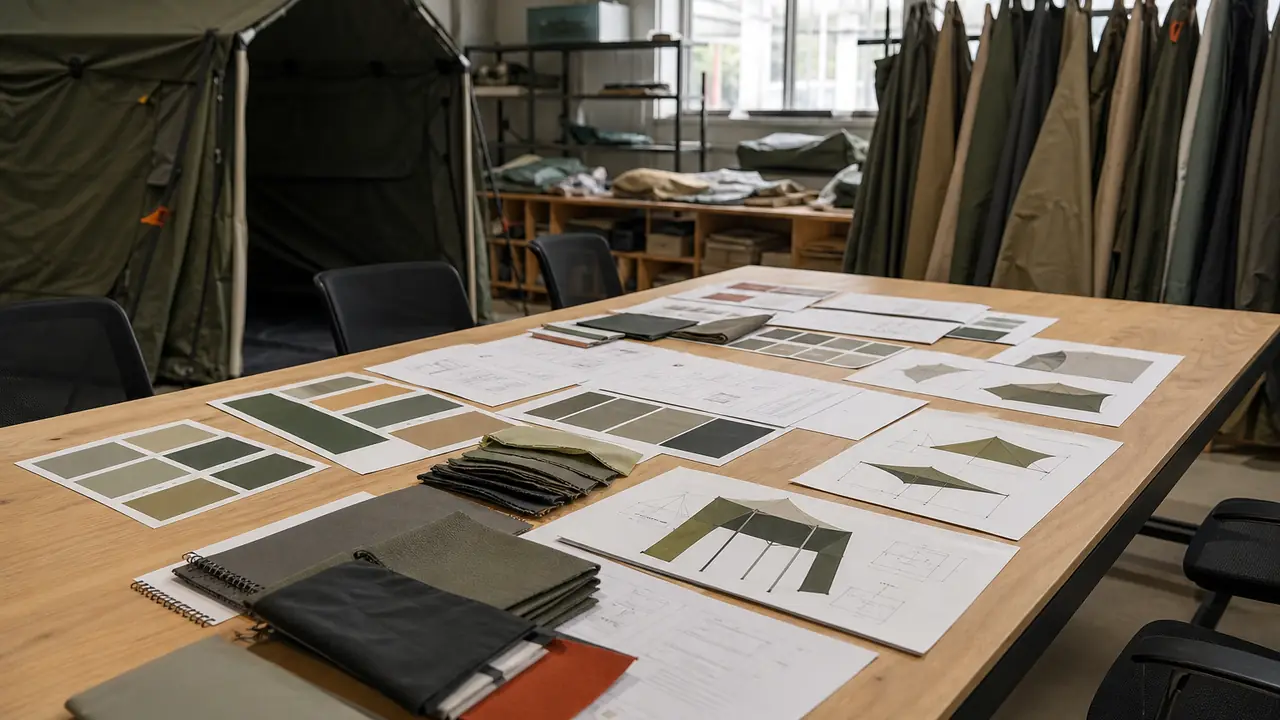
What an MOQ really covers
When a partner factory quotes a minimum order, it is pricing the fixed work around a style. Fabric is dyed and coated in lots, and a custom colour means a dyeing run whether you order 50 tents or 5,000. Cutting tables are set up per pattern. Seam taping machines, print screens and sublimation transfers are prepared per design. Carry bags, labels, manuals and cartons are printed in runs with their own minimums. Below a certain quantity the fixed cost per tent climbs steeply, and many factories prefer to decline rather than quote a figure the buyer will find unreasonable.
That is why the MOQ depends far more on what you change than on the tent itself. A stock dome tent with your logo on the carry bag carries little set-up. The same dome in a custom fly colour with a new pole geometry is a different project.
Typical ranges by type of order
The figures below are typical working ranges quoted by partner factories, not fixed rules. Every quantity is confirmed in writing for each order, because the same factory may quote differently in peak season, for a new colour or for a mixed order.
| Order type | What changes | Typical starting quantity |
|---|---|---|
| Existing style, your branding | Logo, colour, carry bag, labels on a style the factory already makes | 300-500 tents per style |
| 10x10 canopy or printed canopy kit | Top colour or full print, walls, flags on a standard frame | 20-50 sets per style |
| New build | New structure, new moulds or hubs, new fabric development | Assessed per project |
The canopy range is lower because the frame is standard and the top is a single printed or coloured panel, while a camping tent involves a fly, an inner, a floor, poles and many trims. For new builds there is no meaningful typical figure: tooling, fabric development and testing all depend on the design, and the desk assesses them with the partner factory before quoting. See MOQ and lead time for the working ranges in one place.
What pushes the MOQ up or down
Fabric colour and specification
A stock fabric in a stock colour is the easiest path. A custom colour on a 68D or 75D polyester fly needs a dyeing lot; a new coating, a fluorine-free DWR option or a heavier floor fabric may need a separate fabric order. If your range uses one custom colour across several sizes, the fabric lot can be shared and the per-style minimum often becomes easier to reach.
Printing and branding method
A screen-printed one-colour logo needs a screen per colour; dye-sublimation on a canopy top needs a transfer per design but no screens. Woven labels, printed bags and boxes each carry their own minimums. Simple branding on the bag and a sewn label keeps the threshold low.
Structure and tooling
Changing pole lengths within a familiar geometry is minor. New hubs, new moulded fittings, a new air beam layout or a new rooftop base is tooling work, and the cost has to be spread across enough units to make sense.
Season
Partner factories ship heavily in the first half of the year for spring and summer shelves in Europe and North America. In peak months a factory may raise its minimum for new customers or new styles; in quieter months it may accept smaller runs. Plan early if you need a low quantity in spring.
How to plan a first order around the MOQ
- Start from existing styles. Choose a structure the partner factory already makes and change colour, logo and packaging. That keeps you at the lower end of the range.
- Share fabric across sizes. Use the same fly and floor fabric in two or three sizes so one dyeing lot covers the range.
- Keep the first branding simple. A logo on the bag, a sewn label and a branded manual are enough for a first season; full custom packaging can follow on the reorder.
- Consolidate. Mix several styles from different partner factories into one shipment with one inspection plan.
- Agree the reorder terms. Ask what the minimum is for a repeat order of the same approved style, which is often easier because fabric, screens and patterns already exist.
Common misunderstandings
- Sample quantity is not MOQ. A factory will make one or a few samples, typically in 7-15 days, without committing you to a bulk quantity. The sample is charged separately.
- MOQ is not lead time. Meeting the minimum does not shorten production. Standard bulk typically takes 30-45 days and custom work 45-60 days, confirmed in writing per order.
- Per order is not per style. A 500-unit order split across five colours may fall below each colour's minimum.
- A low MOQ is not a better factory. A very low figure on a complex tent may signal stock fabric substitution or skipped seam taping. Check the spec, not just the number.
An illustrative example
Consider an anonymous, illustrative case. A marketplace seller wants three dome tent sizes, two, four and six person, in a custom olive fly colour with a logo on the bag. The first idea was 200 tents of each size in two colours, which fell below the per-colour minimum on every style. The revised plan used one custom colour for all three sizes, so a single fabric dyeing lot covered the order, and settled on 300-400 tents per size with a sewn label and a printed bag. The printed retail box, which carried its own higher minimum, was replaced by a plain carton with a branded label for the first season. The seller reached each minimum without stretching the budget, and the reorder could add the second colour once sell-through was known. Exact figures were confirmed in writing with the partner factory before the deposit.
Bringing it together
An MOQ is a negotiation over fixed cost, not a wall. Define what you change, keep fabric shared across sizes, and ask for each minimum in writing. The OEM vs ODM note explains how ownership of design and tooling affects quantities, the OEM and private label page shows what can be branded at each level, and the quote form is the place to send your sizes, colours and target quantities.