
Three levels of private label
Search demand shows how many buyers look for branded tents: in a US keyword export from October 2026, custom canopy tent drew about 2,900 monthly searches, custom tent with logo about 1,600 and custom pop up tent about 1,300 (Semrush). Behind those phrases sit three quite different projects.
- Level 1: existing style with your logo. A partner factory's proven structure, fabric and pole set, with your logo on the fly, labels, carry bag and carton. The fastest route and the lowest risk, because the tent has already been made and pitched many times.
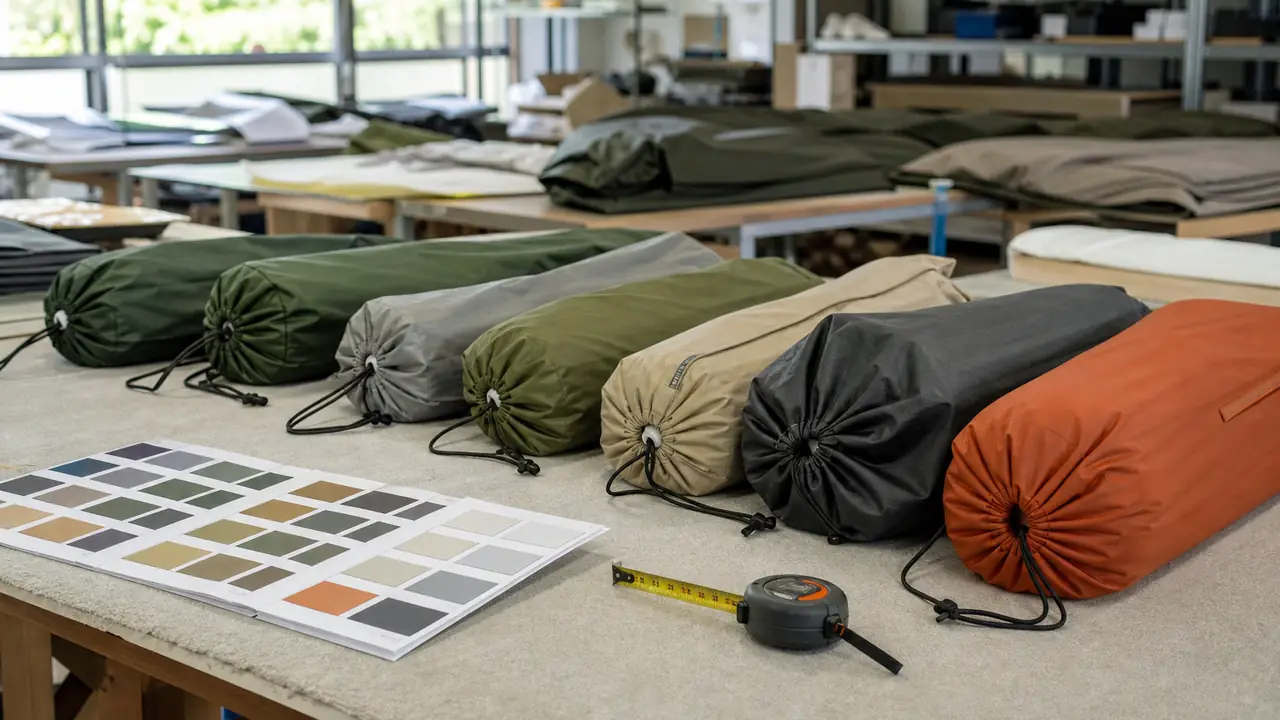
- Level 2: existing structure, your fabric and colours. The same structure, with your choice of fabric grade, coating, colourways, mesh, zips and accessories. It changes the bill of materials but not the pole geometry, so most of the engineering is already known.
- Level 3: new structure. A new pole layout, new frame part, new moulded fitting or a new fabric development. It needs drawings, tooling decisions, several sample rounds and its own test plan, and the ownership of drawings and tooling should be agreed in writing at the start. See OEM vs ODM.
MOQ, samples and timing by level
| Level | What changes | Typical MOQ | Samples | Bulk |
|---|---|---|---|---|
| 1. Existing style with logo | Logo, labels, bag, carton | 300-500 tents per style; 20-50 sets per style for canopies | 7-15 days | 30-45 days |
| 2. Your fabric and colours | Fabric, coating, colours, trims | 300-500 tents per style, depending on fabric minimums | 7-15 days per round | 45-60 days |
| 3. New structure | Poles, frame, fittings, fabric development | Assessed per project | Several rounds | Per project plan |
These are typical starting points across partner factories, not fixed rules. A colour that matches a factory's stock fabric is easier than a custom-dyed one; a printed canopy kit with a standard frame starts lower than a tent with new fabric. The final quantity and timing for each order are confirmed in writing. More detail is on MOQ and lead time.
What you can brand
Branding goes further than a logo on the fly. Common points are the fly or canopy top (printed, heat-transferred or with a sewn patch), the zip pullers, the pole bag and stake bag, the carry bag, the woven or printed care label, the manual, the hang tag, the carton print and barcode labels. For canopies, dye-sublimation covers top, walls and flags in full colour, and screen printing handles a single-colour logo. Each branded item needs artwork, a colour reference and an approval step. See private label branding.
Steps to a first order
- Brief. Products, sizes, target market, channel, quantities and the level of customisation.
- Shortlist. The desk shortlists partner factories by tent type and cluster and proposes reference models.
- Spec sheet. Fabric, coating, poles or frame, seams, fittings, labels, packing and the test reports the market needs. See writing a tent spec sheet.
- Sample. Sample in 7-15 days; you pitch it, comment and approve. The approved one becomes the golden sample for the order.
- Pre-production sample and testing. Fabric and product tests are booked on the approved materials where the market requires them.
- Bulk and inspection. Production, then pre-shipment inspection against the golden sample, sampled to ISO 2859-1 at general inspection level II.
- Packing and shipping. Cartons, labels and shipping documents; tents ship by volume, so carton size is fixed early.
Common mistakes
Most private label problems come from decisions left open. Approving a sample without writing down the fabric denier, coating and pole alloy lets the bulk drift. Ordering too many sizes or colours spreads the minimum thin. Planning tests after the fabric is bought adds weeks. Claims on the box that the report does not support cause returns and disputes. A complete spec sheet and a golden sample prevent most of them.
Starting a project
Pitchmere coordinates the project direct from vetted partner factories via the desk, from brief to shipment, and keeps the spec, samples, reports and inspection results in one order file so a reorder starts where the last one ended. Send your brief through the quote form with the level you have in mind, and the desk will come back with reference models and typical quantities.