
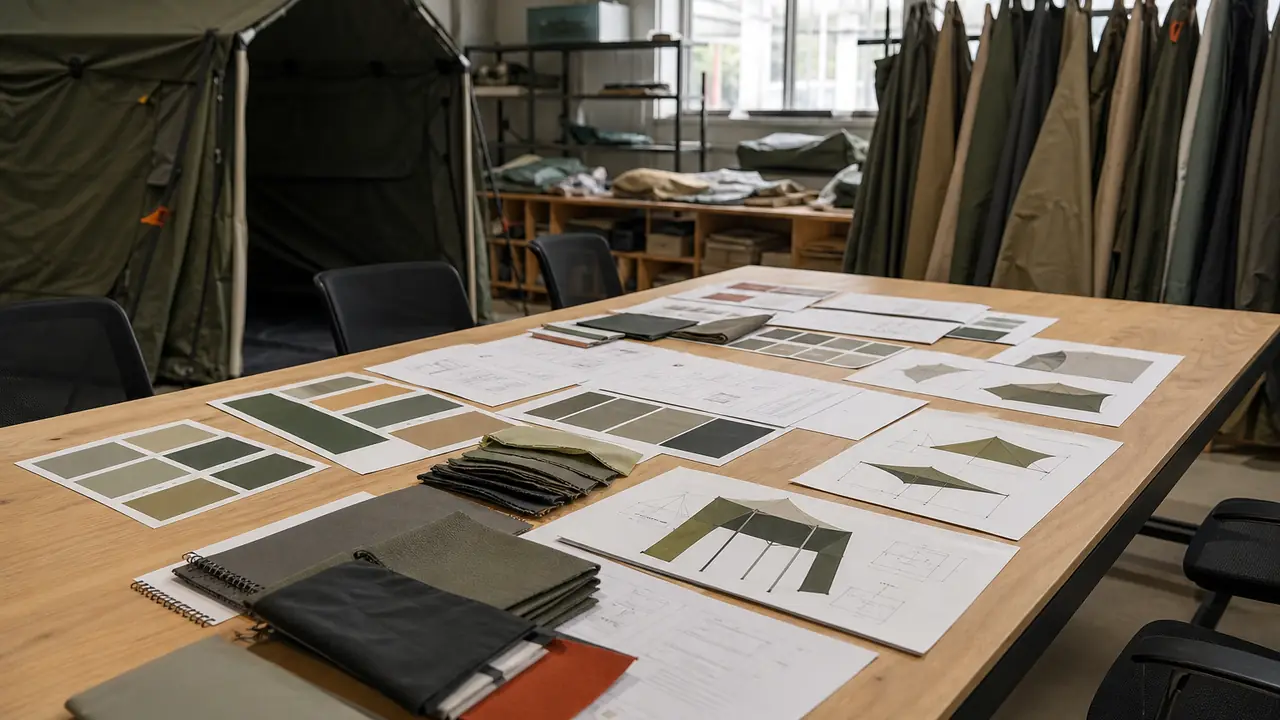
Why a spec sheet comes before a quote
A brief that says 'four-person dome, waterproof, good poles' invites each factory to fill the gaps with its own assumptions. One quotes 68D polyester with taped seams and 7001 aluminium poles; another quotes thinner fabric, untaped seams and fiberglass. The second quote looks better until the first rainy weekend. A spec sheet removes that guesswork. It also becomes the reference for samples, inspection and every reorder, so the time spent writing it is repaid several times.
The spec sheet does not need to be an engineering drawing. It needs to fix every choice that changes cost, weight, durability or a claim on the listing, and leave the rest to the factory's experience.
The sections every tent spec sheet needs
1. Product and market
Line, capacity, target market and channel, and the claims you plan to make. A tent for EU retail needs EN ISO 5912 testing and GPSR labelling; a tent for a US event rental fleet may need NFPA 701; a kids play tent for the US needs CPSIA work. The market decides the reports, and the reports decide the fabric.
2. Dimensions
Footprint, peak height, inner size, vestibule depth, packed size and target weight, with tolerances. Use a reference model as the starting point: a four-person dome at 274x213 cm with a 150 cm peak, or a 10x10 ft canopy at 300x300 cm with a 330 cm peak. State how capacity is measured.
3. Fabrics
For each component: fibre, denier, thread count, coating and colour. For example, fly in 68D 190T polyester with PU coating; floor in 150D-210D oxford or PE; inner in breathable polyester with mesh; canopy top in 600D PU polyester; canvas at 285-360 gsm. Add the hydrostatic head target and the test method, ISO 811, for fly and floor.
4. Poles or frame
Material, diameter, wall thickness, number of sections and hub type. Fiberglass or 7001 aluminium for domes; 40 mm hex aluminium with 1.1-1.2 mm walls for a commercial canopy; steel for cabin tents and consumer canopies. Wall thickness and alloy are where silent substitutions happen, so write them down.
5. Seams, zips and fittings
Seam construction and whether seams are taped; zip size and slider type; vents and windows; number of stakes, their type and length; guy lines, tensioners and guy-out points; for canopies, leg weight attachment points.
6. Branding and packing
Logo position and method, labels, carry bag, inner packing, carton strength, carton marks, barcodes, manual and the drop test, typically ISTA 1A. See the packaging note.
7. Reports, inspection and tolerances
Which lab reports are required per market, who they are issued to, the inspection standard (ISO 2859-1 or ANSI/ASQ Z1.4, general level II, AQL 2.5 for major and 4.0 for minor defects as a stated working default) and the checks to run: pitch test, water spray on seams, dimensions, fabric weight, zips, poles and print colour.
A sample layout
The table shows the kind of line items that belong in a spec sheet for a four-person dome tent. Values are taken from a reference model from public listings and typical category options; your own figures replace them.
| Item | Specification | Tolerance or check |
|---|---|---|
| Footprint and peak | 274x213 cm, 150 cm peak | Measured on pitched sample, agreed tolerance |
| Fly fabric | 68D 190T polyester, PU coated, colour per swatch | Hydrostatic head per ISO 811 report |
| Floor | PE or 150D oxford, tub construction | Hydrostatic head per ISO 811 report |
| Poles | 8.5 mm fiberglass or 7001 aluminium, sections stated | Diameter and length check at inspection |
| Seams | Fly seams heat taped | Water spray check on sampled tents |
| Anchoring kit | 9 stakes, 2 guy lines, tensioners | Count per tent at inspection |
| Weight | About 4-4.5 kg target range | Weighed on golden sample, recorded in order file |
| Packing | Printed carry bag, carton, manual | Carton drop test to ISTA 1A |
Write claims as test references, not adjectives
Words like waterproof, strong and durable cannot be quoted or inspected. Replace them with references the factory and lab can work to. Waterproof becomes waterproof-rated fabric with a hydrostatic head figure per ISO 811 report, plus taped seams. Wind becomes an anchoring plan: number of stakes, guy-out points and, for canopies, about 40 lb (18 kg) of weight per leg as an industry convention, with a note to take the canopy down in strong wind. Flame resistance becomes fabric tested to CPAI-84, ASTM F3431 or NFPA 701 per report. UV becomes a UPF figure per AATCC 183 report for the US or UVE per AS 4174 for Australia and New Zealand. The compliance guide lists which reports suit which market.
Common gaps in tent spec sheets
- Coating side and number of coats left open, which changes hydrostatic head and price.
- Pole wall thickness missing on canopies, the easiest place to cut cost unseen.
- Stake type and count left to the factory, which often means thin wire pegs.
- Packed size not stated, which affects carton size and freight cost.
- Colour reference given as a photo rather than a physical swatch or code.
- Manual language and content forgotten until the week before shipment.
How the spec sheet is used after the quote
Once quotes are compared and a partner factory chosen, the spec sheet is revised against the sample and frozen at the golden sample. It then drives the pre-production check, the inspection checklist and the reorder. Changes after that point go through a written change note. Keep a version number and date on every revision, and send the same version to the partner factory, the lab and the inspector, so nobody checks a tent against an outdated sheet. The golden sample note explains the approval steps, and quality control shows how the checks are run.
Next step
Send a draft, even a rough one, with your sizes, markets and claims through the quote form. The desk completes the gaps with the partner factory before asking for prices, so the quotes you receive are comparable line by line.