
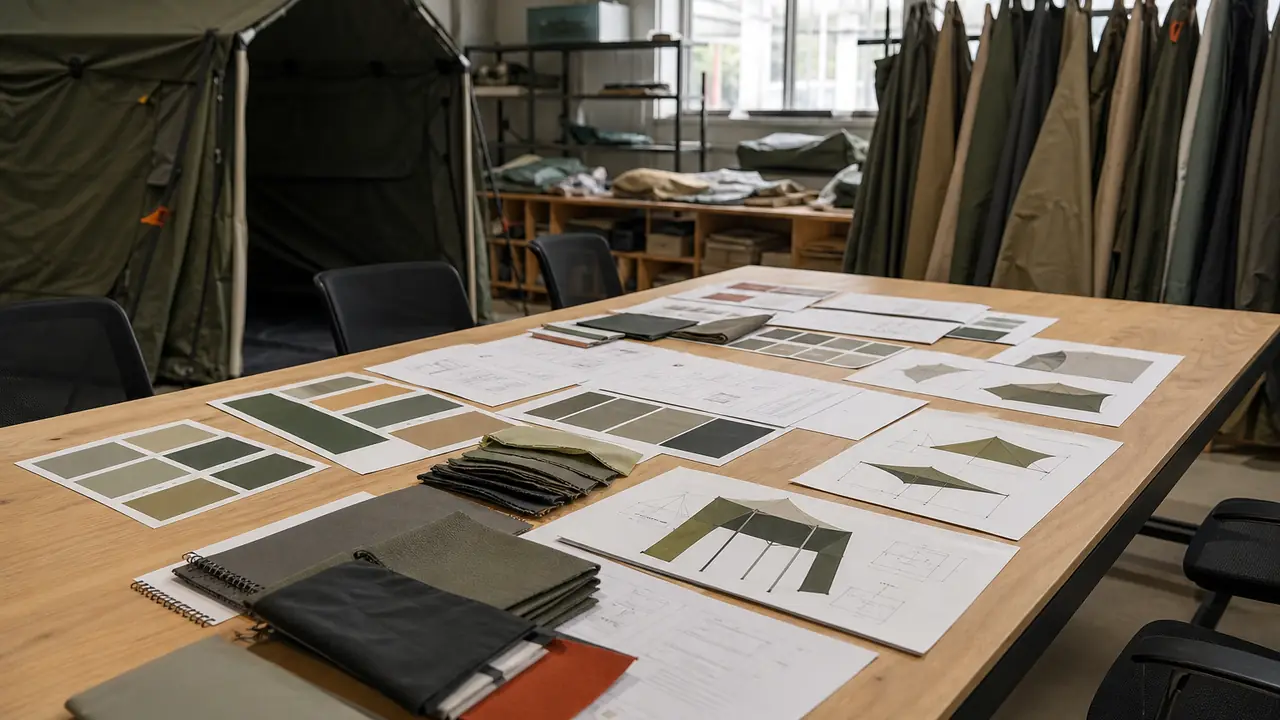
The sample stages
Tent projects usually move through three kinds of sample. The names vary between factories, so agree them at the start.
- Development or first sample. Made from the spec sheet, often with stock fabric in a near colour. It answers the question: is this the right structure, size and feature set?
- Revised sample. Made after your comments, in the correct fabric, colour and fittings where possible. There may be more than one round on new builds.
- Pre-production sample. Made from the bulk fabric lot, bulk trims and bulk packaging, just before production starts. Once approved and sealed, it becomes the golden sample.
Samples typically take 7-15 days per round, plus express shipping of about 5-8 days, confirmed in writing per order. A private label order on an existing style may need only one round; an ODM or OEM build often needs two or three.
What to check on every sample
A sample review is not looking at a tent in its bag. It is a pitch, a measurement and a set of simple tests, recorded with photos.
| Check | How | What it catches |
|---|---|---|
| Pitch test | Pitch from the bag using only the manual; time it | Missing parts, confusing steps, wrong pole lengths |
| Dimensions | Measure footprint, peak, inner, vestibule, packed size | Size drift against the spec sheet and listing |
| Weight | Weigh complete tent and packed bag | Fabric or pole substitution, listing accuracy |
| Seams and water | Water spray on taped seams, zips and floor corners | Untaped or poorly taped seams, zip leaks |
| Fabric | Compare to swatch, check denier and coating side | Colour error, wrong fabric grade |
| Poles or frame | Diameter, wall thickness, joints, hubs, locking pins | Thinner walls, weak joints, sharp edges |
| Fittings | Zip sliders, buckles, tensioners, stake count and type | Cheaper trims than specified |
| Branding and packing | Logo position, colour, labels, bag, carton marks | Artwork errors, missing warning labels |
For canopies, add a full frame cycle, open and close several times, and check leg wall thickness against the spec, typically 1.1-1.2 mm on 40 mm hex aluminium legs for a commercial grade. For printed canopies, check the print against the colour proof in daylight. For air tents, inflate each beam and leave it overnight to check pressure hold. For kids play tents, check small parts, labels and tracking information before any lab test is booked.
Writing useful sample comments
Comments like 'better quality' or 'stronger poles' cannot be acted on. Each comment should name the part, the problem, the required change and how it will be checked. For example: 'Fly seam at rear vestibule leaks under water spray; heat tape full length; recheck by water spray on revised sample.' Number the comments, attach photos and ask the partner factory to answer each number on the revised sample. The desk keeps the comment list in the order file so nothing is lost between rounds.
Approving the golden sample
- Use bulk materials. The golden sample must be made from the bulk fabric lot, bulk poles and bulk trims, not leftovers from development.
- Re-run the checks. Pitch, measure, weigh and water-test it again, and record the figures. The measured weight becomes the order figure.
- Match the reports. Confirm that lab reports, such as hydrostatic head per ISO 811 or flame resistance per CPAI-84, were run on the same fabric and coating.
- Seal and sign. Label the sample with order number, date and signatures from the buyer side and the factory, and photograph it pitched and packed.
- Keep two. One golden sample stays at the partner factory as the production reference; one comes to you or stays with the desk for inspection.
Approval should be in writing, ideally on the spec sheet itself, with any accepted deviations listed. A deviation that is not written down will not be recognised at inspection.
How bulk is checked against the golden sample
At pre-shipment inspection the inspector compares sampled units with the golden sample and the spec sheet. Sampling usually follows ISO 2859-1 or ANSI/ASQ Z1.4 at general inspection level II, with AQL 2.5 for major defects and 4.0 for minor as a stated working default, confirmed per order. Typical checks include pitch tests, seam water checks, dimensions, fabric weight, zips, poles, print colour, accessory counts and carton marks, plus a carton drop test to ISTA 1A. The testing and inspection page lists them in more detail, and the pitch test note explains how to run one consistently.
Common sample mistakes
- Approving a development sample in stock fabric and assuming the bulk colour will match.
- Skipping the pitch test because the tent 'looks right' in photos.
- Approving without weighing, then printing a listing weight from a catalogue.
- Changing a trim by email after approval without updating the spec sheet.
- Booking lab tests on a sample fabric that differs from the bulk lot.
An illustrative case
An anonymous, illustrative example shows why the steps matter. A distributor approved a six-person instant tent from a revised sample in a near colour, intending to confirm the bulk fabric by photo. The bulk fly arrived a shade lighter, and the factory had switched to a lighter zip slider because the original was out of stock. Neither change was recorded, so neither could be rejected at inspection. On the next order the distributor insisted on a pre-production sample from the bulk lot, re-ran the pitch and water checks, listed the zip slider and fabric code on the spec sheet and sealed two golden samples. The reorder shipped without disputes, and the inspection report referred to the sealed sample line by line.
Who should approve
Approval works best when one named person on the buyer side signs off, with product, compliance and packaging comments collected beforehand. If you cannot review the sample yourself, an inspector or the desk can pitch and test it on your behalf against the spec sheet, and send a photo and measurement report for your written approval.
Timing the sample rounds
Each round adds about two to three weeks once making, shipping and review are counted. Plan them into the calendar before production, not inside it; see the lead times note. When you are ready to start, send your spec sheet and target dates through the quote form; the spec sheet note explains what to include.