
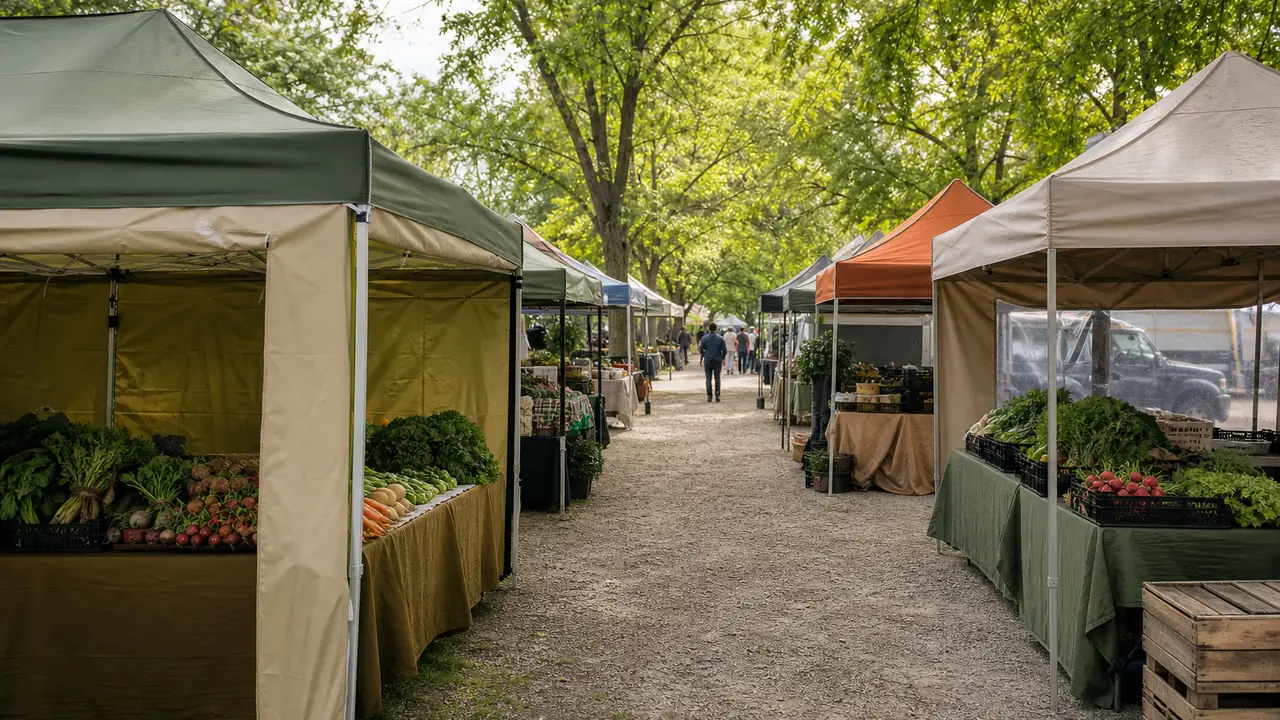
What a market canopy has to survive
A vendor canopy is a working tool. At a farmers market, craft fair or street food event it goes up before dawn and comes down after dark, every weekend through the season. It stands on asphalt, concrete or a paved square where stakes cannot go in, in sun all day and wind gusts between buildings. At trade shows and outdoor exhibitions it must also look sharp in photos, pass the organiser's rules and fit the booth plot. Over a few seasons, frames are opened and closed hundreds of times.
Failures follow from that use: bent or snapped truss bars, cracked plastic joints, rust on steel frames, tops that tear at the corners, printed tops that fade, and canopies that lift because no weights were used. Most of these are decided by the frame grade and the anchoring kit chosen at order stage.
Recommended lines and reference specs
The reference model is a 10x10 ft commercial pop-up canopy from public listings: 300x300x330 cm, about 9.3 m2 of shade, 40 mm hex aluminium legs with 1.1-1.2 mm walls, a 600D PU-coated polyester top, about 20-24 kg as a set with the frame at about 16 kg, in a carton of about 158x27x27 cm. A printed kit adds a back wall of 301x217 cm, two half walls of 301x91 cm and two 11 ft flags, in 600D oxford polyester printed by dye-sublimation; set weight depends on the configuration.
| Frame | Typical use | Strengths | Watch points |
|---|---|---|---|
| Steel square tube | Consumer and occasional use | Lower cost | Heavier, rust at joints and cut ends |
| 40 mm hex aluminium | Weekly markets, exhibitors, the commercial norm | Lighter, no rust, stiffer legs | Wall thickness and joint material |
| 50 mm hex aluminium | Heavy duty, rental fleets, frequent use | Stiffest legs, longest service | Weight and carton size |
Sizes run 10x10, 10x15 and 10x20 ft. Leg wall thickness, joint material and truss bar profile belong on the spec sheet; see canopy frame grades.
Vendors who trade every weekend should also order spares with the first batch: a replacement top, a few truss bars, foot plates and joint parts. A canopy with one bent bar is out of service until the part arrives, and parts ordered later may not match the original frame.
Anchoring on paved ground
Each leg comes with a stake and a guy line for soft ground, but at markets and shows the anchor is weight. The industry convention is about 40 lb or 18 kg per leg, which is a convention rather than a regulation; many markets and organisers set their own minimum. The order specifies the weight type (sandbags, stackable plates or water weights), how it attaches to the foot plate and whether it is in the kit or sold separately. Canopies must come down in strong wind, and the manual and listing say so. There is no wind rating. See anchoring and wind.
Print that lasts the season
Dye-sublimation gives full-colour graphics on the top, walls and flags; screen print suits a one-colour logo. The order runs on vector artwork placed on the factory template, a colour proof, a printed first piece approved before bulk, and a colour and rub fastness check at inspection. Sun fades any print over time, so the care card covers drying and storage. See canopy printing.
Flame resistance and venue rules
Trade show halls, festivals and some markets ask for flame-resistant fabric, typically tested to CPAI-84 or NFPA 701 per report, with a label on the top. CPAI-84 results do not equal NFPA 701 results, so ask the organiser which one they accept. Permits and inspections are set by the local fire authority; confirm with them. Reports are issued to the partner factory or to your brand per order and verified by the desk.
How to brief a vendor or exhibitor program
Send size, frame grade, top fabric, wall configuration, artwork and colour targets, weight kit, the fire test your venues ask for and quantities per design. 10x10 canopies and printed kits typically start at 20-50 sets per style; samples take 7-15 days plus print approval, and bulk 30-45 days, confirmed in writing for each order. Use the quote form.