
Start with the use
Canopies are bought for very different jobs. A family wants backyard shade a few weekends a year. A market vendor sets up and takes down every week on asphalt. A promotional brand needs its logo on every surface at trade shows. A rental company needs frames that survive a hundred set-ups and tops that pass a fire inspection. The same 10x10 ft shape serves all four, but the frame, fabric, walls and paperwork should not be the same. Decide which job the program serves before comparing quotes, because a consumer frame and a commercial frame can look alike in a photo.
Frame grades and legs
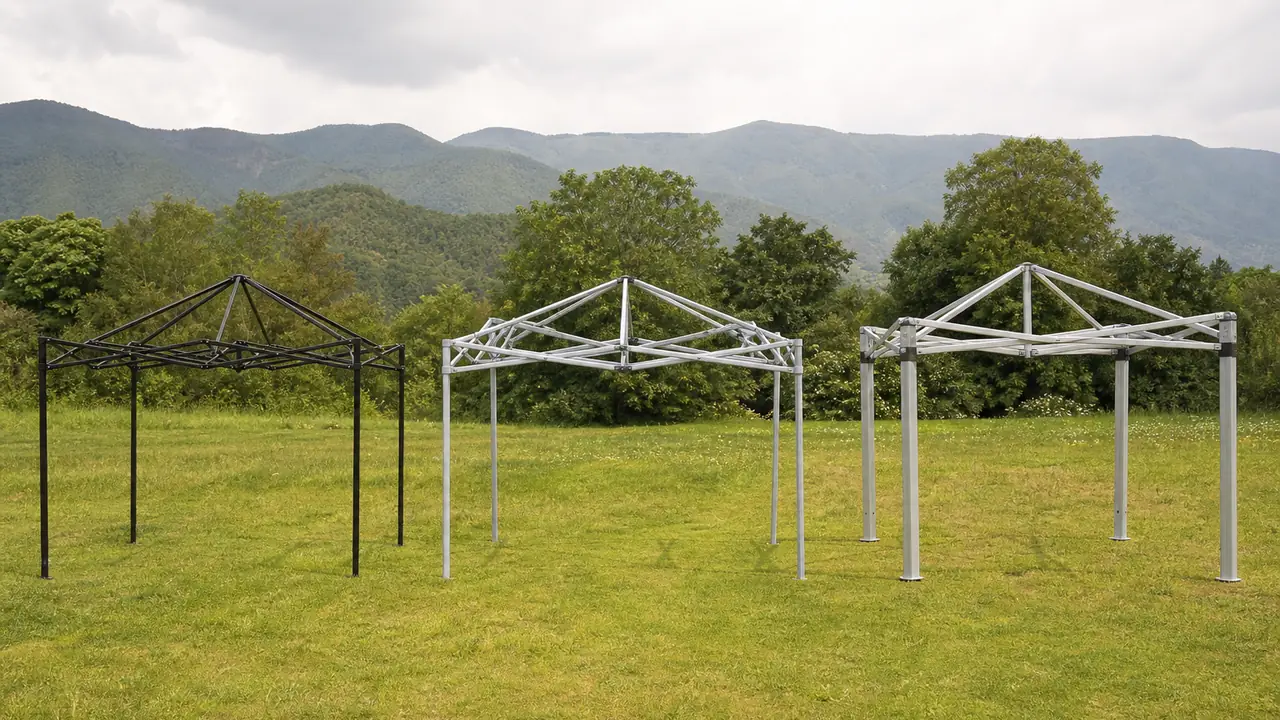
Three frame grades cover most of the market. Consumer canopies use square steel tube: cheap and stiff, but heavy and prone to rust where the coating is chipped at joints. Commercial canopies use 40 mm hexagonal aluminium legs, the common grade for vendors and promotional programs. Heavy-duty canopies step up to 50 mm hexagonal aluminium for rental fleets and frequent use. The hexagonal profile resists twisting better than a round tube of the same weight.
Leg size alone is not enough. The commercial reference model uses 40 mm hex legs with a wall thickness of 1.1-1.2 mm; a thinner wall at the same outside size saves cost and weight but dents and bends sooner. Put the leg profile, wall thickness, truss material, joint and bracket material, and the height adjustment system on the spec sheet, and check them at inspection. The frame grades note goes deeper.
| Grade | Leg | Typical buyer | Watch points |
|---|---|---|---|
| Consumer | Square steel tube | Backyard and occasional use | Weight, rust at joints, plastic brackets |
| Commercial | 40 mm hex aluminium, 1.1-1.2 mm wall on the reference model | Vendors, trade shows, promotional programs | Wall thickness, bracket material, top fit |
| Heavy duty | 50 mm hex aluminium | Rental fleets, frequent set-up | Kit weight, carton size, spare parts |
Tops and walls
The commercial reference uses a 600D PU-coated polyester top; printed kits use 600D oxford polyester printed by dye-sublimation. Ask for the coating, the seam construction at the corners and the hook-and-loop or strap fixings to the frame. Water resistance is stated as waterproof-rated fabric with hydrostatic head per ISO 811 test report, and UV figures only per AATCC 183 report, or per AS 4174 for Australia and New Zealand.
Walls change how a canopy is used. The printed reference kit adds a back wall of 301x217 cm, two half walls of 301x91 cm and two 11 ft flags. Full side walls, zip doors, windows and banners are common options. Each wall adds weight and windage, so it also changes the anchoring plan.
Weights and anchoring
A canopy has no floor and catches wind like a sail. The desk does not publish wind ratings, because there is no common test for them. Instead each kit carries an anchoring plan: on soft ground one stake and one guy line per leg, and on paved ground leg weights. The industry convention is about 40 lb (18 kg) of weight per leg, more when walls are fitted; it is a convention, not a regulation, and event organisers may set their own rules. Users should take the canopy down when strong wind is forecast. Weight bags and plates can be added to the kit; see canopy weights per leg.
Printing and branding
Dye-sublimation prints full colour into the polyester and suits logos, photos and full-coverage designs across top, walls and flags. Screen printing suits single-colour logos at lower cost. Either way, the order runs through an artwork template, a colour proof and a first-article check before bulk, and inspection checks colour difference and print fastness against the approved sample. Print fading over time depends on ink, fabric and sun exposure. See canopy printing for files and proofs.
Event reports and buying steps
Canopies used at events, markets and trade shows are often inspected by the local fire authority. The usual documents are a flame resistance report to NFPA 701 or California CSFM Title 19 registration of the fabric. A camping tent report to CPAI-84 is a different test and does not show NFPA 701 performance. Reports are issued to the partner factory or your brand per order, verified by the desk; whether a document is accepted is the authority's decision.
- Name the use and the frame grade.
- Fix leg profile, wall thickness, top fabric and walls on the spec sheet.
- Choose the print method and send artwork for a colour proof.
- Agree the anchoring kit and the reports the event market needs.
- Approve the sample, then bulk: typical starting points are 20-50 sets per style, confirmed in writing; send your brief through the quote form.