
What gets printed
A custom canopy program is usually more than a roof. The reference 10x10 ft printed kit from public listings combines a printed top, a back wall of 301x217 cm, two half walls of 301x91 cm and two 11 ft flags on a 40 mm hexagonal aluminium frame. The printed parts are 600D oxford polyester, and the full set weighs about 23-31 kg depending on configuration. Each printed part has its own artwork template, and each adds to the print time, the proof work and the carton.
Before artwork starts, the desk fixes the part list in writing: which parts are printed, which are plain, which side carries the print, and whether walls attach by hook and loop or zip. Changing the part list after proofs are approved restarts the proof cycle, so it is cheaper to settle it first.
| Part | Reference size | Common print |
|---|---|---|
| Top (roof and valance) | 10x10 ft, 300x300 cm frame | Full-colour dye-sublimation or single-colour logo on valance |
| Back wall | 301x217 cm | Full-colour dye-sublimation |
| Half walls | 301x91 cm, two per kit | Full-colour or logo |
| Flags | 11 ft, two per kit | Full-colour dye-sublimation |
Dye-sublimation
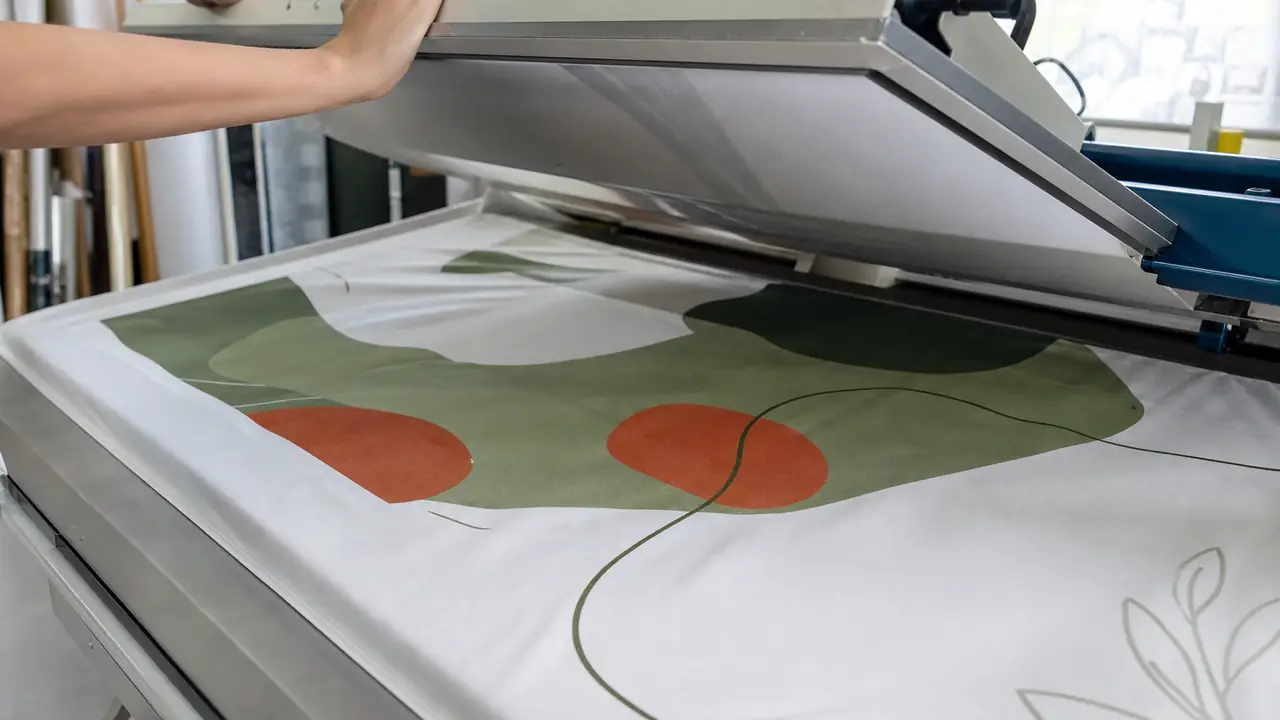
Dye-sublimation prints the artwork onto transfer paper, then heat and pressure turn the dye into a gas that bonds into polyester fibres. The image becomes part of the fabric rather than a layer on top, so it does not crack or peel and can run edge to edge with photographs, gradients and many colours. It works on polyester, which is one reason canopy tops are 600D polyester. Colours depend on the fabric, the coating and the heat settings, so a colour proof on the actual fabric is part of every program.
Screen print
Screen print pushes ink through a mesh stencil onto the fabric, one screen per colour. It suits one- or two-colour logos on a plain coloured top, especially on the valance, and stays cost-effective when the artwork has few colours. It sits on the surface of the fabric, so ink choice and curing matter for abrasion and folding. Large photographic artwork or many colours point to dye-sublimation instead; the trade-offs are set out in dye-sublimation vs screen print.
Artwork, proofs and first-piece approval
- The desk sends the partner factory's template for each printed part, with seam lines, safe areas and bleed.
- You supply vector artwork, with brand colours given as spot colour codes and fonts converted to outlines.
- The factory returns a digital layout on the template; text near seams and the valance fold is checked.
- A physical colour proof is printed on the order fabric and compared with your references under the same light.
- The first finished piece is approved before the run, and kept as the golden sample for inspection.
Fading, cleaning and storage
Every printed canopy fades with sun exposure; the rate depends on inks, fabric and hours outdoors. The desk records ink type and fabric on the spec sheet and checks colour against the golden sample at inspection. Users should dry the canopy before packing, clean with mild soap rather than solvents, and avoid long storage folded wet, which marks and mildews the print. UV protection claims on a canopy are stated only per AATCC 183 test report in the US or AS 4174 in Australia and New Zealand; see flame and UV standards.
Event use and fire rules
Printed canopies used at markets, trade shows and events may need flame-resistant fabric tested to NFPA 701 or registered with the California State Fire Marshal (CSFM Title 19), depending on the venue and the local fire authority. When a program needs a report, ask whether it covers the printed fabric used in your order. Labels are sewn into the top where a venue expects them. The local fire authority decides what it accepts, so confirm with the venue before the order is placed.
Ordering a printed program
Printed 10x10 kits typically start at 20-50 sets per style, with samples in 7-15 days after artwork approval and bulk in 30-45 days, confirmed in writing; see MOQ and lead time. Frames, walls and weights are covered in the canopy buying guide. Send your artwork and part list through the quote form.