
What market use asks of a canopy
Farmers markets, craft fairs, flea markets, night markets and street food events share a pattern. Stalls are allocated in fixed units, the surface is usually paved, the vendor arrives with a vehicle and sets up in a short window before opening, and the canopy stays up all day in sun, rain and gusts. Over a season, a working vendor pitches the same canopy dozens of times. The frame, the top and the anchoring kit have to survive that rhythm, and the canopy has to satisfy the market manager's rules every single day.
For buyers supplying this trade, the product is not just a canopy. It is a canopy, a set of walls, a weight kit and a bag that a single person can handle, sold with honest instructions.
The returns and complaints in this segment are predictable: bent trusses after a gust caught an unweighted canopy, slider brackets that crack after a season, tops torn at the corners, legs that rust where the coating chipped. Each one maps to a line on the spec sheet, which is why the sections below follow the parts of the kit.
Size: the 10x10 unit
Most markets allocate stalls in 10x10 ft units, which matches the commercial reference canopy: 300x300 cm on the ground, about 9.3 m2 of shade, about 330 cm at the peak with adjustable legs. Vendors with larger pitches use 10x15 or 10x20 ft frames, but those are heavier and usually need two people. Wholesalers and retailers serving markets typically carry the 10x10 as the main line and the larger sizes as a narrower option. The 10x10 vs 10x20 comparison sets out the differences.
Frame grade for daily set-up
The frame is where vendor canopies wear out first. Consumer steel square tube frames are the low-cost entry point and suit occasional use, but they are heavier, and once the coating is chipped they are prone to rust. Commercial 40 mm hexagonal aluminium legs with a wall of about 1.1-1.2 mm are the usual specification for regular vendors. Heavy-duty 50 mm hex frames are stiffer again, at higher weight and cost.
| Frame | Suits | Watch for |
|---|---|---|
| Steel square tube | Occasional vendors, seasonal fairs | Weight, rust at chipped coating, bent trusses |
| 40 mm hex aluminium | Weekly markets, regular vendors | Connector and slider wear, leg wall thickness |
| 50 mm hex aluminium | Daily traders, food stalls, shared fleets | Higher kit weight and carton size |
The commercial 10x10 reference kit weighs about 20-24 kg with a frame of about 16 kg, which one person can move from a vehicle. See canopy frame grades for the detail behind leg profiles.
Walls for shade, weather and security
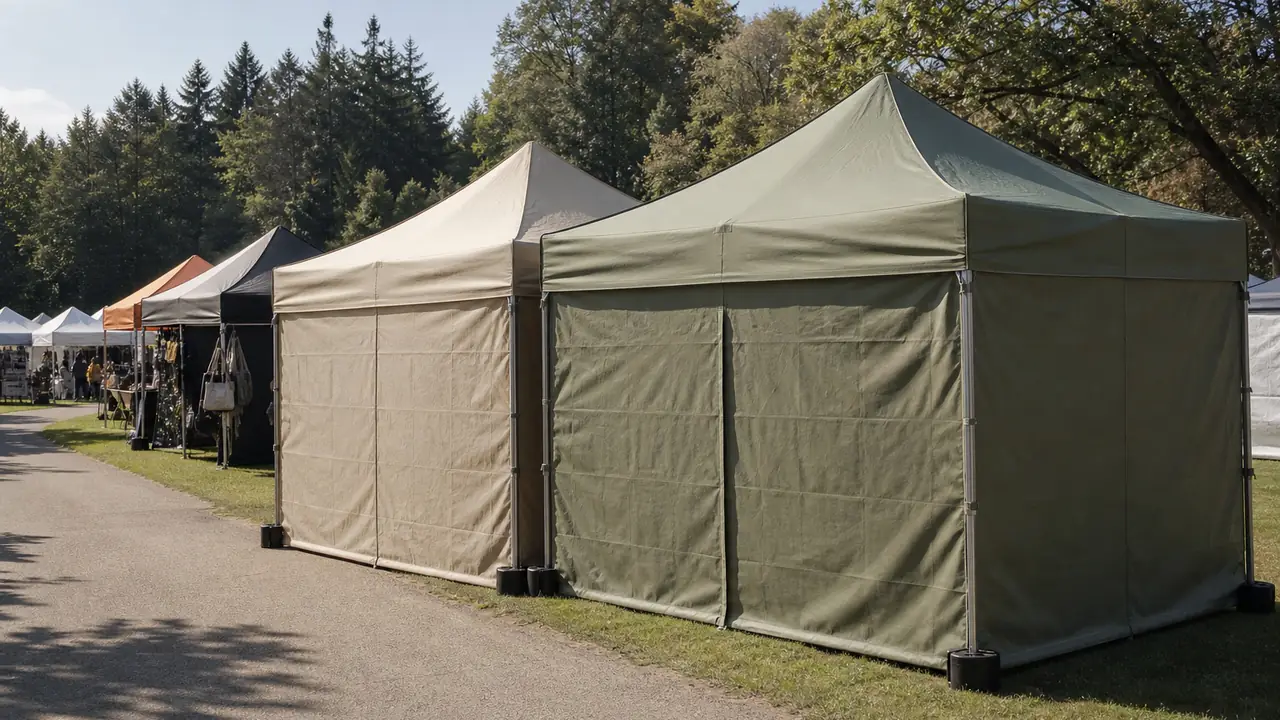
Walls do three jobs at a market. A back wall blocks low sun and wind from behind the stall and carries the vendor's name. Side walls or half walls separate the stall from neighbours. Full walls with zipped doors turn the canopy into a lockable, if not secure, enclosure at the end of the day. A reference printed 10x10 kit from public listings includes a back wall of 301x217 cm and two half walls of 301x91 cm. For plain vendor canopies, a back wall and one or two full side walls in a stock colour are a common bundle.
Fabric choice follows use. A 600D PU-coated polyester top is the commercial reference; walls can be specified in the same fabric or a lighter one, and the choice belongs on the spec sheet with the attachment method. Mesh walls suit produce stalls where airflow matters. For walls that roll up, check that the fasteners and ties are part of the kit.
Weights: the part markets check
Many markets require every canopy leg to be weighted, because a canopy lifting on a crowded street is a real hazard. The industry convention is about 40 lb (18 kg) per leg, which is about 160 lb across a 10x10; it is a convention, not a legal requirement, and many markets set their own minimum. On paved ground, stakes are not an option, so weights carry the full load. The desk does not quote wind ratings for any canopy; instructions should tell vendors to take the canopy down in strong wind, and the anchoring plan should match the surface. See canopy weights per leg.
- Sandbags or fillable weight bags: light to ship, filled locally, strapped to each leg.
- Steel or cast plates: compact and stable, heavy to ship and to carry.
- Stakes and guy lines: one stake and one guy line per leg on grass, where the market allows them.
Fire and food stalls
Food vendors using cooking equipment under a canopy often face extra fire safety rules, and some markets ask for flame-resistant fabric evidenced by an NFPA 701 test report or California CSFM registration. CPAI-84 appears on some canopy specifications but is a different test. Reports are issued to the partner factory or brand per order and verified by the desk; the local fire authority and the market manager decide what is accepted. Wholesalers selling to food vendors should keep a flame-resistant option in the range with the report on file. See tent flame resistance rules.
Packing for one person
A vendor carries the canopy from a vehicle to the pitch, often alone. A wheeled bag for the frame, a separate pouch for the top so it is not torn by frame corners, and a labelled bag for walls and weights all help. The reference 10x10 kit ships in an outer carton of about 158x27x27 cm, and canopies ship by volume, so carton size drives freight per unit for wholesalers. Carton drop testing to ISTA 1A is worth including for programs sold through parcel networks.
What wholesalers and retailers should stock
A focused vendor range usually covers a 10x10 frame in commercial 40 mm hex aluminium in two or three stock top colours, a matching wall set, a weight bag set and a spare parts pack, with a 10x20 and a flame-resistant option as narrower lines. Printing a logo is an add-on for vendors who want their stall name on the valance. Ten by ten canopies and printed kits typically start at 20-50 sets per style; samples typically take 7-15 days and bulk 30-45 days, all confirmed in writing for each order. See MOQ and lead time, then send the range through the quote form.