
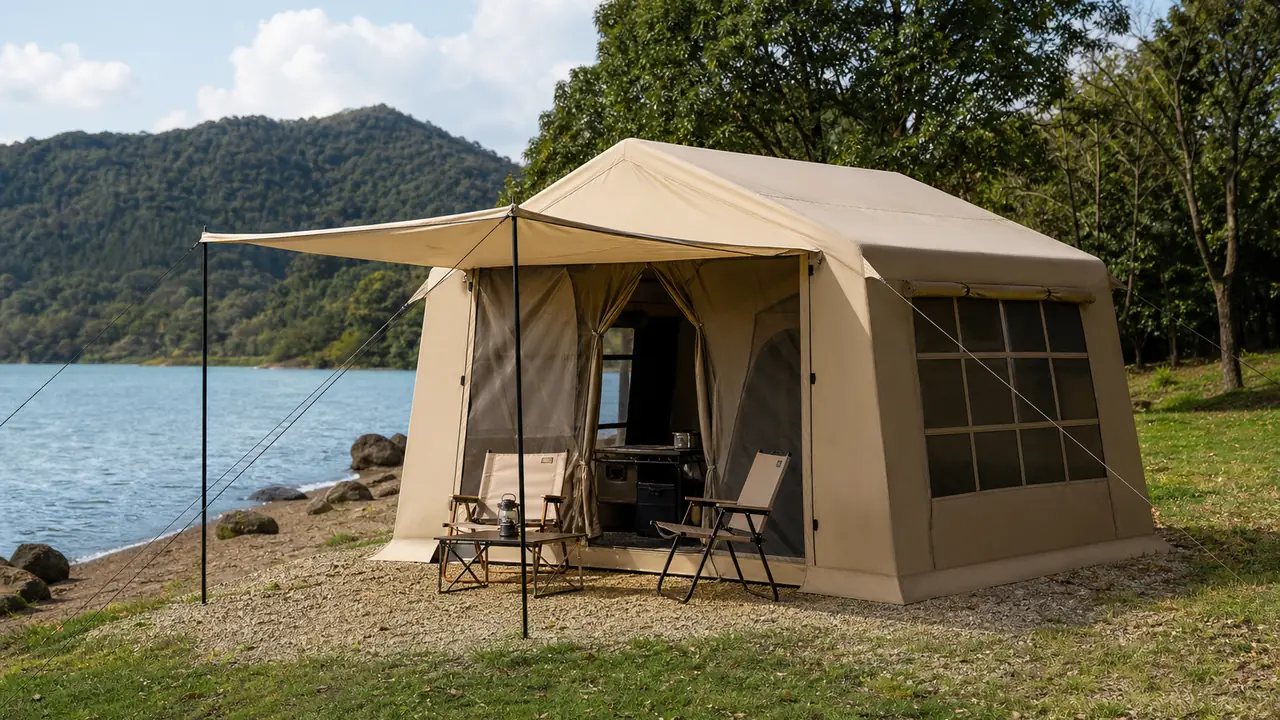
What this line covers
A cabin tent is built for standing up inside. Its poles run close to vertical at the walls instead of curving over a dome, so almost all of the floor is usable at full height. That makes it the tent for families and groups who camp by car, stay several nights and want room for camp beds, a table or a play corner. Most models add a removable divider that turns one space into two or three rooms, plus large mesh windows and two doors.
The reference model on the pitch plate is a ten-person cabin tent from public listings: 427x305 cm on the ground and 218 cm at the centre, about 13 m2 of floor. It uses a 68D polyester fly and walls over a PE floor with steel poles, and is listed at about 14-15 kg. An older version of the listing shows 18 steel stakes in the kit. The weight recorded in your order file is the one measured on your approved sample, because sellers of the same model often list different figures.
Sizes and layouts
Cabin tents scale by floor length and number of rooms rather than by pole geometry. The table shows typical steps across the category; the ten-person row is the reference model.
| Capacity | Typical layout | Typical use |
|---|---|---|
| 6 person | One room, optional divider | Families of four with gear inside |
| 8 person | Two rooms with a divider | Larger families, longer stays |
| 10 person | 427x305x218 cm, two or three rooms (reference) | Groups, multi-family trips |
| 12 person | Three rooms, often a screened porch | Base camps and group bookings |
Person ratings assume sleeping pads side by side with nothing else inside. With camp beds and luggage, families fit noticeably fewer than the rated number in comfort and often choose one size up, and the sizing guide explains how to state capacity on a listing so it matches what buyers find when they pitch it.
Frame: steel or fiberglass
Straight walls put more load on the poles than a dome does, which is why steel uprights are common on the larger models: they keep the walls vertical but add most of the weight. Fiberglass appears on lighter and lower-priced versions, often combined with steel legs. The spec sheet should fix pole material, diameter, wall thickness where stated, and the joint design, because bent uprights and cracked joints are the most common frame complaint in this line. See poles and frames.
Fabric, seams and rain
Many cabin tents use a partial fly over the roof only, with the walls doing double duty as the outer skin. That saves weight and cost but places more demand on wall fabric coating, window flaps and door zips. Hydrostatic head is a fabric test under ISO 811; whether the finished tent stays dry depends on taped seams, covered zips, the window design and how taut the roof is pitched. A flat roof can pool water if the frame sags, so the pitch test in inspection should check roof tension. Listings should say waterproof-rated fabric with the hydrostatic head per test report. See seams and waterproofing.
Anchoring a large tent
Tall, flat walls catch more wind than a dome, so a cabin tent depends on its anchoring kit. The desk does not publish wind speed ratings. Instead the order fixes the number and type of stakes, the guy-out points on the walls and roof, and tensioners, and the manual tells users to stake every point and to strike the tent when strong wind is forecast. Steel stakes are the norm on this line, and upgrading them is cheap compared with the cost of a return.
Reports, packing and ordering
EU buyers test to EN ISO 5912 and apply GPSR labelling with an EU responsible person. US flame resistance requirements for small camping tents vary by state and buyer, so the desk confirms them before testing to CPAI-84 or ASTM F3431; reports are issued to partner factories or your brand per order and verified by the desk. Cabin tents are bulky, so freight is charged by volume and carton size should be fixed early. Existing styles with your logo and colours typically start at 300-500 tents per style, with samples in 7-15 days and bulk in 30-45 days, confirmed in writing. Send your sizes and room layout through the quote form.