
What this line covers
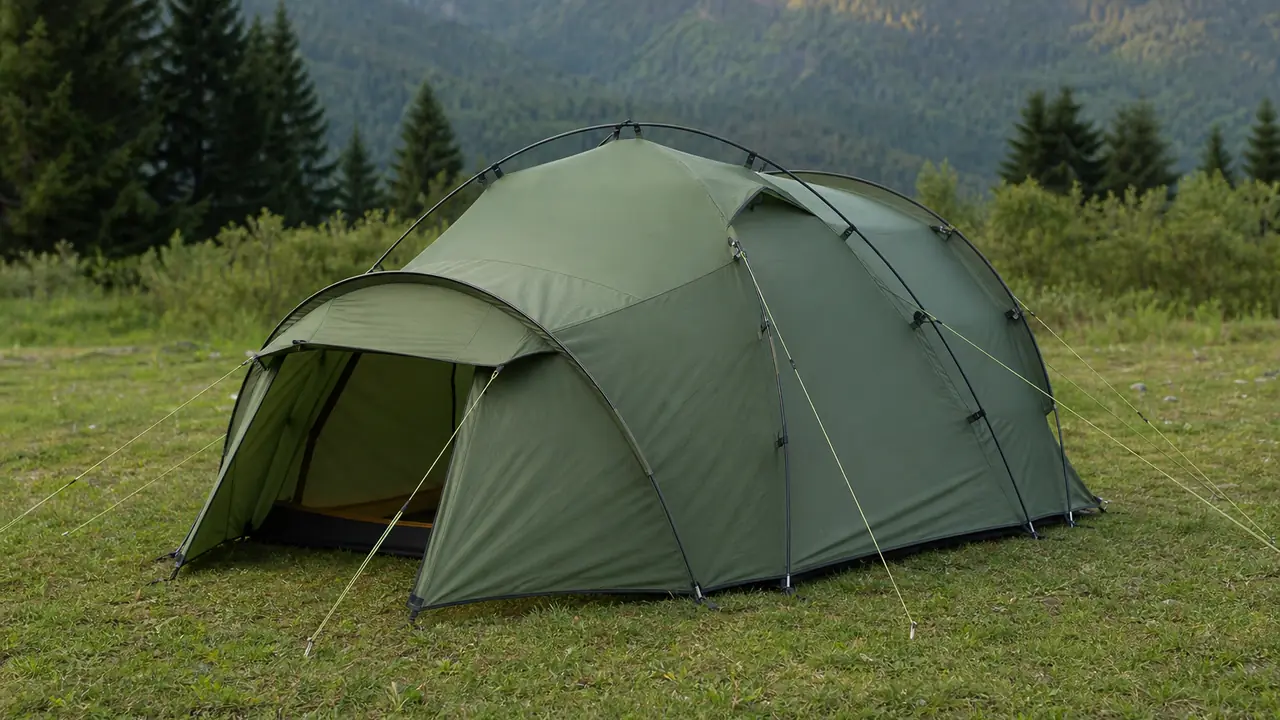
A dome tent is the tent most buyers picture first: two flexible poles cross over a freestanding inner tent, a rainfly goes over the top and a vestibule at the door shelters boots and bags. It pitches on any ground that holds a stake, packs into a short bag and scales from a two-person model to an eight-person family tent by lengthening the poles and widening the floor. That is why dome tents carry the volume in most camping ranges.
The reference model on the pitch plate is a four-person dome from public listings: 274x213 cm on the ground, 150 cm at the peak, about 5.9 m2 of floor. It ships with nine stakes and two guy lines, weighs about 4-4.5 kg depending on the listing, and uses a 68D 190T polyester fly over a PE floor with 8.5 mm fiberglass poles. Weights vary between sellers of the same model, so the order file always records the weight measured on your sample.
Sizes on one structure
Most dome ranges keep one pole geometry and change the floor size. The table shows typical steps across the category; the four-person row is the reference model, the others are ranges seen across listings and factory catalogues.
| Capacity | Typical floor | Typical use |
|---|---|---|
| 2 person | About 210x150 cm | Couples, festivals, entry price point |
| 4 person | 274x213 cm (reference) | Small families, car camping |
| 6 person | About 300x270 cm | Families with gear inside |
| 8 person | About 400x300 cm, often with a second door | Large families and groups |
Person ratings assume sleeping pads side by side with no gear inside. Brands that sell to families usually list one size up, and the sizing guide explains how to state capacity honestly on a listing.
Fabric, coating and what waterproof means
The fly is usually 68D or 75D polyester at 185T to 210T, coated with PU; silicone coatings appear on lighter, more expensive models. The inner is breathable polyester with mesh panels for airflow. Floors are PE on entry models and 150D to 210D oxford polyester on better ones, cut as a tub so the seams sit above ground level.
Fabric water resistance is measured as hydrostatic head under ISO 811 and reported in millimetres. A 1,500 mm or 3,000 mm figure is an industry convention for the fabric, not a promise about the finished tent: seams must be taped, zips covered and the fly pitched taut. Listings should therefore say waterproof-rated fabric with the hydrostatic head per test report, not that the finished tent stays dry in every condition. See seams and waterproofing.
Poles and pitch
Fiberglass poles keep the price down but are heavier and can split when bent too far or used in the cold. 7001-T6 aluminium is the common choice for lighter and more durable models; it costs more and moves the tent up a price tier. Steel appears in larger cabin tents rather than domes. Pole diameter, alloy and the number of sections all belong on the spec sheet, because they drive weight, pack length and failure rate. The poles and frames page compares them.
Anchoring instead of a wind rating
A dome tent sheds wind well when it is staked at every corner and the guy lines are out. The desk does not publish wind speed ratings: there is no common test, and seller claims are not comparable. Instead the order specifies the number and type of stakes, the guy-out points on the fly and the tensioners, and the manual shows the pitch sequence. That is the honest way to describe stability on a listing.
Reports, private label and ordering
For the EU, buyers ask for testing to EN ISO 5912, the camping tent standard, and the GPSR labelling that has applied since December 2024. In the US, flame resistance rules for small camping tents have changed: California dropped its chemical treatment requirement for small synthetic tents from January 2024, and Michigan and Minnesota have also amended theirs, so the desk confirms what each buyer and state needs before testing to CPAI-84 or ASTM F3431. Reports are issued to partner factories or to your brand per order and verified by the desk; the compliance guide lists them.
Existing styles with your logo, colours and carry bag typically start at 300-500 tents per style, with samples in 7-15 days and bulk in 30-45 days, confirmed in writing for each order. Send the sizes, fabric and pole preferences and your market through the quote form.