
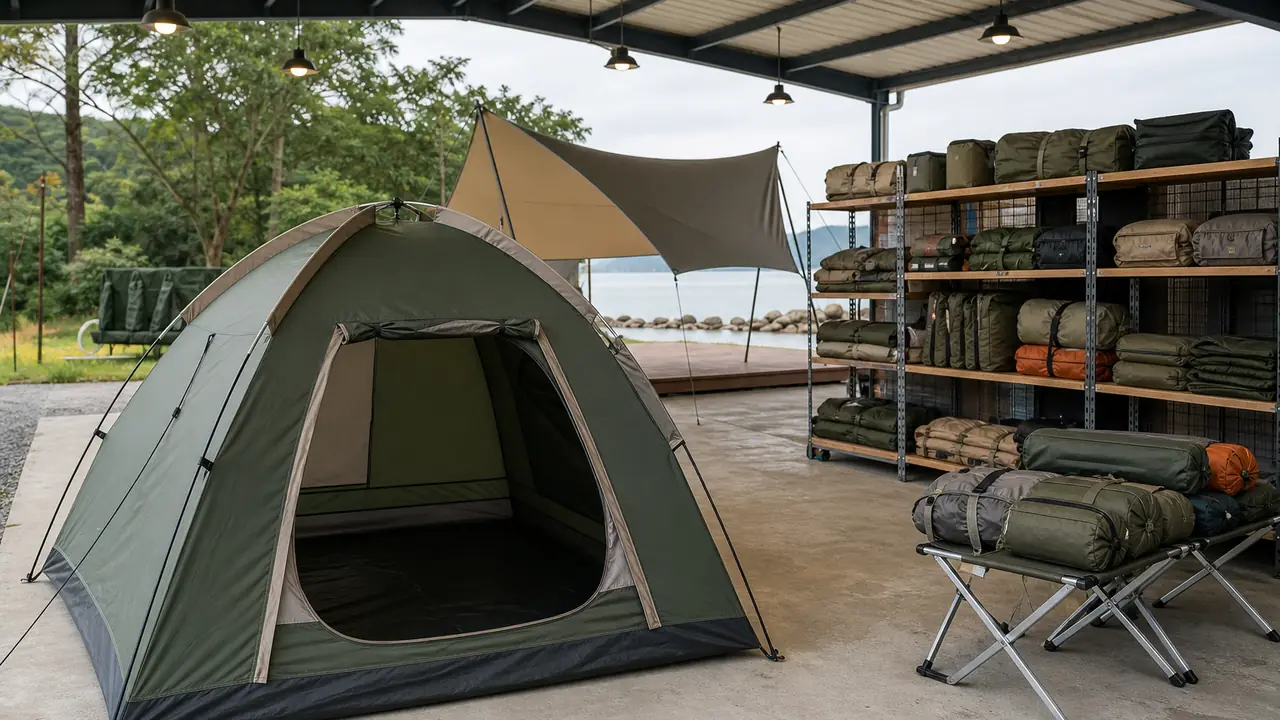
What store buyers need from a tent range
Retailers buy a range, not a product. A camping and beach section needs clear price tiers, packaging that sells without a salesperson, barcodes and labels that work in the store system, and stock that arrives before the display goes up. Retail buyers also need consistency: when two tents from the same range sit next to each other, the claims on the boxes must be measured the same way, or customers compare them unfairly and return the wrong one.
The retail program builds the range on a few shared structures, writes the packaging as part of the specification and times production backwards from the set date for the season.
A good-better-best camping and beach range
The table shows how a typical retail range is built from reference models in the camping and beach lines. Tiers share structures where possible, which keeps manuals, poles and cartons common.
| Tier | Product and reference | Typical upgrade path |
|---|---|---|
| Entry | Dome, 4 person, 274x213x150 cm, fiberglass poles, PE floor | Base fabric, plain bag |
| Middle | Dome, 6 person on the same pole geometry; instant 6 person, 305x274x183 cm | 150D-210D oxford floor, more vents, printed bag |
| Upper | Cabin, 10 person, 427x305x218 cm, about 14-15 kg | Room divider, steel frame, extra stakes |
| Beach | Stretch shade 274x274 cm and pop-up beach tent with sandbags | UV report per AATCC 183, colour series |
Packaging that sells on the shelf
Retail packaging is specified like the tent itself. The printed carton or bag carries the product image pitched, the measured footprint and peak height, capacity with how it was measured, packed weight, the kit contents and the barcode. Claims follow the same rules across the range: waterproof-rated fabric with the hydrostatic head per ISO 811 report, UPF-rated fabric per AATCC 183 report only where one exists, and for beach products a reminder to follow local beach rules. EU packaging carries the GPSR information, including the EU responsible person, which has applied since December 2024. The labels and instructions note lists what to print.
Stores that pitch a tent on the floor as a display need a few extra units per style, and those display tents take more handling than any customer's. The desk can add display units to the order with spare stakes, guy lines and pole sections, so a damaged display is repaired rather than pulled. For US stores, flame resistance requirements for small camping tents changed in several states, including California from January 2024; the desk confirms what your buyers and states ask for before testing to CPAI-84 or ASTM F3431, and reports are issued per order.
Season timing
Camping and beach ranges sell in a spring and summer window. Working backwards from the set date: sea freight of about 15-25 days to the US West Coast or about 30-45 days to Europe, bulk production of 30-45 days, and samples of 7-15 days, plus time for your packaging approval. That usually means range sign-off in autumn and bulk in winter. Factories in the clusters typically concentrate shipments in the first half of the year, so late briefs compete for capacity. The buying calendar sets out the steps.
Quantities and checkpoints
Existing styles with your branding typically start at 300-500 tents per style; new structures are assessed per project; all quantities are confirmed in writing for each order. Inspection covers:
- Pitch test on sampled tents and a water spray check on taped seams.
- Footprint, height and packed weight against the figures printed on the box.
- Barcode scan, label content and carton print against the approved artwork.
- Kit count and manual language versions.
- Carton drop test to ISTA 1A, sampling to ISO 2859-1 at general level II.
Illustrative example
An illustrative, anonymous case: a regional outdoor retailer wants an own-brand camping and beach range for next summer. The desk proposes three dome and instant tents on two structures and a stretch shade, writes one packaging sheet with common claim wording, and plans samples so the range is signed off before bulk. Each style sits within the typical 300-500 per style, and the inspection plan checks box figures against measured tents.
How to start
Send your season, store count or channel, price tiers, packaging requirements and set date through the quote form. The desk replies with a range proposal on shared structures and a timeline.