
Why custom canopies need a full brief
Custom canopy work is one of the most searched corners of the tent trade: in a Semrush export of US keywords taken in October 2026, custom canopy tent alone showed about 2,900 monthly searches, and custom pop up tent about 1,300. Behind that demand sit very different buyers: a beverage brand ordering fifty kits for field marketing teams, a promotional products distributor reselling to dozens of clients, a farmers market vendor ordering one shelter, an event rental company refreshing a fleet. They all ask for the same thing, a canopy with a logo, and they all need different products.
The quickest route to a usable quote is to brief the canopy as a kit. A partner factory prices the frame, the top, the print, the walls, the accessories and the packing separately, so a request that only says 10x10 with our logo leaves most of the cost undecided. The sections below follow the order in which those decisions are usually made.
Step one: size and frame grade
The commercial reference is a 10x10 ft pop-up canopy: 300x300 cm on the ground, about 330 cm to the peak, about 9.3 m2 of shade. The category also covers 10x15 and 10x20 ft footprints on the same family of frames. Frame grade matters more than size for a branded program, because a canopy that bends or rusts in its second season carries the logo with it.
| Grade | Leg profile | Typical buyer | Notes |
|---|---|---|---|
| Consumer | Steel square tube | Occasional backyard and retail use | Heavier, prone to rust once the coating is damaged |
| Commercial | 40 mm hex aluminium, wall about 1.1-1.2 mm | Brands, market vendors, promo programs | The common reference for printed kits |
| Heavy duty | 50 mm hex aluminium | Rental fleets, frequent set-up crews | Stiffer, heavier, higher cost per kit |
The reference 10x10 commercial kit weighs about 20-24 kg, with the frame alone at about 16 kg. The frame grades note explains how leg profile and wall thickness change stiffness and weight.
Step two: top fabric and print method
Printed tops on commercial kits are usually 600D polyester oxford with a PU coating. Two print methods cover almost every order:
- Dye-sublimation prints full colour edge to edge: photographs, gradients, a background colour across all four valances. The ink is transferred into the polyester fibre, so it suits artwork that covers the whole panel.
- Screen print lays a single-colour logo onto a stock-colour top. It suits simple marks on a plain canopy and is often used where the brand colour is a standard fabric shade.
Mixed programs are common: a stock-colour top with a screen-printed logo for the field team, and full dye-sublimation kits for flagship events. The print method comparison covers colour, durability and setup trade-offs in more detail.
Step three: walls, flags and accessories
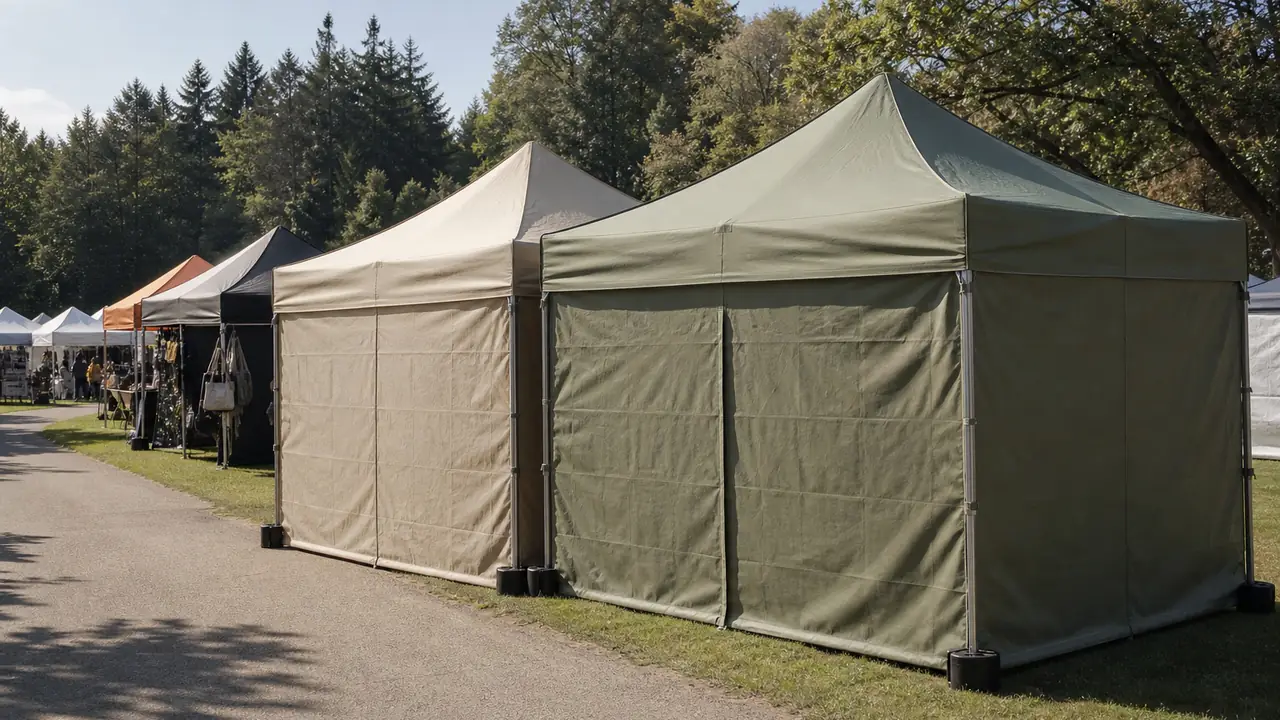
Walls change the canopy from a sunshade into a booth. A reference printed 10x10 kit from public listings includes the top, a back wall of 301x217 cm, two half walls of 301x91 cm and two 11 ft flags. Full side walls, walls with zipped doors or windows, table covers and banners are options. With walls and flags, the reference kit range moves to roughly 23-31 kg depending on configuration, so the kit list needs to be fixed before cartons are designed.
Each wall is a separate print file and a separate panel to inspect. A useful rule is to brief the minimum kit the end user really sets up, and offer extra walls as add-ons, rather than shipping every option in every carton. See canopy sidewalls and accessories.
Step four: anchoring and honest stability claims
A pop-up canopy has no floor and a large roof area, which makes it behave like a sail. The desk does not quote wind speed ratings for any canopy, because there is no common test and the figures sellers use are not comparable. Instead, each kit ships with an anchoring plan: one stake and one guy line per leg for soft ground, and leg weights for paved surfaces, where about 40 lb (18 kg) per leg is the industry convention, not a legal requirement. Instructions should tell users to take the canopy down in strong wind. That plan belongs on the spec sheet and in the manual; see anchoring and wind.
Step five: fire and UV documents
Many event venues and local fire authorities ask for flame-resistant fabric, often tested to NFPA 701 or registered with the California State Fire Marshal (CSFM) under Title 19. Some buyers specify CPAI-84. Passing one test does not mean passing another, so the desk confirms which report the buyer's venues ask for before the fabric lot is ordered. Reports are issued to the partner factory or to the brand per order and verified by the desk; the final decision sits with the local fire authority. UV figures are stated only per test report, to AATCC 183 for the US or AS 4174 for Australia and New Zealand. The flame and UV standards page summarises the options.
Step six: quantity, timing and approval
Ten by ten canopies and printed kits typically start at 20-50 sets per style, confirmed in writing for each order. A style here means one frame grade, one size and one artwork set; a change of artwork usually counts as a new style. The usual sequence is:
- Brief: size, frame grade, kit list, print method, market and documents.
- Artwork on the factory template, with a colour proof for approval.
- Sample or first-article print, typically within 7-15 days.
- Bulk production, typically 30-45 days, or 45-60 days for custom builds.
- Pre-shipment inspection: pitch test, print colour against the approved proof, accessory count and carton marks.
The reference 10x10 kit packs into an outer carton of about 158x27x27 cm, and canopies ship by volume, so carton size drives freight. Production for canopies and gazebos concentrates in Linhai in Taizhou, a cluster of more than 1,000 outdoor leisure firms (Zhejiang Online, 2025), which the desk draws on for printed programs. Quantities and timing are set out on MOQ and lead time; when the kit list is ready, send it through the quote form.