
Accessories by job
Every accessory on a canopy does one of four jobs: it creates shelter, it carries a brand, it holds the canopy down, or it protects the kit in transport. Thinking in those terms helps a buyer build a kit that suits its end users, rather than a catalogue of options that pushes up carton size and cost without being used. The commercial reference behind this note is a 10x10 ft pop-up canopy, 300x300 cm on the ground, about 330 cm to the peak, with 40 mm hex aluminium legs and a 600D PU-coated polyester top.
Walls
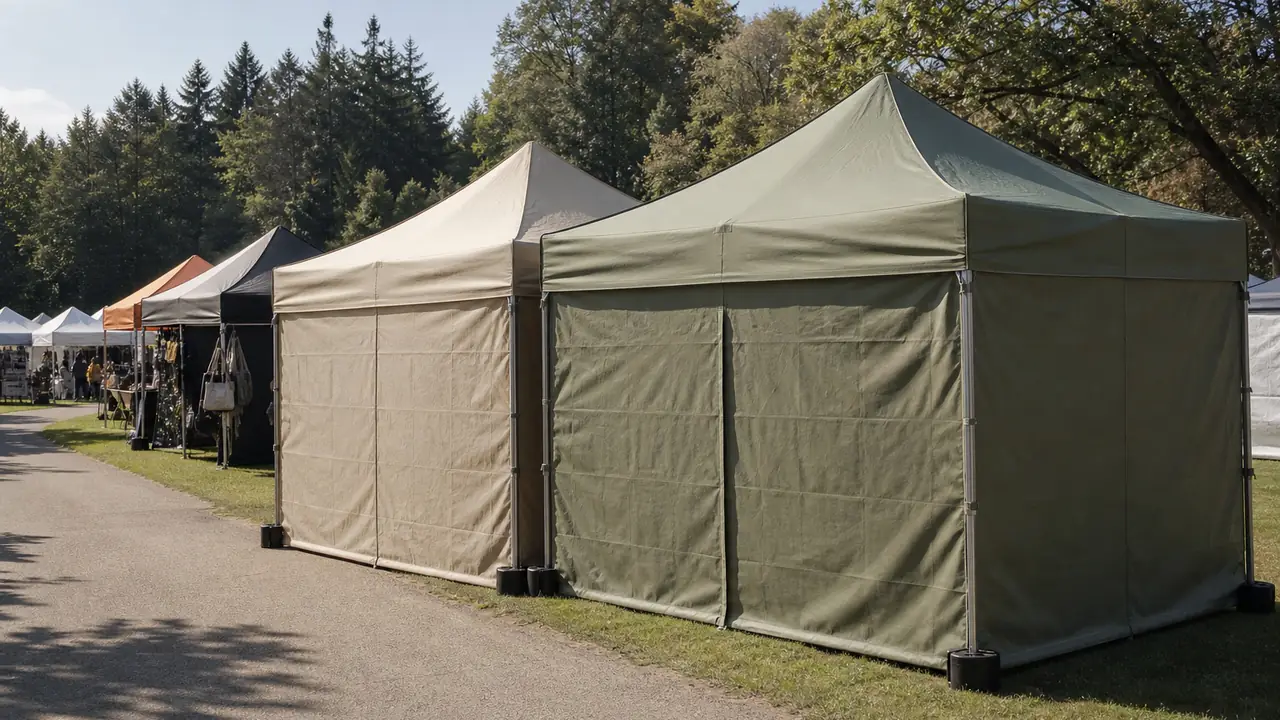
Walls hang from the frame, usually by hook-and-loop strips along the truss and ties or clips at the legs. A reference printed 10x10 kit from public listings includes a back wall of 301x217 cm and two half walls of 301x91 cm. The main types are:
| Wall type | What it does | Typical buyer |
|---|---|---|
| Back wall, full height | Blocks sun and wind behind, carries the main brand panel | Trade show exhibitors, market vendors |
| Half wall | Separates the stall from neighbours at table height | Trade shows, markets |
| Full side wall | Encloses one side for shade and weather | Vendors, event rental |
| Door wall with zip | Encloses the front, allows access | Events, overnight storage at markets |
| Window wall | Light and view with the wall in place | Hospitality, event rental |
| Mesh wall | Airflow and partial shade | Produce stalls, warm climates |
Walls need the same care on the spec sheet as the top. State the fabric and whether it matches the top, the attachment method, the zip type on door walls, and whether walls are printed. If walls must be flame resistant for a venue, the report has to cover the wall fabric as well as the top.
Fit is the other common problem. Walls are cut to a specific frame, and a wall made for one supplier's 10x10 can hang short or loose on another's because truss height, leg spacing and attachment points differ. Buyers adding walls to an existing fleet should send the frame details or a sample frame, and should order walls for new frames at the same time as the frames. Wall zips and fasteners also wear faster than the fabric, so a few spare zipped door walls in a fleet go a long way.
Walls change how a canopy behaves
A canopy with four walls attached catches far more wind than an open frame. That is not a reason to avoid walls, but it is a reason to match the anchoring to the configuration. The desk does not quote wind ratings for canopies with or without walls. The reference anchoring is one stake and one guy line per leg on soft ground, and about 40 lb (18 kg) of weight per leg on hard surfaces as an industry convention. Instructions should say to remove walls or take the canopy down in strong wind. See anchoring and wind.
Flags, banners and table covers
Branding accessories make a stall visible above a crowd and frame the brand at eye level. The reference printed kit includes two 11 ft flags; banners, table covers and leg banners are common options.
- Flags: feather or teardrop shapes on a pole with a ground spike or a weighted base. Check that the base suits the surface; a spike does not work on asphalt.
- Banners: printed panels fixed to the front truss or between legs, useful when the top is plain.
- Table covers: fitted or throw covers printed to match the walls, sized to the vendor's standard table.
- Leg banners or sleeves: printed fabric covering each leg, used on premium booth kits.
Each printed accessory is another artwork file and another colour to match. The artwork files note covers templates and proofs; keep colour references consistent across top, walls and flags.
Anchoring accessories
Anchoring accessories are the ones end users most often forget and most need. A complete anchoring kit for a 10x10 covers four legs:
- Stakes and guy lines, one per leg, for grass and soil.
- Weight bags, fillable with sand or gravel, strapped to each leg.
- Steel or cast weight plates that sit under or around the foot.
- Water weights where the venue allows them.
Fillable bags ship light and are filled locally; plates are compact but heavy to ship. For markets and trade shows on hard surfaces, weights should be treated as part of the kit rather than an optional extra. See canopy weights per leg.
Bags, cases and packing
The reference 10x10 kit ships in an outer carton of about 158x27x27 cm and weighs about 20-24 kg; with a back wall, two half walls and two flags, reference kits run at roughly 23-31 kg depending on configuration. A wheeled bag for the frame is the most requested transport accessory, followed by separate bags for the top and walls so prints are not rubbed by the frame. Every extra accessory changes the carton or adds a second one, and canopies ship by volume, so the kit list should be fixed before carton sizes are confirmed.
Building kits for different channels
| Channel | Core kit | Add-ons |
|---|---|---|
| Trade show program | Printed top, back wall, two half walls, two flags, wheeled bag, weights | Table cover, leg banners |
| Market vendor range | Plain top, back wall, one side wall, weight bags, wheeled bag | Door wall, mesh wall, valance print |
| Event rental fleet | Plain top, plain walls in sets, weights | Window walls, client banners |
| Promotional distributor | Printed top, wheeled bag | Back wall, flags, table cover |
Fixing the core kit per channel keeps quotes comparable and inspection simple: the accessory count on the packing list is one of the standard pre-shipment checks.
Quantities and ordering
Ten by ten canopies and printed kits typically start at 20-50 sets per style, confirmed in writing for each order. Accessories ordered with the kit follow the kit quantity; separate accessory orders, such as extra walls for an existing fleet, are quoted per item and fabric lot. Samples typically take 7-15 days and bulk 30-45 days, or 45-60 days for custom builds. See custom printed canopies and MOQ and lead time, then send the kit list through the quote form.