
Two ways to hold up a roof
A pole tent works like a large bell tent stretched into a rectangle. Centre poles push the cover up, side poles hold the edges, and the whole cover is tensioned by ropes and stakes around the perimeter. Without the stakes, the tent cannot stand. A frame tent works like a building: a rigid frame of uprights, rafters and purlins stands on its own, and the cover is laced or tensioned onto it. Frame tents still need anchoring, but the structure does not depend on staking to stand.
Both families appear on the party and event tents line, and both are made by partner factories in the event tent regions around Changzhou, Zhuhai and Shanghai, which also build aluminium frame structures and larger marquees.
Pole tents
The pole tent reference is a 20x40 ft tent, 1219x610 cm on the ground with a 452 cm peak and about 74 m2 under cover, holding about 144-160 standing guests. It uses a 16 oz PVC vinyl cover and is staked with 16 steel stakes of 3/4 x 30 in. The peaked roof sheds rain well and gives the tent its traditional look, which is why pole tents remain popular for weddings and garden events.
The trade-offs follow from the structure. Centre poles stand inside the tent, which constrains table layouts and dance floors. The guy ropes and stakes extend beyond the footprint, so the site needs clear ground around the tent. And because stakes are essential, pole tents need soft ground that will hold them: lawns and fields, not car parks, patios or ground with buried services. Set-up is mostly ground work: laying out the cover, raising the poles in sequence and tensioning the ropes evenly.
Frame tents
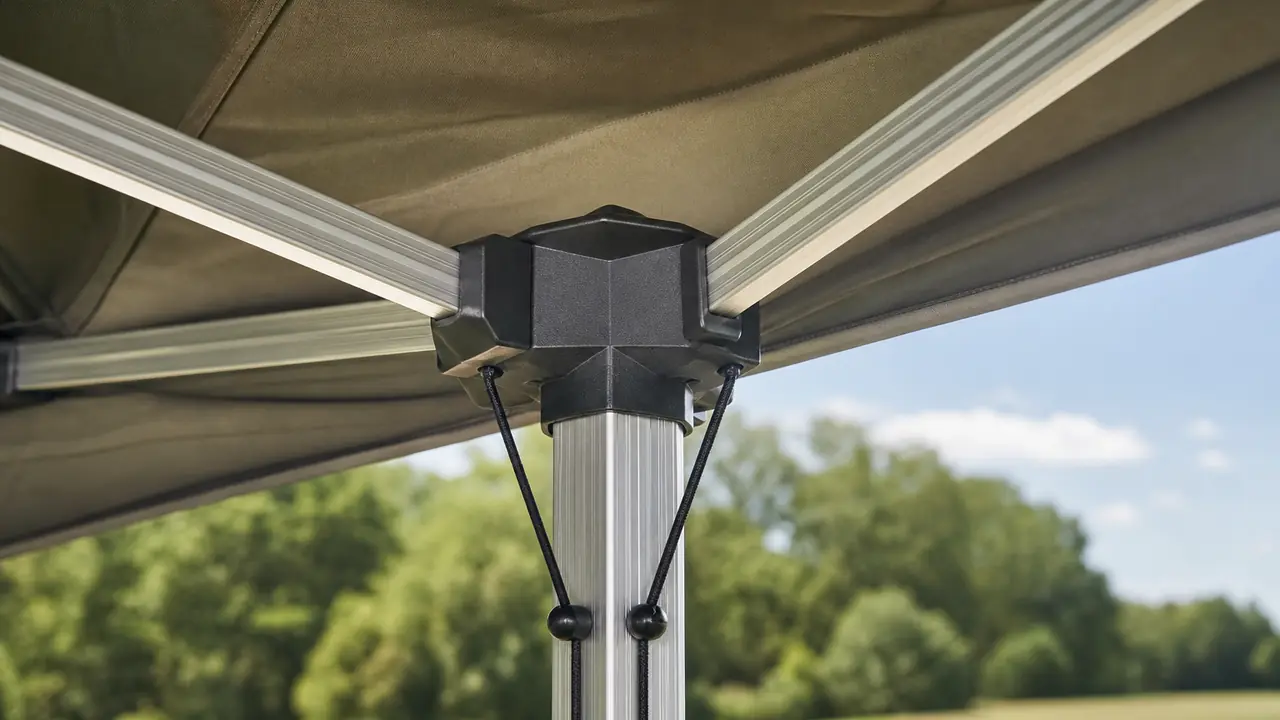
The frame tent reference is a 6x12 m structure with a 2.6 m side height and a 3.7 m ridge, a 550 g/m2 PVC cover and a frame of 50 mm galvanised steel tube, a common tier in Europe. Aluminium frame systems are used for larger and more permanent-looking structures. The interior is clear of centre poles, so the floor plan is free, and the frame can stand on hard surfaces when it is weighted or bolted down instead of staked.
Frame tents take more parts and more assembly: the frame is built first, often with a crew working at height on the roof members, then the cover goes on. They are heavier to transport and have more fittings to count and maintain. In exchange, they can be placed on paved squares, decks and courtyards, and they connect side by side into longer runs.
The two side by side
| Factor | Pole tent | Frame tent |
|---|---|---|
| Reference model | 20x40 ft, 1219x610x452 cm, about 74 m2 | 6x12 m, 2.6 m sides, 3.7 m ridge |
| Cover | 16 oz PVC vinyl | 550 g/m2 PVC |
| Structure | Centre and side poles, tensioned by ropes | 50 mm galvanised steel tube frame |
| Anchoring | 16 steel stakes, 3/4 x 30 in | Stakes, weights or bolts by surface |
| Interior | Centre poles inside | Clear span |
| Ground | Soft ground that holds stakes | Soft or hard surfaces |
| Set-up | Fewer parts, ground-based tensioning | More parts, frame assembly at height |
Weights for event tents vary so much between channel listings for the same size that the desk does not quote a single figure; the shipping weight comes from the supplier's packing list for the exact configuration.
Covers and fire rules
Commercial party tent covers are typically PVC in the 500-650 gsm range. Event tents fall under fire rules that small camping tents do not. In the US, many jurisdictions expect flame-resistant fabric tested to NFPA 701 per report, or California CSFM registration, and the International Fire Code generally requires a permit for tents above 400 sq ft, with state and local versions differing. In the EU, temporary tents above 50 m2 fall under EN 13782, and in the UK marquee fabrics are often asked to meet BS 7837. Both reference models exceed these area thresholds. The local fire authority decides what applies to each event, so confirm with your local fire authority before ordering; see NFPA 701 for event tents and tent permits and fire codes.
Anchoring and weather
A pole tent's anchoring is its structure, so stake count, stake length and rope tension are non-negotiable and belong in the set-up manual. A frame tent's anchoring depends on the surface: stakes on grass, ballast or bolts on hard ground, sized by the supplier and the event's engineer or rental company. Neither family gets a wind rating from the desk. Events should have a weather plan, including the point at which guests are moved and the tent is taken down. The anchoring and wind page sets out what to specify.
Inspection and spares
Event tents are inspected as kits, not as single products. For a pole tent, the desk checks cover dimensions and welds, grommets and webbing at the pole and rope points, pole lengths and caps, rope lengths and the stake count against the packing list. For a frame tent, it checks tube diameter and galvanising, connector fit, the count of every upright, rafter, purlin and fitting, and the cover lacing points. Where possible a sampled tent is pitched in full. Rental fleets should order spare poles, fittings, stakes and cover repair material with the first order, because event tents are model-specific and a missing connector can stop a set-up on the day.
Choosing for a fleet
- Garden weddings and lawn events: pole tents for the look and simpler transport, where the site holds stakes.
- Paved venues, festivals and corporate events: frame tents for clear spans and hard surfaces.
- Mixed rental fleets: both, with shared cover colours, spare poles, frame fittings and stakes ordered alongside.
Party tent orders are assessed per project because size, frame, cover and fire report vary widely; every quantity and lead time is confirmed in writing. See event rental and projects and MOQ and lead time, or send the brief through the quote form.