
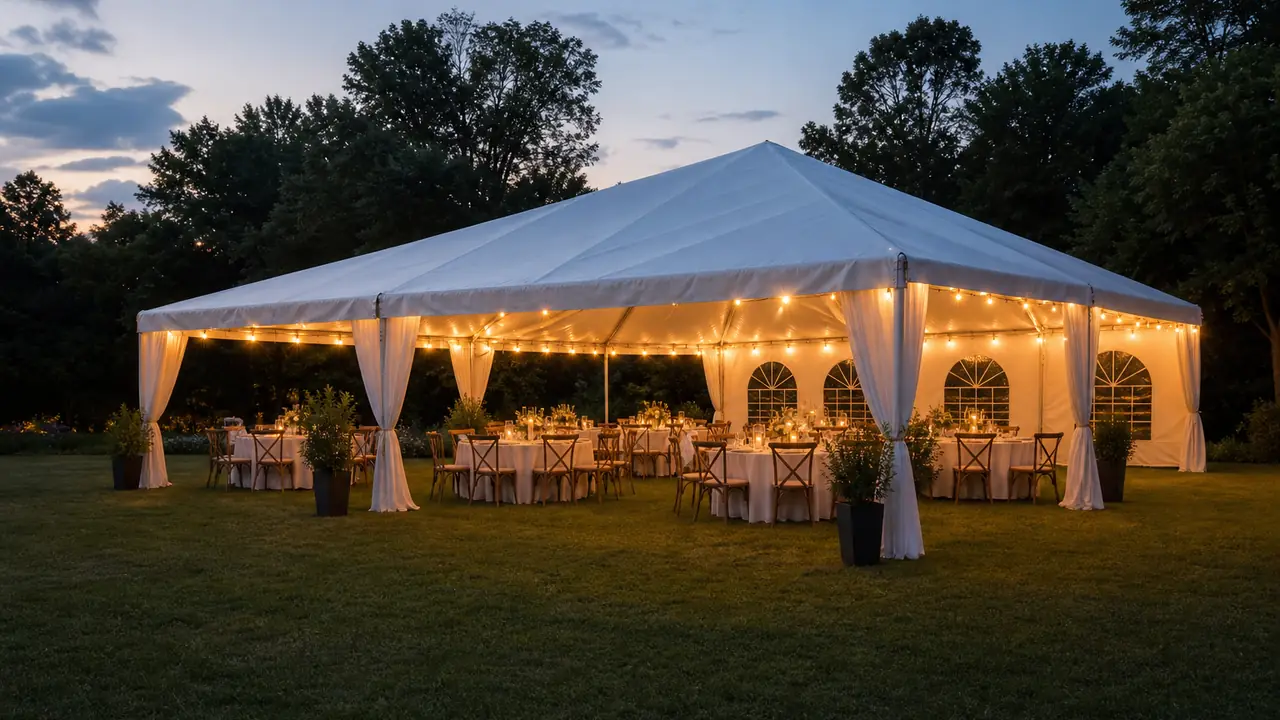
What an event tent has to survive
A wedding marquee or event tent stands for one to several days with guests underneath: tables, a dance floor, lighting, catering and sometimes heaters. It has to shed rain off a wide roof without pooling, stay tensioned through changing weather, pass a fire inspection before the doors open and look clean in every photo. A rental fleet then takes it down, packs it wet or dry, trucks it to the next site and pitches it again, often dozens of times a season. Covers get scuffed on asphalt, walls get grease marks, stakes bend and frame parts go missing.
For rental companies and planners the questions are whether the tent passes inspection, how many guests it holds, how fast a crew can pitch it and how long the covers last before they need replacing.
Recommended lines and reference specs
| Line | Reference model | Cover and frame | Anchoring |
|---|---|---|---|
| Pole tent | 20x40 ft, 1219x610x452 cm, about 74 m2, about 144-160 standing guests | 16 oz PVC vinyl, centre and side poles | 16 steel stakes, 3/4x30 in |
| Frame tent | 6x12 m, side height 2.6 m, ridge 3.7 m | 550 g/m2 PVC, 50 mm galvanised steel tube | Stakes or ballast, per site |
| Bell tent | 5 m diameter, 300 cm centre pole, 60 cm walls, about 35 kg | 285 gsm cotton canvas, 540 gsm PVC tub floor, 31 mm steel pole | 12 guy lines and about 24 stakes, about 7 m footprint fully guyed |
Pole tents are lighter to truck and pitch, but need stakes driven into soft ground and an open floor. Frame tents stand without centre poles and can go on hard surfaces with ballast, which suits venues and paved sites. Bell tents serve as lounges, kids areas and guest accommodation at weddings and festivals. Weights for large party tents vary between channels, so the desk records them per configuration rather than quoting a single figure.
Anchoring and site
A large tent catches a great deal of wind, so the anchoring plan is part of the order: stake size and count, ballast per leg or per upright where stakes cannot be used, tie-down points and the pitch and tensioning sequence. The desk does not give wind ratings. Rental contracts and the manual should state that the operator monitors weather and clears the tent when conditions require it. Local rules may set minimum anchoring; confirm with the authority having jurisdiction.
Fire codes, permits and reports
Event tent covers are typically tested to NFPA 701 or registered with the California State Fire Marshal under Title 19, and the label stays on the cover. CPAI-84 results do not equal NFPA 701 results. Under the International Fire Code, tents over about 400 sq ft generally need a permit from the fire authority, though state and local versions differ, and the authority having jurisdiction decides what it accepts. In the EU, temporary tents over 50 m2 fall under EN 13782; in the UK, marquee fabrics are often asked to meet BS 7837. Reports are issued to the partner factory or to your brand per order and verified by the desk; confirm the permit route with your local fire authority. See the compliance guide.
Where these tents come from
PVC party tents and aluminium or steel frame structures come mainly from partner factories in Changzhou, Zhuhai and Shanghai; bell tents come from canvas specialists in the camping clusters. The desk shortlists by structure type and size, and the inspection plan covers a full pitch of a sample unit, cover weld and seam checks, frame dimensions and galvanising, and the fire label.
How to brief an event program
Send the structure type, sizes, guest counts and layouts you plan for, cover colour and fabric weight, wall and window options, the fire test your authorities accept, the markets you rent in, and spares. Party tent orders are assessed per project by size and configuration rather than a fixed MOQ; samples of fabric and fittings take 7-15 days and bulk 30-45 days, or 45-60 days custom, confirmed in writing for each order. Start from the quote form or the event rental page.