
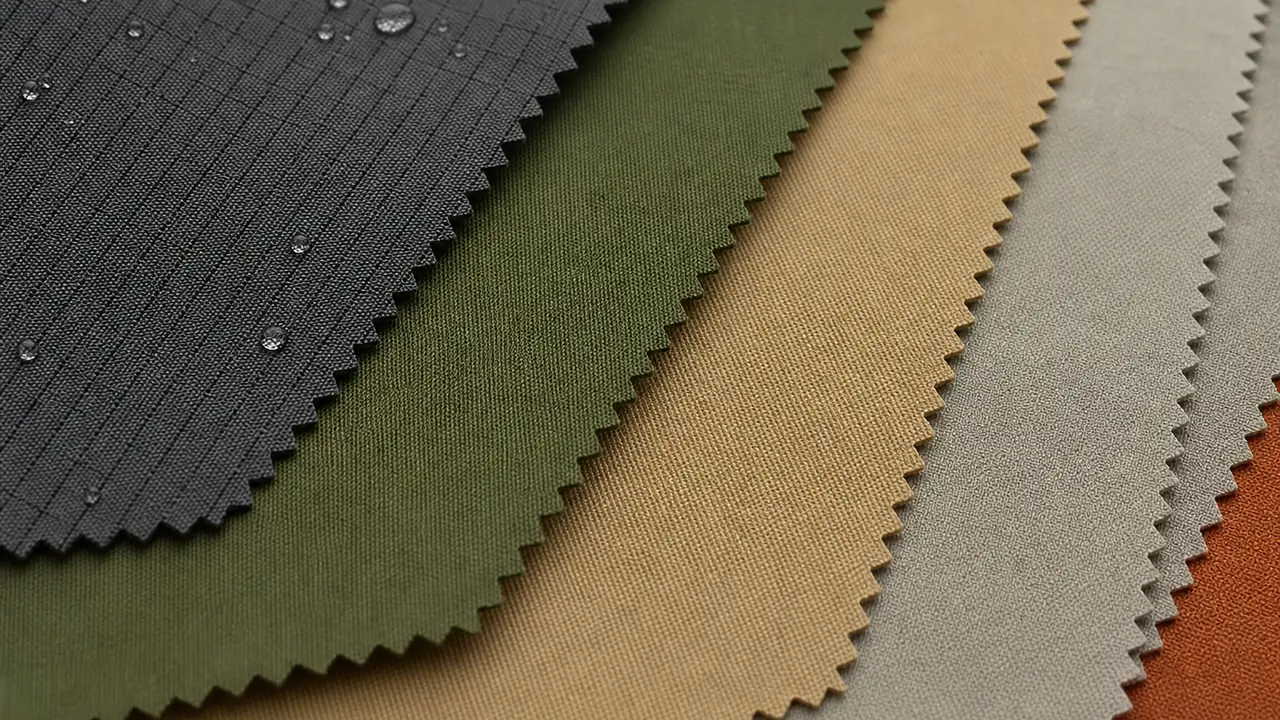
The five fabric groups
Almost every product in the range uses one of five fabric groups. Each has a place where it works and a place where it is the wrong choice.
- Polyester taffeta. The standard fly and body fabric for dome, cabin, instant and beach tents. It stretches little when wet, holds colour well under sun and takes PU coating easily. Typical flies are 68D or 75D at 185T to 210T.
- Nylon ripstop. Used where weight matters, mainly backpacking tents. Nylon is stronger for its weight than polyester but stretches when wet, so the pitch needs retensioning. A grid of heavier yarns stops small tears from running. Typical weights are 20D to 40D.
- Oxford polyester. A heavier basket-weave polyester. At 150D to 210D it becomes a tent floor; at 600D it becomes a commercial canopy top or a rooftop tent body that takes daily handling and printing.
- Canvas and polycotton. Cotton or cotton-polyester blends at 285 to 360 gsm, used for bell and glamping tents. Canvas breathes, so condensation is lower, but it is heavy, slow to dry and has to be dried before storage to avoid mildew.
- PVC and PE. Coated or laminated sheet materials. PVC vinyl at 500 to 650 gsm is the cover of party and event tents and the groundsheet of bell tents; woven PE is the low-cost floor of entry camping tents.
Denier, thread count and gsm
Denier (D) is the weight of the yarn: the mass in grams of 9,000 metres of a single yarn. A 20D yarn is finer and lighter than a 75D yarn, and a 600D yarn is heavy. Denier says nothing on its own about how tight the weave is. Thread count (T) is the number of yarns per square inch in warp and weft together, so 190T is a common mid-density taffeta and 210T is denser. A fabric is described by both, for example 68D 190T polyester.
Canvas and PVC are usually described by gsm, grams per square metre, because the yarn figure is less useful for them. The party tent reference model uses 16 oz PVC vinyl and a European frame tent reference uses 550 g/m2 PVC. The denier note works through more examples.
Fabrics by weight and use
| Fabric | Typical weight | Main use | Watch points |
|---|---|---|---|
| Nylon ripstop, silicone or PU coated | 20D-40D | Backpacking flies and inners | Stretch when wet; seam taping on silicone |
| Polyester taffeta, PU coated | 68D-75D, 185T-210T | Dome, cabin and instant tent flies | Coating weight, seam taping |
| Polyester, heavier | 150D | Instant tent bodies | Pack weight |
| Silver-coated polyester | 190T | Pop-up beach and shower tents | UV claims only per AATCC 183 or AS 4174 report |
| Oxford polyester | 150D-210D | Tent floors | Coating, tub height |
| Oxford polyester, PU coated | 600D | Canopy tops, printed kits, rooftop tents | Print fastness, flame report for events |
| Cotton or polycotton canvas | 285-360 gsm | Bell and glamping tents | Weight, drying, mildew |
| PVC vinyl | 500-650 gsm | Party tent covers, bell tent groundsheets | NFPA 701 report, weld quality |
| Woven PE | Per spec sheet | Entry tent floors | Abrasion, welded corners |
PU vs silicone coatings
A coating turns a woven fabric into a waterproof-rated one. PU (polyurethane) is the default on polyester and on floors: it is cheap, it bonds well with seam tape, so seams can be heat-sealed, and it can reach high hydrostatic head figures. Its weakness is age: PU coatings break down with heat and humidity over years, especially when a tent is stored wet. Silicone is used on nylon ripstop: it soaks into the yarn, adds tear strength and sheds water well, but standard seam tape does not stick to it, so silicone-coated tents are usually seam-sealed by hand. Many light fabrics are silicone on the outside and PU on the inside, which allows taping.
Water-repellent finishes (DWR) on the face are a separate layer. Where a market asks for it, the desk specifies a fluorine-free DWR option, verified by test report; see the compliance guide for what is known about PFAS rules.
Hydrostatic head and ISO 811
Hydrostatic head is the height of a water column, in millimetres, that a fabric sample resists before water passes through, tested under ISO 811. Figures of 1,500 mm and 3,000 mm are industry conventions for describing tent fabric, not legal thresholds. A high figure on the fabric does not make the finished tent waterproof: water gets in through untaped seams, uncovered zips, floor corners and a slack pitch. That is why listings should say waterproof-rated fabric with the hydrostatic head per ISO 811 test report, and why inspection adds a water spray check on taped seams. The seams and waterproofing page covers the build side.
Choosing a fabric for a brief
Start from the use and the price point, then fix the numbers. A family dome usually lands on 68D or 75D PU polyester with a 150D-210D oxford floor; a lightweight tent on 20D-40D nylon ripstop; a commercial canopy on 600D polyester; a glamping tent on canvas; a party tent on PVC. Ask for fabric swatches and colour cards before the sample, and for test reports on the actual fabric lot. Typical quantities for existing styles in a new colour are 300-500 tents per style, confirmed in writing; see MOQ and lead time or send your fabric brief through the quote form.