
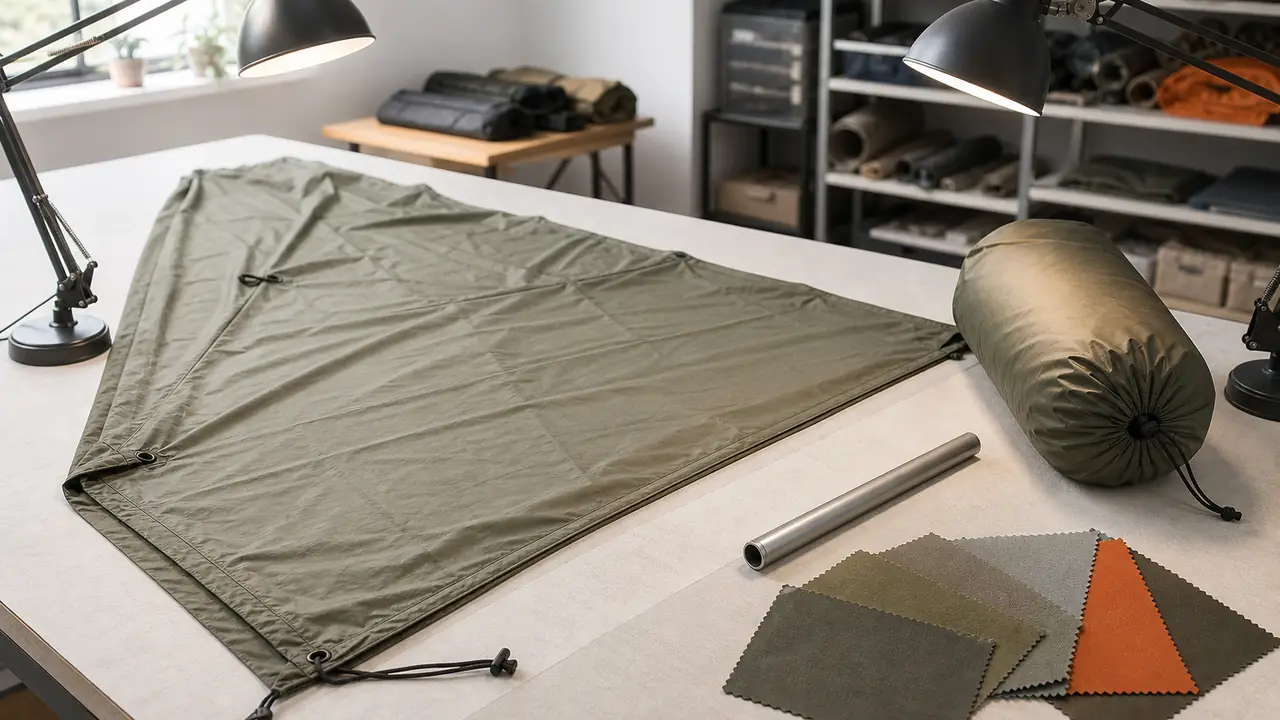
What brand owners usually struggle with
Brand owners rarely struggle to find a tent. They struggle to make a tent that is recognisably theirs and stays the same from one season to the next. Three problems come up again and again. The first is a range that looks like everyone else's because it is a catalogue model with a new logo, so the brand competes on price from day one. The second is a test file that does not match the product: reports that belong to a different fabric lot, a different factory or a different market. The third is packaging that drifts between orders, with bag colours, label positions and carton prints changing because nobody wrote them down.
The brand owner program addresses all three. The desk starts from a reference structure that already works, changes the parts a brand can own, fixes those choices in a spec sheet and golden sample, and arranges the reports for that exact build.
Recommended lines and reference specs
Most brand ranges are built on three lines. Dome tents carry the volume, backpacking tents carry the technical image and bell tents carry the premium and glamping end. The figures below are reference models from public listings and factory catalogues; weights are ranges and the order file records the weight measured on your sample.
| Line | Reference model | Typical fabric and frame | What a brand usually owns |
|---|---|---|---|
| Dome | 4 person, 274x213x150 cm, about 4-4.5 kg | 68D 190T polyester fly, PE floor, 8.5 mm fiberglass poles | Fly colour, floor grade, pole upgrade to 7001 aluminium, bag |
| Backpacking | 2 person, 210x185x100 cm, about 1.7-1.8 kg | 20D siliconised nylon, 7001 aluminium poles | Fabric weight, colour, vestibule layout, stated weight |
| Bell | 5 m diameter, 300 cm centre pole, about 35 kg | 285 gsm cotton canvas, 540 gsm PVC floor, steel pole | Canvas weight within 285-360 gsm, stove jack, doors, bag |
Keeping one structure per line and changing only size and finish keeps poles, manuals and cartons shared across the range, which lowers development cost when the brand later moves to its own geometry.
Quantities and development path
An existing style with your fabric colours, logo and carry bag typically starts at 300-500 tents per style. A new structure, new tooling or a new fabric is assessed per project, because it adds sampling rounds and testing. Samples usually take 7-15 days; bulk takes 30-45 days and custom builds 45-60 days. All quantities and dates are confirmed in writing for each order. The OEM and private label page explains who owns which part of the design.
Reports in the brand file
A brand file usually holds a hydrostatic head report on the actual fly and floor fabric to ISO 811, testing to EN ISO 5912 for EU sales, GPSR labelling with an EU responsible person since December 2024, and flame resistance to CPAI-84 or ASTM F3431 where a buyer or US state still requires it. Several states, including California from January 2024, have changed their rules for small camping tents, so the desk confirms each requirement before testing. Reports are issued to the partner factory or to your brand per order and verified by the desk; for legal conclusions, confirm with your test lab.
Checkpoints before shipment
- Pitch test on sampled tents against the golden sample: footprint, peak height, pole fit.
- Water spray check on taped seams, because a waterproof-rated fabric with untaped seams still leaks.
- Fabric denier and weight, coating, colour against the approved swatch.
- Zips, sliders, guy-out points, stake count against the kit list.
- Bag, label positions, carton print and barcodes against the packaging sheet.
- Carton drop test to ISTA 1A, sampling to ISO 2859-1 at general level II.
Illustrative example
An illustrative, anonymous case: a European outdoor brand wants a family range in its own colours. The desk proposes the four-person dome as the base, adds a six-person size on the same pole geometry, upgrades the poles to 7001 aluminium for the top model and writes one spec per size. The brand approves a golden sample of each, the partner factory arranges EN ISO 5912 and ISO 811 reports for the fabric lot, and the first order sits within the typical 300-500 tents per style. The next season starts from the same file.
How to start
Send the lines you want to own, target markets, colour references, quantities per style and your launch window through the quote form. The desk replies with a shortlist of partner factories, a sample plan and the report list for your markets.