
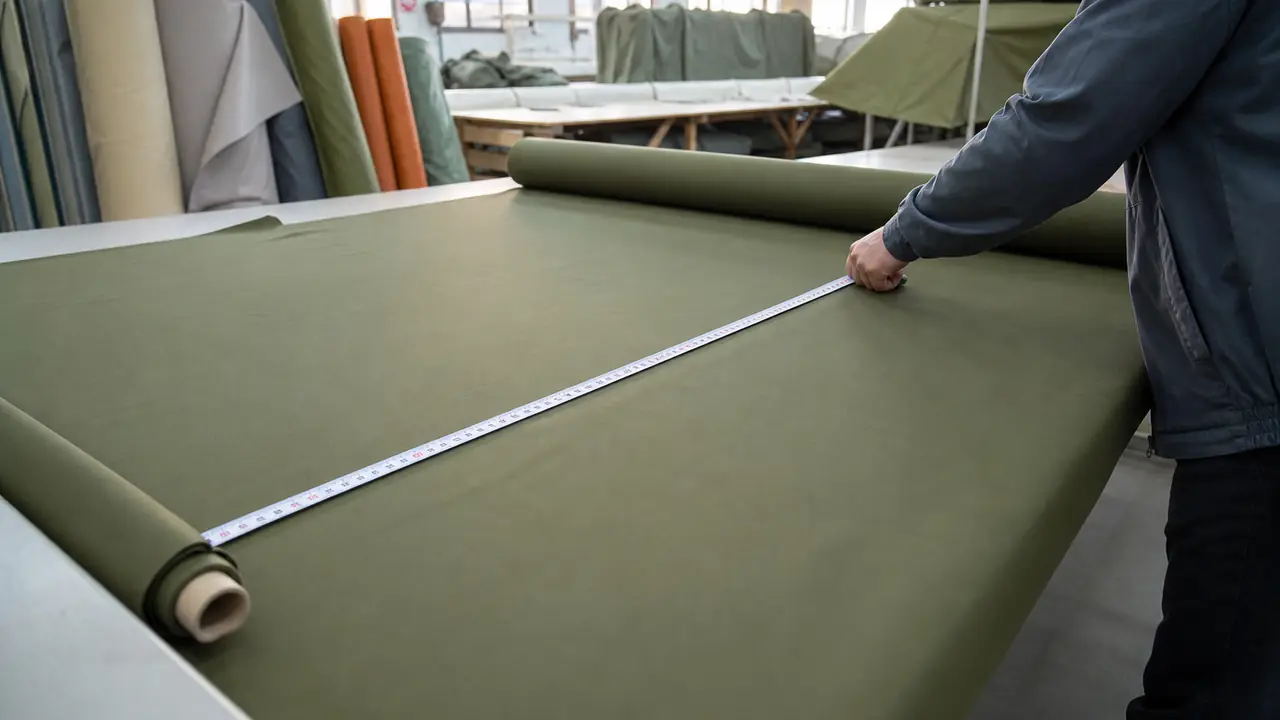
The fabric figure is not the tent
A tent listing usually leads with a number such as 2,000 mm or 3,000 mm. That is the hydrostatic head of the fabric, measured to ISO 811 in a lab: a column of water pressed against a clamped sample until drops come through. It says the fabric and its coating resist water up to that pressure when new. It says nothing about the needle holes along every seam, the gap where a zip meets a panel, the point where a floor meets a wall, or what happens when a fly sags onto the inner in the rain. Those are where tents leak. Figures such as 1,500 mm or 3,000 mm are industry conventions, not legal thresholds, and the fabric figure is stated per test report.
A finished tent stays dry because of the whole assembly: coated fabric, taped seams, covered zips, a raised floor, enough tension and enough ventilation. The seams and waterproofing page explains the construction; this note works backwards from the complaint.
Seams
Every stitch is a hole. On a coated polyester fly the seams are sealed with tape applied by a hot-air seam-taping machine, which melts the adhesive onto the coating. Silicone-coated nylon does not take hot tape well, so seams on silicone fabric are often sealed with a liquid sealant instead, or the fabric is coated with silicone on one side and PU on the other. Leaks at seams come from tape that was never applied, tape that did not bond because of the wrong temperature or speed, tape that lifts at a tight corner, or a seam re-sewn after taping. A seam that leaks on a new tent is a production defect, not wear.
Zips and openings
Zip coils are not water resistant. A door zip on a fly needs a storm flap or a rain gutter over it, and the flap has to be long enough to cover the zip when the tent is under tension. Leaks at zips usually come from a flap cut short, a flap that does not stay closed, or a zip set vertically at the top of a sloping panel where water runs straight into it. Vents and windows have the same problem: a vent without a hood, or a window panel sealed only on three sides, lets rain in when the wind turns.
Floors and corners
Water on the floor is the most common complaint on family and instant tents. A floor can let water in through its own fabric, through its seams, or over its edge. A bathtub floor, where the floor fabric turns up the walls to a height set on the spec sheet before it meets the wall seam, keeps that seam above ground water. A flat floor sewn straight to the wall at ground level leaks as soon as water pools. PE floors on many value tents are welded rather than sewn, which avoids stitch holes, but the weld has to be continuous at the corners. See tent floor materials.
Pitch, tension and condensation
A tent pitched slack lets the fly touch the inner. Where fabric touches fabric, water wicks through. Guy lines left in the bag and a fly that sits too close to the inner turn a good tent into a wet one. Condensation is the other half: a family breathing overnight in a closed tent puts moisture into the air, and it settles on the cold underside of the fly and drips back. Customers report it as a leak. Good vents, a gap between fly and inner and clear instructions reduce it; see tent ventilation and condensation.
Diagnosing a leak complaint
| Symptom | Likely cause | Check | Fix |
|---|---|---|---|
| Drips along a fly seam line | Tape missing, unbonded or lifting | Peel-check tape at corners; spray the seam on a pitched sample | Taping temperature and speed set in the process; tape on every load-bearing seam per spec |
| Water inside below a door | Storm flap short or open | Measure flap overlap when pitched under tension | Lengthen flap, add a toggle or hook to hold it closed |
| Wet floor along the edges | Flat floor seam at ground level | Measure bathtub height | Specify a bathtub floor with taped or welded corners |
| Wet patch in the floor centre | Floor fabric or coating too light; ground water pressed through | Floor fabric per spec; footprint use | Heavier floor coating per report; supply or recommend a footprint |
| Damp inner walls, drops from the roof | Condensation, not a leak | Are vents open? Is the fly touching the inner? | Add vents, explain venting in the manual |
| Water where fly touches inner | Slack pitch, missing guy lines | Pitch per manual and inspect spacing | Better tension points, guy lines in the kit, clear pitch instructions |
| Leak after a season of use | Coating aged by UV, seam tape aged | Fabric condition, storage history | Care instructions; UV-stable coating option per report |
What to put in the specification
- Fly and floor fabric with hydrostatic head stated per ISO 811 test report for the fabric lot, not a headline figure.
- Seam treatment for each seam group: taped, welded or sealed, and the tape width.
- Storm flap length and closure for each door, hoods on vents.
- Floor type and bathtub height, with corner construction.
- A clearance between fly and inner on the pitched golden sample.
- Guy lines and stakes in the kit, and a manual that shows tension and venting.
Listing copy matters as much as construction. A customer told that a tent is waterproof expects nothing to get damp; a customer told that the fly fabric is waterproof-rated, with hydrostatic head per ISO 811 test report, taped seams and covered zips, and that ventilation reduces condensation, knows what to expect. See hydrostatic head explained.
How the desk checks for leaks
At sample stage, the pitched golden sample is sprayed at the seams, doors, vents and floor corners and inspected inside. In production, the seam-taping settings and a peel check are part of the in-line checks. At pre-shipment, a subset of sampled tents is pitched and spray-checked, and the fabric test reports for the lot are verified. These are stated working defaults, confirmed per order. A leak found at seams or zips under spray is classed as a major defect under the AQL plan; see the inspection checklist.
To review a design or a returns pattern, send the spec sheet or complaint photos through the quote form.