
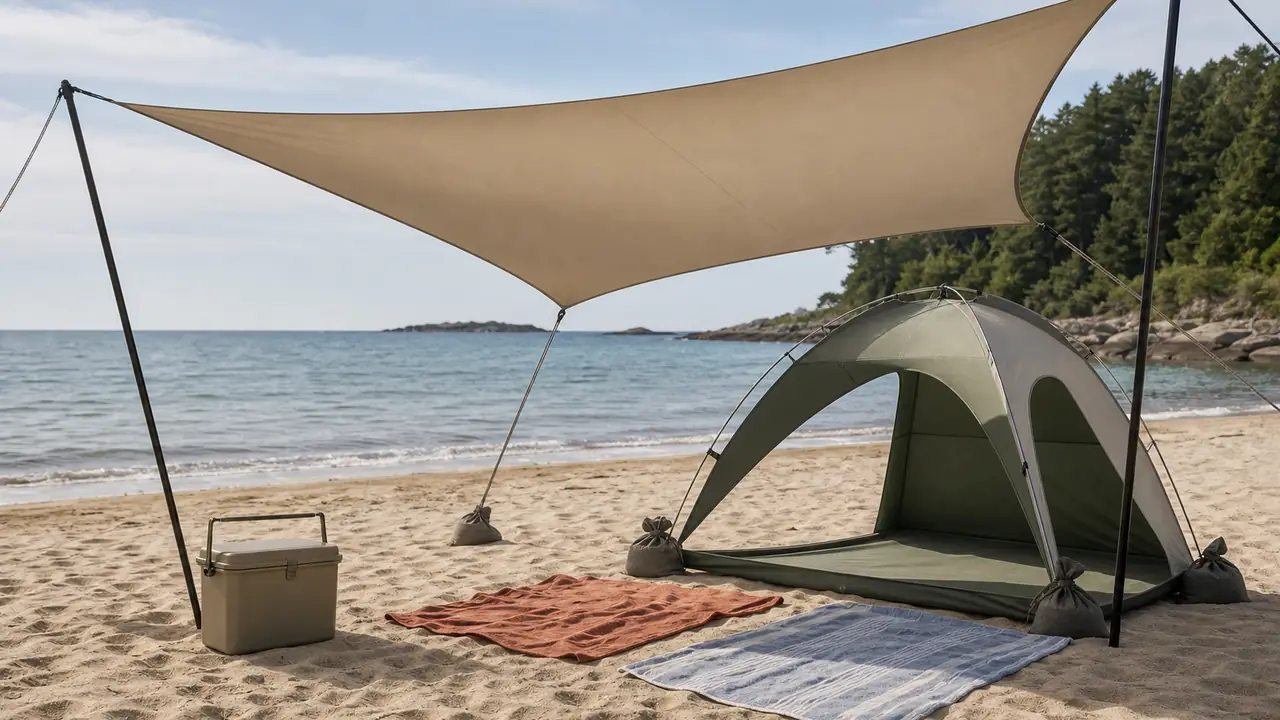
What a beach shade has to survive
A beach shade spends a full day in direct sun, which fades fabric and weakens coatings over a few seasons. It stands in loose, dry sand where ordinary stakes do not hold, in a sea breeze that builds through the afternoon, and it comes home with sand and salt in every seam, zip and pole joint. Pool and garden use is gentler on anchoring but just as hard on UV. Families set these up quickly, often one adult with children nearby, so the design has to be simple and the packing has to work on the first try.
Returns in this setting cluster around shades that lift in a gust, pop-up frames that will not fold back into the bag, UV claims a buyer cannot back with a report, and products bought for a beach where tents turn out to be restricted.
Recommended lines and reference specs
| Line | Reference model | Fabric and frame | Anchoring |
|---|---|---|---|
| Four-pole stretch shade | 274x274 cm footprint (9x9 ft), 208 cm poles, about 2.9 kg | Nylon or lycra stretch fabric, aluminium poles | Sandbags at the corners, no stakes in sand |
| Pop-up beach tent | 2-6 persons across the category | 190T silver-coated polyester, spring steel frame | 4 sandbags and 8 stakes |
| Shower and privacy tent | 120x120x190 cm, about 1.6-2.0 kg | 190T silver-coated polyester, spring steel wire frame | 8 stakes and 4 guy lines |
| Kids play tent | Indoor teepee 120x120x140 cm | Cotton canvas, pine poles | Indoor or sheltered garden use |
The stretch shade's 208 cm figure is pole length; the actual shade height is lower once the fabric is tensioned. Across the category, beach shades come as pop-up, four-pole and umbrella styles for two to six people, with sun protection stated per report.
Sun: UV claims per report
For the US, UV protection is stated as UPF-rated fabric per AATCC 183 test report. In Australia and New Zealand, shade structures are assessed under AS 4174:2018 and stated as UVE, so a UPF 50+ claim does not belong on listings for those markets; AS/NZS 4399 applies to clothing, not shades. Without a report, the listing describes the fabric and leaves the UV figure out. Silver coatings reflect heat but also wear with folding, so the inspection checks coating adhesion. See flame and UV standards.
Sand: anchoring that holds
Stakes barely hold in dry sand, so beach programs anchor with fillable sandbags at each corner or pole, plus stakes for firmer ground. The order fixes the number of bags, their size and handle strength, the length of the tie-off lines and the corner reinforcement where they attach. Shades should face the open side away from the wind and come down when the breeze builds; the listing says so. The desk does not publish wind ratings. Rinsing sand and salt from zips and poles before storage belongs on the care card.
Beach rules
Many beaches limit tent and shade size, position or overnight use, and some ban them. Ocean City, Maryland limits shades to 10x10 ft from 2025, and Rehoboth Beach, Delaware has banned tents and canopies on its beach since 2017. Rules change by town and season, so listings should tell buyers to check and follow local beach rules, and brands selling into a specific coast should check the local rules before choosing sizes. The field note on beach tent rules by location collects examples.
Kids and pool use
Kids tents sold in the US need CPSIA compliance: lead and phthalate limits, testing to ASTM F963, a Children's Product Certificate and tracking labels. Canada requires permanent warning labels. Listings avoid words such as safe or harmless and state the reports instead.
How to brief a beach program
Send the styles and sizes, the markets and beaches you sell into, the UV claim you want and its standard, fabric and colours, sandbag and stake kit, bag and carton artwork. Existing styles with your logo and colours typically start at 300-500 per style; samples take 7-15 days and bulk 30-45 days, confirmed in writing for each order. Beach stock sells in a short season, so book bulk early. Use the quote form.