
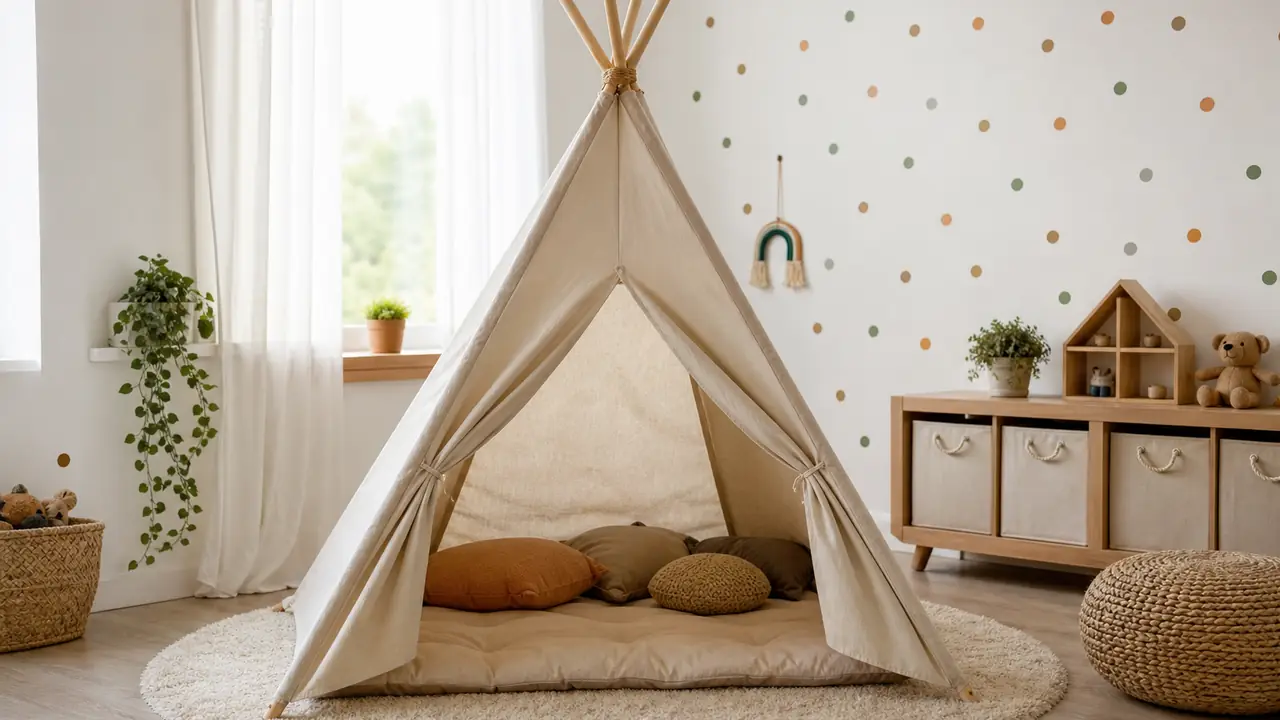
What this line covers
Kids play tents are tents for the house, not the campsite. The common shapes are canvas teepees on wooden poles, A-frame play tents and pop-up castles and play houses. They sell through gift, nursery and home channels as much as outdoor ones, and the buyer is often a home or toy brand rather than a camping brand. What sets the line apart is that, in the US and Canada, these are children's products, and the documents matter as much as the fabric.
The reference model on the pitch plate is an indoor teepee from public listings: 120x120 cm on the floor and 140 cm tall, made from cotton canvas on ten pine poles with five connectors, for one or two children. It weighs about 3.5 kg depending on the listing. Pop-up castle tents are a related design, but public specifications for them are not reliable enough to publish a reference figure, so the desk works from your sample.
The US file: CPSIA and ASTM F963
A play tent sold for children in the US falls under the Consumer Product Safety Improvement Act. In practice the file covers testing for lead in surface coatings and substrates, phthalate testing where plasticised parts are present, testing to the ASTM F963 toy safety standard where it applies, a Children's Product Certificate (CPC) issued by the importer or brand on the basis of reports from an accepted lab, and permanent tracking labels on the product and packaging that identify the maker, date and batch. Reports are issued to the partner factory or to your brand per order, and the desk verifies them against the order file. Whether every part falls in scope is a question for your test lab; the desk does not draw legal conclusions.
Canada and other markets
For Canada, children's products need permanent warning labels in English and French, and the desk works the wording out with your test lab and importer. For the EU, GPSR has applied since December 2024 and requires a responsible person in the EU; whether toy rules also apply depends on how the product is designed and marketed, which your test lab confirms. Listings should never describe a play tent as safe or free of chemicals; they should state the tests performed and the age grading on the report. See the compliance guide and the note on kids play tent compliance.
Materials, design and testing points
| Part | Typical spec | What to check |
|---|---|---|
| Cover | Cotton canvas, printed or dyed | Lead in coatings and prints, colour fastness |
| Poles | Pine, 10 per teepee (reference) | Smooth finish, no splinters, coating tests |
| Connectors | 5 per teepee (reference) | Material, phthalates if plasticised |
| Ties and cords | Fabric ties, top cord | Length and attachment, per the test lab |
| Mat and cushions | Optional padded mat | Filling, cover material, labels |
| Labels | Tracking, care, warning | Permanent, legible, bilingual for Canada |
Small parts, cords and loose decorations are the points test labs look at most closely on play tents. Keep the design simple, and agree with your lab before sampling which decorations can stay.
Inspection and packing
Inspection checks dimensions, pole count and finish, connector fit, stitching, print colour against the approved sample and label placement, sampled to ISO 2859-1. Teepees pack long because of the poles, so carton length and retail presentation belong on the spec sheet from the start. The lab samples for CPSIA testing should come from the bulk production lot, not only from the first sample, and the desk records which lot each report covers so the CPC matches the goods that ship. See testing and inspection and MOQ and lead time.
Private label and ordering
Common customisations are canvas colour and print, window shape, pole finish, mat and cushion sets, and retail packaging. Existing styles with your branding typically start at 300-500 units per style, with samples in 7-15 days and bulk in 30-45 days, or 45-60 days custom, confirmed in writing for each order; lab testing time is added on top. Send the design, target age group and markets through the quote form.