
The two sizes in numbers
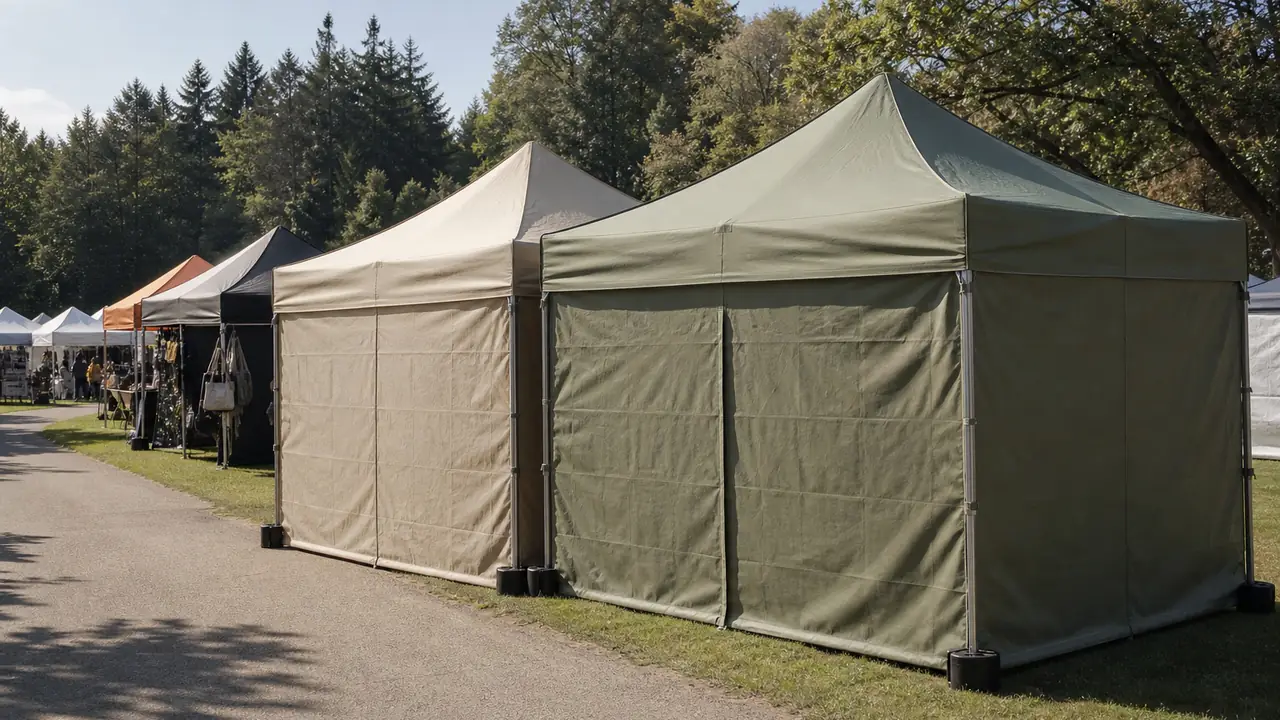
The commercial reference model is a 10x10 ft pop-up canopy from public listings: 300x300 cm on the ground, about 330 cm to the peak, about 9.3 m2 of shade. It runs on 40 mm hexagonal aluminium legs with a wall thickness of about 1.1-1.2 mm and a 600D PU-coated polyester top, weighs about 20-24 kg as a kit with the frame alone at about 16 kg, and packs into an outer carton of about 158x27x27 cm.
A 10x20 ft canopy covers 300x600 cm, about 18.6 m2, twice the area of the 10x10. The category also includes 10x15 ft as a middle step. All three sizes are built on the same families of frame: steel square tube for consumer use, 40 mm hex aluminium as the commercial standard and 50 mm hex aluminium for heavy-duty use. Weights for the larger sizes vary widely with frame grade and configuration, so they belong on the spec sheet of the sample rather than in a general comparison.
| Factor | 10x10 ft | 10x20 ft |
|---|---|---|
| Footprint | 300x300 cm (reference model) | 300x600 cm |
| Shade area | About 9.3 m2 | About 18.6 m2 |
| Legs | Four | Usually six, with a centre leg on each long side |
| Kit weight | About 20-24 kg (reference, commercial frame) | Heavier; per spec sheet of the chosen frame |
| Leg weights at about 40 lb per leg | About 160 lb (73 kg) for four legs | About 240 lb (109 kg) for six legs |
| Set-up crew | Two people is the usual practice | More hands, more time |
| Typical use | Market stalls, trade show booths, field marketing | Food service, group shade, larger booths, sponsor areas |
Space: what the extra area buys
A 10x10 is sized for one table, one or two staff and a queue in front. It is the standard unit for many markets and trade shows, which is one reason it dominates printed programs. A 10x20 doubles the depth or width of a booth: two tables and a service area, a seating area under shade, or a stall where cooking and serving have to be separated. If a buyer's end users regularly put two 10x10 canopies side by side, a 10x20 can replace them with one roof and no gap between them; if they mostly work alone, the larger frame becomes a burden.
The 10x15 ft size sits between the two and is worth considering when a 10x10 is slightly too small but a 10x20 will not fit the pitch or the vehicle. It is a narrower line at most partner factories, so walls, spare parts and printed templates are less widely available. For a range or a fleet, two well-supported sizes usually serve better than three thinly stocked ones.
Venue rules often decide the size before the buyer does. Many markets and shows sell space in 10x10 units, some beaches limit shade size (Ocean City in Maryland, for example, limits shade to 10x10 ft from 2025), and larger tents can cross local fire code thresholds. In many US jurisdictions following the International Fire Code, tents above about 400 sq ft generally need a permit, with versions varying by state; a 10x20 at 200 sq ft is usually below that line on its own, but several canopies joined together may not be. Confirm with the local fire authority. See tent permits and fire codes.
Weight and handling
The 10x10 reference kit at about 20-24 kg can be carried by one person from a vehicle to a stall and set up by two. A 10x20 frame has longer trusses, two more legs and a larger top, and the kit is correspondingly heavier and longer to handle. Frame grade matters even more at this size: a light steel 10x20 sags and flexes in ways a 10x10 does not, and most commercial buyers specify 40 mm or 50 mm hex aluminium for the larger footprint. The frame grades note sets out the differences.
Anchoring scales with roof area
A canopy behaves like a sail, and a 10x20 has twice the sail. The desk does not quote wind ratings for either size; each kit ships with an anchoring plan. On soft ground, one stake and one guy line per leg is the reference fitting. On paved surfaces, about 40 lb (18 kg) of weight per leg is an industry convention, not a legal requirement, which adds up to about 160 lb across a 10x10 and about 240 lb across a six-leg 10x20. Many venues set their own rules, and instructions should tell users to take the canopy down in strong wind. See canopy weights per leg.
Walls, print and packing
Walls scale with the frame: a 10x20 back wall is twice as wide as a 10x10 back wall, and side walls stay the same depth. For printed programs this means larger panels, more print area and more files. A reference printed 10x10 kit from public listings includes a back wall of 301x217 cm, two half walls of 301x91 cm and two flags; a 10x20 kit follows the same logic on a longer side. Packing changes too. The 10x10 reference carton is about 158x27x27 cm; larger frames need longer or heavier cartons, and canopies ship by volume, so carton size drives freight per kit. Confirm carton dimensions on the sample before planning a container.
Which size for which buyer
- Market vendors and field marketing teams: the 10x10 is the default, portable and accepted by most venues. See vendor tents for markets.
- Trade show exhibitors: 10x10 for standard booth units, 10x20 for double booths.
- Food service and group events: 10x20 where cooking and serving need room, or where seating is under shade.
- Event rental companies: a fleet of 10x10 units with a smaller number of 10x20 frames on the same leg profile, so spare parts are shared.
- Wholesalers: 10x10 carries the volume; 10x20 is a narrower line in the assortment.
Quantities and next steps
Ten by ten canopies and printed kits typically start at 20-50 sets per style, confirmed in writing for each order; larger sizes are quoted per frame and configuration. Samples typically take 7-15 days and bulk 30-45 days, or 45-60 days for custom builds. The partner factories for canopies and gazebos are concentrated in Linhai in Taizhou. Details are on MOQ and lead time, and the line overview on pop-up canopy tents.