
What makes a tent instant
A conventional dome tent arrives as a body and a bag of loose poles; the user threads or clips each pole and bends it into place. An instant tent removes that step. The poles are already part of the tent, joined by hinges or hubs, and the user unfolds the frame, extends or locks the legs and stakes it out. The speed is real and it is what customers pay for. The trade-off is that the frame is more complex, heavier and longer when packed, and has more moving parts that can wear or break.
Two designs cover most of the category. Pre-attached pole tents use telescoping or folding legs joined to a roof frame by hinged joints. Hub tents use central hubs that pop the walls outwards when pulled. Both appear on the pop-up instant tents line, and hubs also carry most ice fishing shelters.
Pre-attached pole frames
The six-person reference model on the line page is a pre-attached design: 305x274 cm on the ground with a 183 cm peak, about 8.4 m2 of floor, a 150D polyester body with a welded PE floor, and a frame of steel and fiberglass poles that stays attached to the tent. It weighs about 11 kg. Steel is used where the frame carries the most load, typically the legs and the main joints, and fiberglass where flex is useful, often in the roof.
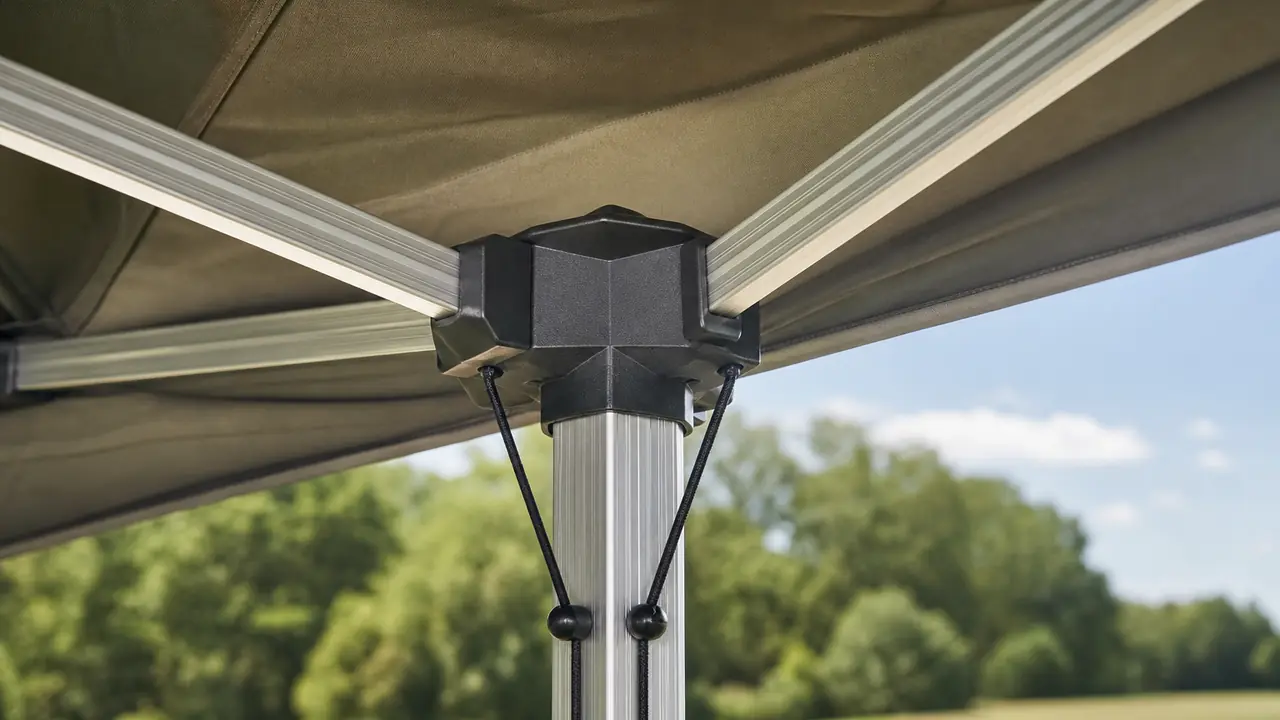
The user lifts the folded frame, spreads the legs until the roof joint locks, extends each leg to height and clicks it into position. Most designs then add a separate rainfly. The joints that lock the roof and the leg slides are the critical parts: if a lock does not engage fully, the frame can fold under load, and if a slide is stiff, users force it and bend the leg.
Pre-attached frames scale across the category from two to ten people, and larger models often use a cabin-like shape with near-vertical walls for standing room. The bigger the tent, the longer and heavier the folded frame becomes, so the largest sizes are firmly car camping products. Buyers planning a size series should check that the same joint and leg parts are shared across sizes, which simplifies spare parts and after-sales.
Hub designs
Hub tents use flexible poles running between hard hubs, typically one at the roof and one in the middle of each wall. The tent packs flat with the hubs folded; to pitch it the user pulls each wall hub outwards until it snaps over centre, which tensions the poles and opens the wall. The design is fast and needs no assembly. It is the structure of the ice fishing reference model, a three-person hub shelter of 178x178x203 cm with metal hubs and fiberglass poles, weighing about 10-12 kg and anchored with six ice anchors; see ice fishing tents.
For camping hub tents there is no reliable reference specification across public listings, so the desk does not quote sizes or weights for them in general terms; they are quoted per model from the supplier's spec sheet. The hub itself is the part to examine: its material, the way poles are retained in it, and how the over-centre snap feels after many cycles.
The two designs side by side
| Factor | Pre-attached frame | Hub design |
|---|---|---|
| How it opens | Unfold roof, lock joint, extend legs | Pull wall hubs outwards until they snap |
| Typical materials | Steel legs and joints, fiberglass roof poles | Metal or plastic hubs, fiberglass poles |
| Reference model | 6-person, 305x274x183 cm, about 11 kg | Ice hub, 178x178x203 cm, about 10-12 kg |
| Packed shape | Long, frame length sets the bag | Flat, folded hubs |
| Common failures | Roof lock not engaged, bent legs, worn slides | Cracked hubs, pole pulled from hub |
| Field repair | Replace leg or joint part | Replace hub or pole section |
Where instant tents fail
Instant tents concentrate stress in a few places. On pre-attached frames, the roof hinge and leg locks carry the load and take the abuse of every pitch. Plastic joints save cost but wear faster than metal ones, and a bent steel leg rarely straightens cleanly. On hub designs, the hub is the single point of failure: a cracked hub disables a wall, and a pole that slips out of its socket collapses that side. Fiberglass in either design can splinter if it is over-flexed during folding.
The user's folding technique causes many of these failures. Instant tents look effortless in a video and are tricky the first time, especially when folding them back into the bag. A clear pitch and fold sequence, printed and sewn into the bag, reduces breakage more than any material change. The pitch sequence note explains how to write one.
Weight, packing and the listing
Because the frame travels with the tent, instant tents are heavier and pack longer than a pole tent of similar size. That is acceptable for car camping and festivals, where the tent goes from the boot to the pitch, but the listing should give the total weight as measured on the approved sample and the packed size from the carton, not a figure from a similar model. Carton length also drives freight cost, since tents ship by volume; see tent packaging and cartons.
Stability follows the same rules as any tent. Taller, straighter walls catch more wind, so instant tents need stakes at every corner and guy lines on the fly. The desk does not publish wind speed ratings; the order specifies stakes, guy-out points and tensioners instead.
What to specify and inspect
- Choose the design: pre-attached for family and cabin-style tents, hub for flat-packing shelters.
- Write the material of every load-bearing part: legs, roof joint, hubs, poles.
- State whether joints are metal or plastic, and the leg lock mechanism.
- Approve a sample after repeated pitch and fold cycles, not a single pitch.
- Inspect bulk with a pitch test on sampled tents, checking every lock and hub.
Existing instant styles with your logo or colours typically start at 300-500 tents per style, with samples in 7-15 days and bulk in 30-45 days, confirmed in writing per order; see MOQ and lead time, or send the brief through the quote form.