
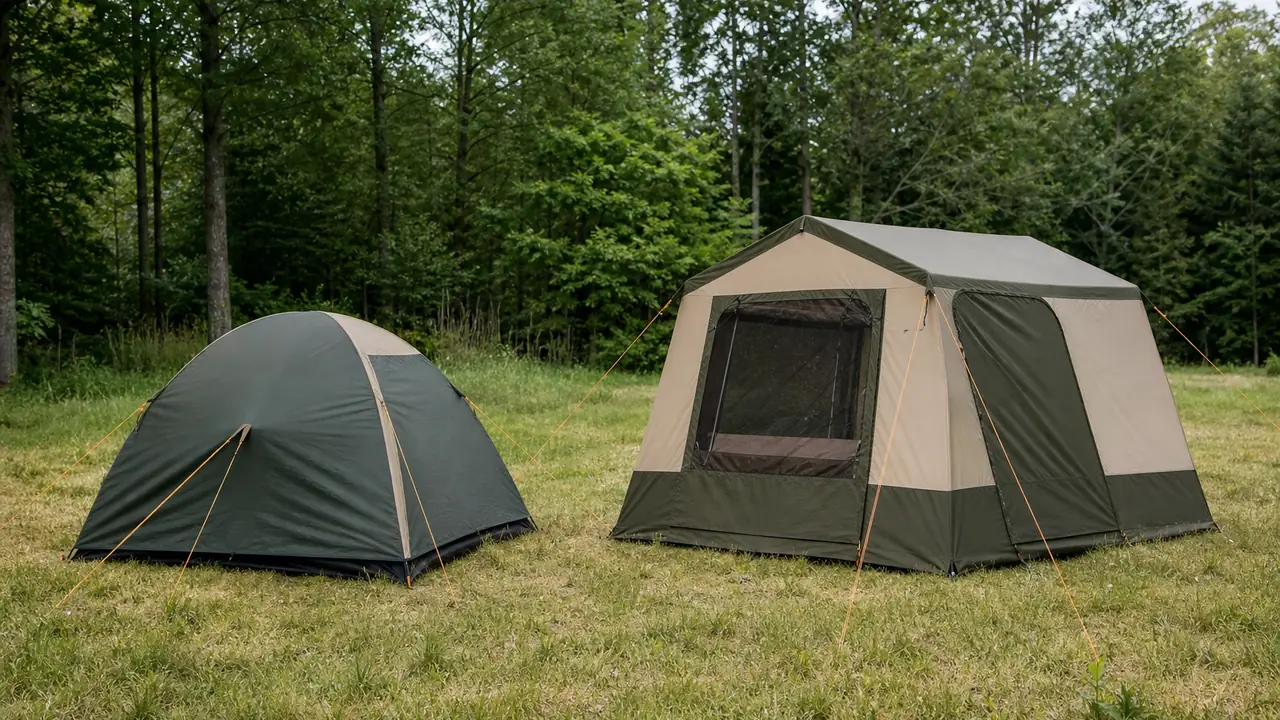
What counts as instant and what counts as traditional
A traditional tent arrives as separate parts: an inner tent, a fly, a bundle of shock-corded poles and a bag of stakes. The user threads or clips the poles, raises the inner and throws the fly over. The dome is the typical example, and it carries the volume in most camping ranges.
An instant tent arrives with the poles already attached to the body. In the pre-attached designs that dominate the category, the user unfolds the tent, extends telescoping legs and locks the joints; the frame is part of the product rather than a separate kit. Hub-style pop-ups are a related family in which the poles meet at central hubs. There is no reliable reference specification for hub-style models in our data, so this note uses the pre-attached reference model and treats hubs qualitatively.
The reference models side by side
| Item | Instant tent (pre-attached poles) | Traditional dome tent |
|---|---|---|
| Reference model | 6-person, 305x274x183 cm (10x9 ft) | 4-person, 274x213x150 cm (9x7 ft) |
| Floor area | About 8.4 m2 | About 5.9 m2 |
| Fabric | 150D polyester, welded PE floor | 68D 190T polyester fly, PE floor |
| Frame | Steel and fiberglass, pre-attached | 8.5 mm fiberglass, separate poles |
| Weight (reference) | About 11 kg | About 4-4.5 kg |
| Category range | 2-10 persons, pre-attached or hub | 2-8 persons |
The capacities differ, so the comparison is not perfectly like for like. Even allowing for the extra floor, the instant tent carries close to twice the weight per square metre on these reference figures, because the steel legs, joints and heavier fabric come with the tent instead of staying at the factory as optional parts.
Speed: real, but not the whole story
The instant tent's advantage is genuine. The frame cannot be assembled wrongly, there are no pole sleeves to thread and the tent stands in a few minutes once the user has done it once. For festival goers, first-time campers and families arriving late, that is worth paying for, and it shows in reviews.
Two caveats belong in the listing and the manual. First, the tent stands quickly, but it is not finished until it is staked out and the guy lines are tensioned; an instant tent left unstaked is an instant tent blown across the field. Second, folding the frame back into the bag takes practice, and a bag cut too tight is a common complaint. A slightly larger bag and a clear fold sequence in the manual cost little and save returns.
Weight and packed length
Traditional tents pack short, because shock-corded poles break down into short sections and pack beside the rolled tent. Pre-attached frames fold only at their hinges, so the packed length follows the longest leg section. The spec sheet should state the target packed length and the carton size for both types, since the carton decides how many units fit on a pallet and what freight costs per tent. The result is a long, heavy bag that suits the boot of a car and nothing else. At about 11 kg for the six-person reference model, instant tents are car camping products. Buyers who sell to walkers, cyclists or festival goers travelling by train should note this before choosing the line.
Cost: what drives the difference
The desk does not publish prices, but the cost drivers can be compared honestly. An instant tent adds a steel and fiberglass frame with hinges, locks and joints, more assembly labour at the factory, a heavier fabric to carry the frame and a larger carton. Those items push the unit cost and the freight per unit up against a dome of similar floor area. A traditional tent shifts more of the value into fabric and pole choice: a 7001 aluminium pole set raises its cost too, but the tent stays lighter and packs smaller. The tent cost factors note breaks this down further.
Strengths and limits at a glance
| Factor | Instant tent | Traditional tent |
|---|---|---|
| Pitch speed | Fastest, hard to assemble wrongly | Slower, sequence must be learned |
| Weight per m2 | Higher, frame travels with the tent | Lower |
| Packed length | Long, set by leg sections | Short, poles break down |
| Repair | Hinges and joints are specific spare parts | Pole sections replaceable, splints work |
| Freight | Larger, heavier carton | Small carton |
| Typical return causes | Joint failure, frame bent on folding, bag too tight | Split poles, seam leaks, wrong pitch |
Repairs and spare parts
A traditional tent with a broken pole section can be splinted in the field and repaired with a replacement section from any pole supplier that matches the diameter. An instant tent with a cracked hinge or joint needs a part that fits that frame only. Brands selling instant tents should therefore order spare joints and leg sections with the bulk order, list them for after-sales and keep the frame drawing in the order file so the part can be reordered later. The repair kits and spares note lists what to ship.
Water and weather
The instant reference model uses 150D polyester, heavier than the 68D fly on the dome, and a welded PE floor without stitched floor seams. That helps, but the waterproof claim works the same way for both: hydrostatic head is a fabric test under ISO 811, and taped seams, covered zips and a taut pitch decide whether the inside stays dry. Many instant tents are single-wall or have a partial fly, so ventilation and condensation deserve a line on the spec sheet. Neither type has a wind speed rating; the order specifies stakes, guy lines and tensioners, and the manual tells users to take the tent down in strong wind.
Which one to stock
- DTC brands and marketplace sellers do well with instant tents, where pitch speed makes a clear story, provided cartons survive fulfilment and the listing states weight and packed length honestly.
- Brand owners with a trekking or lightweight story stay with traditional tents and differentiate on fabric and poles.
- Retailers often carry both: a dome series for price points and one or two instant models for the fast-pitch shelf.
Existing styles with your logo and colours typically start at 300-500 tents per style, with samples in 7-15 days and bulk in 30-45 days, confirmed in writing per order; see MOQ and lead time. Compare pop-up instant tents and dome tents, then send your brief through the quote form.