
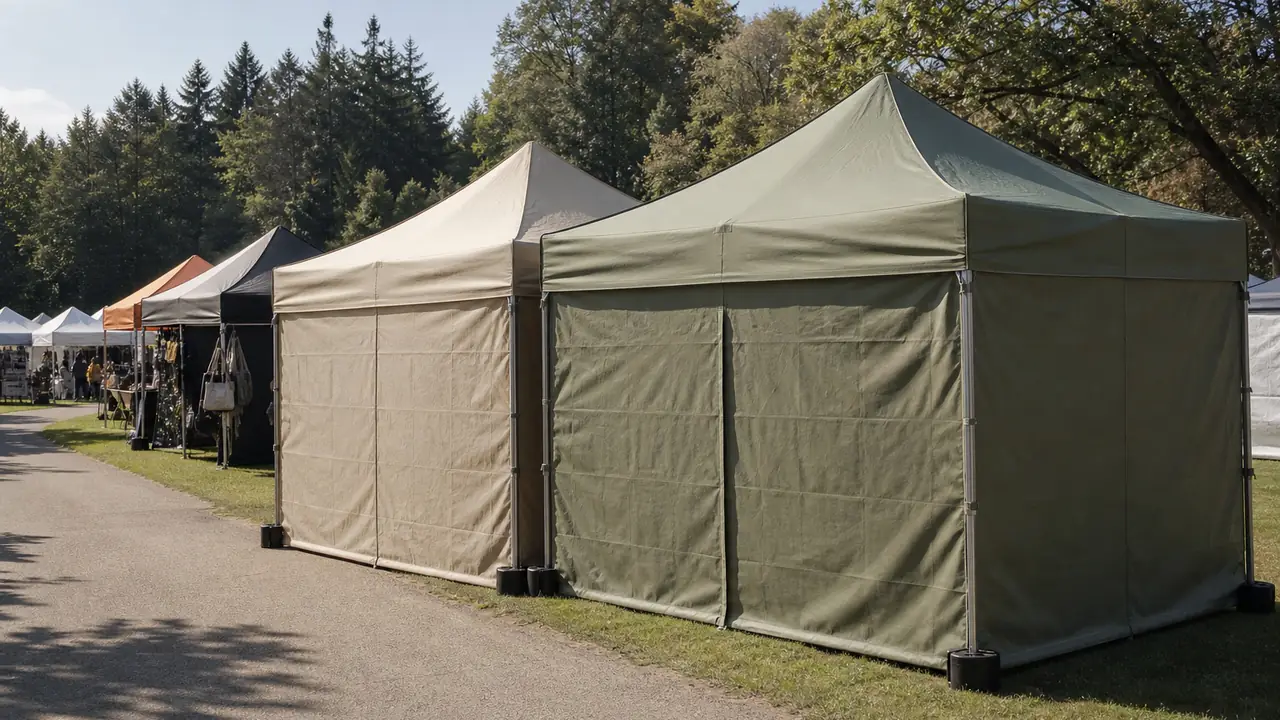
A fleet is a system, not a stack of tents
Event rental companies, event production firms and venue operators buy tents differently from retailers. A retailer sells a tent once; a rental company sends the same tent out again and again, set up by different crews on different surfaces, packed wet or dry, loaded and unloaded from trucks. Every part of the specification is tested by repetition. And because bookings overlap, the fleet has to behave as a system: frames and tops that interchange, walls that fit several sizes, spare parts that are on the shelf when a crew returns with a bent truss.
The decisions below follow that logic: pick the structures, standardise the parts, document the fabric, plan the spares. In an illustrative case, a regional rental company that had bought canopies from three different sources over several seasons found that none of the legs, connectors or walls interchanged, so a single bent part could take a whole unit out of service. Consolidating new purchases onto one frame profile was the first fix, before any question of price.
Choosing the mix
Most event fleets combine pop-up canopies with party tents. Canopies cover entrances, service areas, sponsor booths and small events; party tents cover the main guest area. The desk's reference structures are:
| Structure | Reference | Fleet role |
|---|---|---|
| Pop-up canopy | 10x10 ft, 300x300 cm; 10x15 and 10x20 ft in the range | Entrances, service, booths, small events |
| Commercial canopy frame | 40 mm hex aluminium, wall about 1.1-1.2 mm | Moderate-use units |
| Heavy-duty canopy frame | 50 mm hex aluminium | High-turnover rental units |
| Pole tent | 20x40 ft, 1219x610 cm, 16 oz PVC vinyl, sixteen 3/4x30 in steel stakes | Lawn events, lower cost per area |
| Frame tent | 6x12 m, 2.6 m sides, 3.7 m ridge, 550 g/m2 PVC, 50 mm galvanised steel | Clear-span floors, hard surfaces |
| Bell tent | 5 m diameter, 285 gsm cotton canvas, about 35 kg | Glamping-style hospitality and lounges |
For rental use, heavy-duty canopy frames usually pay back, because the cost of a bent consumer frame is not the frame but the lost booking. See canopy frame grades and the party and event tents line.
Standardise before you scale
The single most useful fleet rule is to standardise interfaces. Keep one leg profile across canopy sizes where possible, so legs, feet and connectors are interchangeable. Keep a small number of party tent widths, so walls, gutters and cover panels can be shared between tents of different lengths. Choose one colour of top and wall for the core fleet; plain white or a neutral shade lets every client brand the space with banners and printed walls rather than requiring printed tops.
- Frames: one canopy leg profile, one party tent tube size per width.
- Covers: one PVC weight per tent family, one canopy top fabric, one colour.
- Walls: plain, window and door walls that fit every frame of the same width.
- Anchoring: one weight system and one stake type, with enough units for the largest booking.
Fire paperwork per fabric lot
Event tents are where flame resistance documents are checked most often. US fire authorities typically expect flame-resistant fabric evidenced by an NFPA 701 test report or California CSFM registration; CPAI-84 is a different test and is not interchangeable. In the EU, temporary tents above 50 m2 fall under EN 13782, and in the UK marquee fabric is often required to meet BS 7837. In many US jurisdictions following the International Fire Code, tents above about 400 sq ft generally need a permit. Reports are issued to the partner factory or the rental company per order and verified by the desk; the local fire authority decides what it accepts.
For a fleet, keep the report and the label reference per fabric lot, and record which tops, covers and walls came from which lot. When a replacement panel is ordered two years later, the new fabric needs its own report. See NFPA 701 for event tents.
Spare parts that keep tents working
Rental tents fail at predictable points. On pop-up canopies: truss connectors and slider brackets bent during set-up, feet cracked on concrete, tops torn at corner pockets, leg weights lost. On party tents: stakes bent or lost, ratchet straps and ropes worn, cover panels torn at grommets or keder edges, frame fittings damaged in transport. Ordering spares with the first batch is cheaper than ordering them alone later, and it lets the parts come from the same lot as the fleet.
| Structure | Spares to hold |
|---|---|
| Pop-up canopy | Legs, truss sections, connectors and sliders, feet, tops, weight bags, stakes |
| Pole tent | Stakes, centre and side poles, ropes and straps, cover repair material |
| Frame tent | Tube sections, fittings, base plates, cover panels or repair material |
| Walls | Plain walls, zips, fasteners |
The right quantity depends on turnover and crew experience; agree it with the partner factory per order. See repair kits and spares.
Anchoring stock
A fleet needs enough anchoring for every unit out at once. For canopies on hard surfaces, about 40 lb (18 kg) of weight per leg is the industry convention, so a booking of ten 10x10 canopies needs about 1,600 lb of weights; venues may set their own rule. The desk does not quote wind ratings; crews should follow an anchoring plan and clear the tents in strong wind. Pole tents use stakes and ropes; frame tents on hard surfaces use ballast specified by the supplier and the installer.
Inspection, care and reorders
Inspect incoming fleet orders more strictly than retail orders: a pitch test on sampled units, frame dimensions and leg wall thickness, cover weight against the spec sheet, seam and weld checks on PVC, accessory counts and carton marks, sampled to ISO 2859-1 at general inspection level II. After each booking, dry tops and covers before storage to avoid mildew and check frames for bends and corrosion. For reorders, keep the approved sample record, the fabric reports and the template versions in the fleet file. The canopy lifespan note covers care and replacement.
Canopies and printed kits typically start at 20-50 sets per style; party tents are quoted per size, structure and report requirement. All quantities and lead times are confirmed in writing for each order. See MOQ and lead time.