
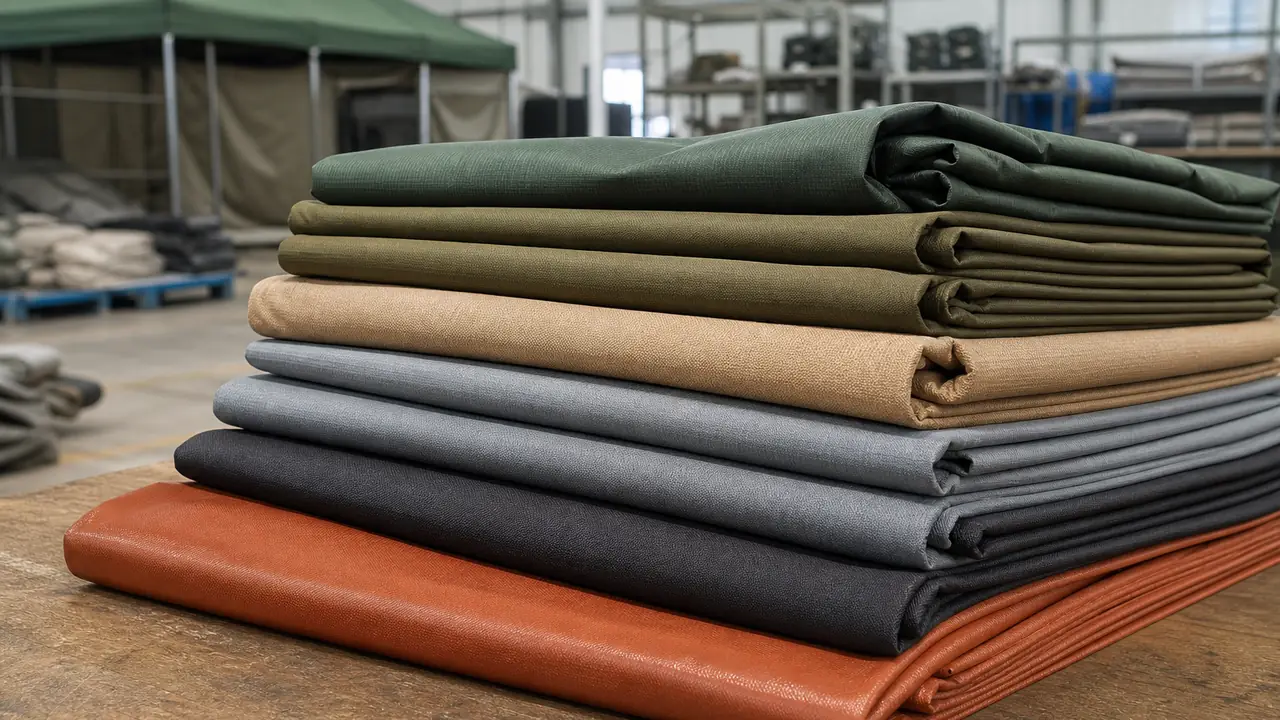
What oxford fabric is
Oxford is a basket weave: pairs of yarns cross over and under each other, giving a heavier, more textured fabric than the fine taffeta used on tent flies. In tents and canopies it is almost always polyester, coated on the back with PU and sometimes faced with a water repellent finish. It is quoted by denier, from around 150D on light floors to 600D on commercial canopy tops and 1000D on heavy PVC-coated covers.
Because the yarn is thick and the weave is open, the coating does much of the work on water resistance, and the finished weight in gsm can vary widely between two fabrics with the same denier. A canopy quote that only says 600D oxford is incomplete.
Where each grade is used
Across the category oxford appears in four places:
- Tent floors: 150D-210D oxford is the better floor option on dome and cabin tents, above PE sheet on entry models.
- Canopy tops and walls: 600D PU-coated polyester is the usual commercial top, as on the 10x10 ft reference model from public listings with 40 mm hex aluminium legs. Lighter grades are offered on consumer canopies with steel frames.
- Printed kits: the 10x10 ft printed reference kit uses 600D oxford for the top, back wall, half walls and flags, printed by dye-sublimation.
- Rooftop tents: the soft-shell reference uses 600D oxford or 280G polycotton for the body, a 420D fly and a 1000D PVC travel cover.
The grades compared
| Grade | Typical use | Handle and weight | Print and wear |
|---|---|---|---|
| 150D-210D | Tent floors, bags, light consumer shade tops | Light, flexible, packs small | Prints, but colours look thinner; wears faster under frame contact |
| 420D | Rooftop tent flies, mid-grade tops and walls | Medium weight | Good print base; moderate abrasion resistance |
| 600D | Commercial canopy tops, printed kits, rooftop bodies | Heavy, stiff, holds shape on the frame | Dense print base, better abrasion and UV ageing at seams and corners |
| 1000D PVC-coated | Rooftop travel covers, heavy covers | Very heavy | Built for road grime and abrasion, not for print |
These are general tendencies, not measured values for an order. The order file records the denier, finished gsm with tolerance, coating and the reports that apply.
Why 600D dominates commercial canopies
A canopy top on a market stall or trade show frame is folded and unfolded dozens of times a season, rubbed at the corners by the frame, stretched by wind loads and left in direct sun all day. A 600D top holds its shape on the frame, resists abrasion at the corner pockets and gives a dense, even base for dye-sublimation print. A lighter top can look identical in a photo and wear through at the corners well before the frame shows age. That is why event rental companies and vendors usually specify 600D and plan spare tops; see pop-up canopy tents.
The trade-off is weight and packed size. The commercial reference set weighs about 20-24 kg in total and ships in a carton of about 158x27x27 cm. A heavier top adds to the weight the user carries and to freight volume, which is why consumer shades often move to a lighter fabric with a steel frame.
Coating and water resistance
Oxford canopy tops carry a PU back coating, which gives a water resistance figure measured as hydrostatic head to ISO 811. That describes the fabric. Whether a canopy stays dry under it depends on the seams at the ridge and valance, how the top sits on the frame and whether water pools. Canopies are shade and light rain shelters; a listing should say waterproof-rated fabric with the figure per test report and nothing broader. The coating also stiffens over repeated folding in the cold, so the care label should advise drying before folding and storing away from heat.
Print on oxford
Dye-sublimation prints full colour into polyester fibres and suits 600D oxford well, because the dense weave holds a sharp image. Screen printing suits a one or two colour logo. In both cases the denier and coating side affect how colour sits on the face, so colour proofs and first article approval should be done on the same fabric as the bulk order. Fading under UV depends on the ink, the fabric and exposure; see dye-sublimation vs screen print and canopy print fading.
Flame resistance for event use
Canopies used at events, markets and trade shows are often asked for flame resistance documentation, such as NFPA 701 or California CSFM registration, and the local fire authority decides what applies. Flame-resistant oxford is available; the claim is flame-resistant fabric tested to NFPA 701 per report, and the report must name the fabric. A flame-resistant finish can also interact with print and colour, so it should be decided before artwork proofs, not after.
Anchoring, not a fabric question
A heavier top does not make a canopy more stable; it adds wind load on the frame. Stability comes from the anchoring plan: one stake and one guy line per leg on soft ground and, by industry convention, about 40 lb (18 kg) of weight per leg on hard ground, with the canopy taken down in strong wind. See canopy weights per leg.
What to check at inspection
Oxford tops are easy to substitute because a lighter grade looks similar once printed. The inspection plan should weigh a fabric swatch against the gsm on the order file, check the coating side and coverage, measure the top against the frame size, check stitching and reinforcement at the corner pockets and valance, and compare print colour against the approved strike-off under the same light. For rental fleets, spare tops from the same fabric lot help keep colour consistent across a set of canopies. The commercial canopy lifespan note covers replacement planning.
Ordering oxford canopy tops
Write the top fabric as denier, finished gsm with tolerance, coating, colour or print reference, and any flame or UV report. Typical starting points for 10x10 canopies and printed kits are 20-50 sets per style, with samples in 7-15 days, confirmed in writing for each order; see MOQ and lead time. Send sizes, wall options and artwork status through the quote form.